Table of Contents
- Forestry Mulching vs Excavation: Which Land Clearing Method Fits Your Project?
- How Forestry Mulching and Excavation Compare: Key Differences
- Benefits of Forestry Mulching for Soil Health
- When Traditional Excavation Is the Right Call
- Land Clearing Methods for New Construction Sites
- Cost of Forestry Mulching per Acre vs. Excavation
- Site Preparation Decision Guide for Your Property
- Get a Free Quote for Your Land Clearing Project
- Frequently Asked Questions
Last Updated: September 7, 2026
Forestry Mulching vs Excavation: Which Land Clearing Method Fits Your Project?
Choosing between forestry mulching and excavation comes down to one question: what do you want left behind? Forestry mulching grinds vegetation into a protective layer of organic matter that stays on your property, while excavation hauls material away, leaving bare soil. For most residential and rural landowners, the decision shapes everything from erosion control to how soon you can use the land. At Timber Shredders LLC, we help Central Virginia property owners find the right approach, and the answer is rarely as simple as picking the cheaper quote.
Forestry mulching is a single-pass method that uses a rotating drum to shred trees, brush, and stumps into a fine mulch layer that stays on site, protecting topsoil and returning nutrients to the ground. Excavation relies on bulldozers and excavators to push, pull, and haul vegetation and root systems away, often leaving disturbed soil that requires additional grading. The trade-off affects your timeline, budget, and the long-term health of your property.
How Forestry Mulching and Excavation Compare: Key Differences
The core difference is how each handles cleared material. Forestry mulching processes vegetation on-site into a mulch layer roughly 4 to 6 inches deep, stabilizing soil and preventing erosion. Excavation removes material entirely, creating disposal costs and exposed topsoil that can wash away in the first heavy rain.
Equipment and Process: Mulcher vs. Bulldozer
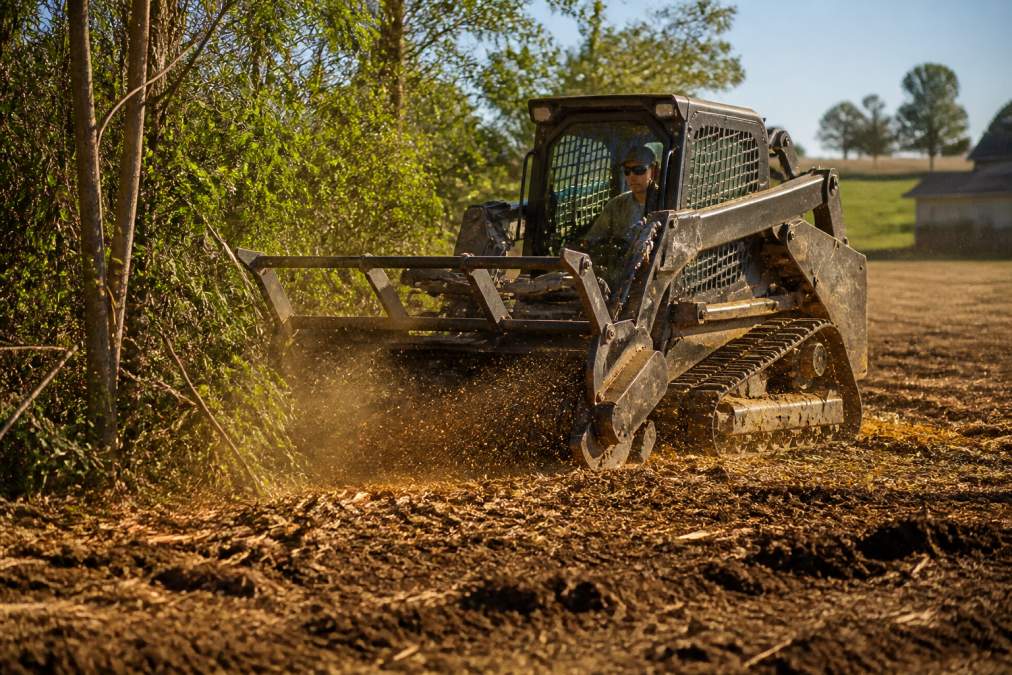
A forestry mulcher is a hydraulic attachment on a skid steer or tracked carrier, using a heavy-duty drum spinning at high speed to shred vegetation into fine pieces. The process is precise, allowing selective clearing without disturbing the soil beneath. A bulldozer or excavator uses sheer force to push over trees and scrape the ground clean, faster on large, dense timber, but it removes the organic layer that keeps soil healthy.
Debris Handling: On-Site Mulch vs. Hauling
This is where project costs diverge. Forestry mulching eliminates debris removal because the mulch becomes part of the landscape. Excavation produces piles of stumps, brush, and logs that must be hauled away, and hauling costs add up quickly when you’re paying by the load. On-site processing also means no burn piles, which matters for owners who want a clean, usable site immediately.
Benefits of Forestry Mulching for Soil Health
Forestry mulching is widely recognized as the more eco-friendly option because it preserves soil structure and nutrient content. The mulch layer acts as a natural blanket, retaining moisture, suppressing weeds, and gradually decomposing to feed the soil, a significant advantage for landowners planning pasture or planting. Traditional excavation strips topsoil and organic matter, leaving compacted ground that struggles to support new growth, and erosion can carry sediment into waterways, creating compliance headaches for construction projects.
The mulch layer from forestry mulching is not waste. It is a slow-release fertilizer and an erosion barrier that keeps your topsoil exactly where it belongs.
When Traditional Excavation Is the Right Call
Excavation is not inherently the wrong choice. If you’re building a structure with a basement or septic system, you need to dig deep, removing root systems and organic material that would otherwise decompose and cause settling. Excavation is also right for precise land leveling for a driveway base or when large, mature trees with massive root balls must come out completely. If your project requires deep earth moving or significant grading, a mulcher alone will not get you there. Many projects benefit from a combination of both methods.
Terrain and Soil Conditions Where Excavation Wins
The decision often hinges on what equipment will encounter beneath the vegetation. A forestry mulcher excels at grinding standing material but struggles when the ground itself is the obstacle. On slopes exceeding roughly 30 percent, a mulcher’s tracked carrier can lose traction or become a rollover risk, especially over clay soils (osha.gov). Excavators, with their lower center of gravity and ability to lock into the ground, handle steep grades more predictably.
Rock density is another deciding factor. Mulching drums are designed to shred wood, not stone. In areas with abundant surface rock or shallow bedrock, common in the Piedmont and Appalachian foothills, a mulcher will dull its teeth quickly, driving up maintenance costs. Excavators with hydraulic breakers or rock rakes can pry out boulders and separate rock from soil in a way a mulcher cannot.
Soil moisture also plays a role. A mulcher working in saturated ground will churn the top layer into mud, rutting the site and potentially getting stuck. Excavators on long-track undercarriages distribute weight better and can work in wetter conditions, though they too will leave deep tracks if pushed too hard. If your property has poor drainage or sits in a floodplain, excavation with proper grading may be the only method that leaves a usable, stable surface.
When Stump Removal Demands Full Extraction
Forestry mulching grinds stumps down to below grade, typically 6 to 12 inches beneath the surface, sufficient for pasture, food plots, or a lawn. But certain projects require complete stump extraction. If you are installing a septic drain field, the trenches must be free of all wood debris, because decomposing roots and stumps create voids that cause the field to settle and fail. The same applies to road bases and building pads, where a rotting stump leaves a depression that cracks asphalt or undermines a concrete slab.
Excavators remove the entire root ball, eliminating settlement risk. For trees over 24 inches at the base, root systems are extensive and dense; grinding them down is possible but slow, and the deep mulch layer can smother soil and create a spongy surface requiring additional compaction. Excavation leaves mineral soil that can be compacted to engineering specifications.
The Hybrid Approach: When Both Methods Are Required
Most experienced contractors do not treat this as an either-or decision. The standard pattern for a residential building site is to run a forestry mulcher across the entire property first, leaving a protective mulch layer that prevents erosion during construction. Once the building footprint is staked, an excavator digs the foundation, septic system, and utility trenches. This hybrid strategy reduces material hauled off-site, lowering disposal costs, while delivering the compacted, level surface foundations require.
If your project involves deep digging, steep slopes, or rocky ground, excavation is not just an option, it is the only method that will produce a stable, code-compliant result. Match the equipment to the ground conditions, not the other way around.
Land Clearing Methods for New Construction Sites
New construction sites demand a stable, compacted base for foundations and must pass erosion control inspections. Forestry mulching can prepare the site in a single pass without the delay of hauling debris, and the mulch layer helps maintain compliance by minimizing erosion. Once the building footprint is marked, excavation takes over for the foundation work itself.
Foundation Work and Grading Requirements
A common approach is to use forestry mulching to clear the entire site first, then bring in excavation equipment only for areas that require digging. This reduces material hauled away, lowering costs, while still delivering the compacted, level surface foundations require.
Cost of Forestry Mulching per Acre vs. Excavation
Pricing varies widely based on vegetation density, tree size, terrain, and accessibility, so any figure without a site visit is an estimate. The cost of forestry mulching per acre can differ from excavation because there are no hauling or disposal fees. When you excavate, you pay for machine time, trucks, disposal site fees, and often grading to repair damage the equipment caused. Forestry mulching bundles site preparation and debris handling into one operation. Excavation may still be more economical for projects that require deep earth moving anyway.
| Factor | Forestry Mulching | Traditional Excavation |
|---|---|---|
| Debris handling | On-site mulch, nothing hauled | Hauled to disposal site |
| Soil impact | Preserves topsoil | Removes organic layer |
| Erosion risk | Low, mulch protects soil | High, bare soil exposed |
| Best for | Brush, small trees, pasture | Foundations, large timber, grading |
| Timeline | Single pass, faster | Multiple steps, slower |
A low quote from an excavation company often excludes hauling and disposal fees. Ask for a written breakdown before you sign, or the final invoice can come as an unwelcome surprise.
Site Preparation Decision Guide for Your Property
Start by asking what the land will be used for after clearing. If the answer is pasture, food plots, or improved accessibility, forestry mulching is almost always the better fit because it leaves usable ground behind. If the answer is a building with a basement, you will need excavation for the footprint regardless. Next, consider your timeline: mulching leaves a clean, walkable surface the day the machine leaves, while excavation often leaves ruts, exposed roots, and piles requiring additional work. Finally, check local regulations, since some jurisdictions restrict burning and require erosion control measures that favor on-site mulching.
Regulatory and Permitting Requirements: What Most Guides Skip
The legal side of land clearing is where many property owners get blindsided. Rules vary by state, county, and township, but several patterns hold across the United States.
Burn permits and open burning restrictions. If you plan to dispose of debris by burning, you will likely need an open burning permit from your local fire marshal or environmental quality department. Many southeastern counties impose seasonal burn bans during dry periods, typically late summer through early fall, forcing you to haul vegetation away at additional cost. Forestry mulching sidesteps this issue because there is nothing to burn, the material is processed on-site into mulch.
Erosion and sediment control permits. Disturbing more than one acre triggers coverage under the National Pollutant Discharge Elimination System (NPDES) permit program, requiring a Stormwater Pollution Prevention Plan (SWPPP) and erosion control measures before ground is broken (the EPA). Excavation leaves bare soil exposed, requiring silt fences, sediment basins, and inlet protection. Forestry mulching leaves a protective ground cover that reduces sediment runoff, simplifying compliance and reducing inspections.
Local tree protection and wetland ordinances. Some municipalities restrict which trees can be removed and require replacement plantings or mitigation fees. Wetland delineations, enforced by the U.S. Army Corps of Engineers under Section 404 of the Clean Water Act, can halt a project if you disturb regulated wetlands without a permit (usace.army.mil). A forestry mulcher, because it grinds material without excavating soil, is sometimes able to work in buffer zones where excavation would trigger a violation.
Zoning and land use classifications. Agricultural zones typically have the fewest restrictions, while residential and mixed-use zones may require a land disturbance permit for clearing over a certain square footage. Some jurisdictions require a site plan review before any trees are removed, a process that can take weeks. If you are on a tight construction schedule, a method requiring fewer permits will get you to groundbreaking faster.
A Decision Framework That Accounts for Compliance
To make this practical, work through these five questions in order:
- What is the end use? Pasture, wildlife habitat, or recreational access points toward mulching. A building with a basement, septic, or pool points toward excavation for at least part of the site.
- What does the ground look like? Walk the property and note slope, rock outcroppings, and wet areas. If more than a third of the site is steep or rocky, factor excavation costs into your budget.
- What are the local rules? Call your county planning office and ask about burn permits, land disturbance thresholds, and tree protection ordinances. Write down what they tell you.
- What is your timeline? If you need the site usable this season, mulching’s single-pass approach wins. If you are months away from breaking ground, you have time for excavation and the grading that follows.
- What is your erosion control plan? If your site drains toward a stream or wetland, choose the method that minimizes bare soil exposure. That is almost always mulching.
Do not assume your county allows open burning. Many jurisdictions have outright bans or seasonal restrictions that will force you into hauling debris, a cost that can add thousands to an excavation project. Verify your local rules before you sign a contract.
Get a Free Quote for Your Land Clearing Project
The right method depends on your specific property, goals, and budget, and there is no substitute for a professional assessment. At Timber Shredders LLC, we provide comprehensive property assessments to recommend the approach that fits your land and plans. Our professional equipment and experienced operators handle projects efficiently, with clear project planning and estimates before any work begins. Whether you need brush cleared for pasture, a building site prepared, or a driveway installed before winter, we restore access and visibility while improving the long-term health of your soil.
Frequently Asked Questions
What are the primary differences between forestry mulching and excavation?
Forestry mulching grinds vegetation on-site into a protective mulch layer, leaving root systems and topsoil largely intact. Excavation uses heavy equipment like bulldozers to physically remove trees, stumps, and debris, which often involves hauling material off-site. Mulching is faster, reduces erosion, and improves soil health, while excavation is necessary when you need to remove deep root systems, complete major grading, or prepare a level building pad for construction.
Is forestry mulching suitable for building foundations?
Forestry mulching is excellent for initial site preparation, clearing vegetation, and brush control before construction. However, it is not a substitute for excavation when it comes to foundation work. Building a foundation requires precise grading, soil compaction, and often the removal of deep root systems, which calls for traditional excavation equipment. Most new construction projects use forestry mulching first for clearing, followed by excavation for the actual foundation pad.
How much do forestry mulchers charge per acre?
The cost of forestry mulching per acre varies significantly based on vegetation density, terrain, and site accessibility. Expect quotes to reflect the amount of material to be cleared, the size of the trees, and the slope of the land. For an accurate estimate, a professional assessment is required. Contact Timber Shredders LLC for a free quote tailored to your property’s specific conditions.
Does forestry mulching improve soil health compared to excavation?
Yes, forestry mulching provides substantial benefits for soil health. The shredded material left on the ground breaks down into organic matter, enriching the topsoil and helping it retain moisture. This mulch layer also protects against soil erosion and suppresses weed growth. In contrast, excavation strips away topsoil and organic material, leaving bare ground that is prone to erosion and compaction.
Choosing between forestry mulching and excavation for site preparation does not have to be a gamble, but it does require honest answers about your project’s end goal. Timber Shredders LLC brings professional equipment, experienced operators, and a streamlined process from initial assessment to project completion, so you know exactly what to expect. Get a free quote and reclaim your property the right way.