Table of Contents
- Forestry Mulching vs Brush Mowing: Which Clears Your Lot Faster?
- Brush Hogging vs Mulching: What Each Method Actually Does
- Key Differences Between Forestry Mulching and Brush Mowing
- Benefits of Forestry Mulching for Soil and Regrowth
- Land Clearing Cost Per Acre: Budgeting for Your Property
- When to Choose Brush Mowing Over Mulching
- When Forestry Mulching Is the Better Investment
- Final Verdict: Matching the Method to Your Land Goals
- Frequently Asked Questions
Last Updated: September 6, 2026
Forestry Mulching vs Brush Mowing: Which Clears Your Lot Faster?
When an overgrown lot needs clearing, the choice between forestry mulching and brush mowing comes down to what is actually growing on your land. Forestry mulching grinds trees, stumps, and dense woody vegetation into fine mulch on the spot. Brush mowing cuts lighter growth like tall grass, weeds, and saplings using a rotary or flail mower. Timber Shredders LLC helps Central Virginia landowners match the right equipment to their property conditions.
The mistake most property owners make is assuming both services accomplish the same goal. They do not. Choosing the wrong approach can double your cost per acre or leave you with a regrowth problem within a single season.
Brush Hogging vs Mulching: What Each Method Actually Does
Brush hogging vs mulching is not about which tool is better overall. It is about matching equipment horsepower and cutting mechanisms to the vegetation you are removing.
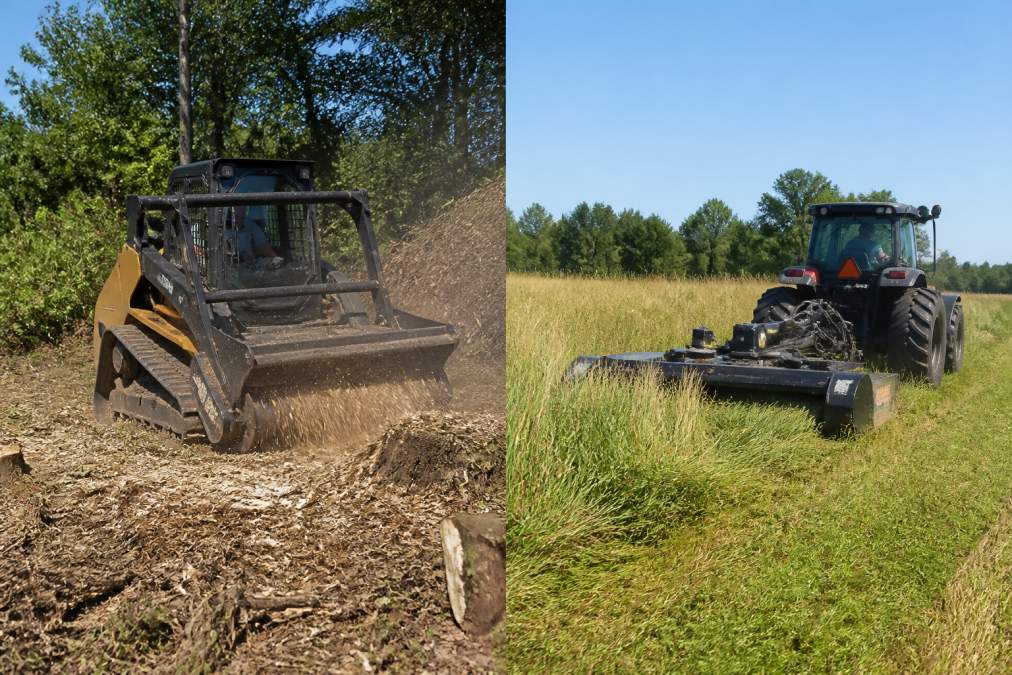
Brush mowing uses a rotary mower, often called a brush hog implement, mounted to a tractor or skid steer. A heavy spinning blade cuts vegetation at ground level, similar to a giant lawnmower. It handles grass, weeds, goldenrod, and light brush effectively. The cut material is left where it falls, creating a layer of cut vegetation that breaks down over time.
Forestry mulching uses a mulching head with a high-torque hydraulic motor and hardened steel teeth. Instead of cutting, the teeth grind vegetation into fine particles. A forestry mulcher processes everything from underbrush and hardwood saplings to trees up to 12 inches in diameter and stumps down to below grade (fs.usda.gov). The resulting mulch layer stays on the soil surface.
Key Differences Between Forestry Mulching and Brush Mowing
The core difference is the size of vegetation each machine can process. A forestry mulcher grinds everything down to soil level, while a brush mower tops vegetation and leaves the root system intact. This distinction drives every other difference, from equipment to cost per acre.
Vegetation Size and Density
Brush mowing suits properties dominated by grass, weeds, and brush up to roughly 4 inches thick. It clears large open areas quickly and is ideal for pasture reclamation or routine land maintenance. Forestry mulching handles dense, established growth: cedar clearing, thick underbrush, old stumps, and woody debris that would destroy a standard rotary mower.
Equipment Requirements and Horsepower
Brush mowers require less hydraulic flow and lower equipment horsepower, making them more economical for large-scale light clearing. Forestry mulchers demand high-flow hydraulics and significantly more power to maintain consistent grinding torque. This equipment gap explains why forestry mulching typically commands a higher land clearing cost per acre than brush mowing.
| Factor | Brush Mowing | Forestry Mulching |
|---|---|---|
| Best vegetation | Grass, weeds, light brush | Trees, stumps, dense brush |
| Max stem diameter | ~4 inches | ~12 inches |
| Root system | Left intact | Ground below grade |
| Debris left behind | Cut vegetation layer | Fine nutrient-rich mulch |
| Regrowth rate | Faster, roots remain | Slower, roots removed |
| Equipment cost | Lower entry point | Higher investment |
Benefits of Forestry Mulching for Soil and Regrowth
The benefits of forestry mulching extend beyond clearing speed. Unlike bulldozing, which strips topsoil, mulching leaves a protective layer that shields soil from erosion while it decomposes. But the real story is what happens below the surface over the next 12 to 36 months.
The Decomposition Cycle: What Happens After the Mulcher Leaves
When a forestry mulcher grinds cedar, oak, or pine into chips, it creates organic matter that decomposes at different rates. Softwoods like pine break down faster, returning nitrogen within one to two growing seasons (srs.fs.usda.gov). Hardwoods like oak decompose slower, releasing carbon and improving soil structure over a longer period. This staggered breakdown creates a slow-release nutrient bank for grass, pasture seed, or native plantings.
Brush mowing leaves cut grass and weed stalks on the surface. That material dries out and loses most of its nitrogen to the air. The root systems remain intact, so the same plants resprout and compete with new seed. The result is a cycle of repeated mowing, not a one-time transition to usable land.
Soil Structure and the Microbial Layer
The grinding action of a mulcher creates a textured interface between the mulch layer and mineral soil. That interface traps moisture and provides habitat for soil microbes and earthworms, which accelerate breakdown and aerate the soil, building a richer topsoil horizon. Brush mowing compacts the soil under the tractor’s weight and leaves a mat of dead vegetation that can shed water rather than absorb it.
If your goal is to seed pasture or plant a food plot within the first year after clearing, forestry mulching gives you a head start. The mulch layer suppresses weed germination while it breaks down, and the soil beneath stays loose enough for a no-till drill or broadcast seeder to make good seed-to-soil contact.
The Regrowth Rate Difference, Quantified
Properties cleared with a forestry mulcher generally experience slower regrowth compared to brush mowed properties, where roots of woody species often survive and resprout. This difference can be a significant factor in long-term land management.
A Unique Angle: The Carbon and Fuel-Load Argument
Forestry mulching also changes the fire risk profile of your property. The fine mulch decomposes quickly and does not accumulate as a dry fuel bed. Brush mowing leaves a thick layer of cured grass and weed stalks that becomes a flash-fuel hazard during the dry season (ready.gov). For properties near wooded areas or in wildfire-prone zones, this matters for safety and insurance liability.
If you are clearing land for long-term utility, the soil benefits of mulching compound over time. If you are just knocking down weeds for a season, mowing is fine. Do not confuse the two outcomes.
Land Clearing Cost Per Acre: Budgeting for Your Property
Land clearing cost per acre for brush mowing runs lower than forestry mulching because the equipment is less expensive to own and operate. But pricing is rarely the deciding factor once you account for what each method leaves behind.
Costs vary based on terrain accessibility, vegetation density, and debris disposal requirements. A flat, open field clears faster than a hillside choked with cedar and hardwood saplings. Many contractors price by the hour, so a dense property with heavy growth will naturally cost more.
The DIY Question: Can You Rent and Do It Yourself?
This is the question almost every property owner asks. Here is the honest breakdown.
Brush mowing DIY is feasible for many landowners. A compact tractor with a rotary cutter rents for roughly $200 to $400 per day from chains like Home Depot or Sunbelt Rentals. If your lot is under two acres of grass and light brush, you can finish in a weekend. Watch for rocks, stumps hidden in tall grass, and steep slopes where a tractor can roll.
Forestry mulching DIY is a different story. A skid steer with a mulching attachment rents for $800 to $1,500 per day, before delivery, fuel, and the high-flow hydraulic requirements many standard skid steers lack. The learning curve is steep. An inexperienced operator can stall the head, damage the machine, or roll the equipment on uneven ground. Rental agreements hold you liable for damage, and a bent tooth or damaged hydraulic line can cost thousands to repair.
If you have never operated a skid steer with a mulching head, do not learn on your own overgrown lot. The machine’s blind spots and the force required to grind a 10-inch stump are unforgiving. A single mistake can total the attachment or cause a serious injury. Professional operators carry insurance and liability coverage that you do not have.
The Hidden Cost of DIY: Your Time and the Second Pass
Even if you successfully rent a brush mower and clear your lot, you will likely need to do it again next year because roots remain intact. That second weekend of work, plus the rental cost, erases much of the savings versus hiring a professional once. Many DIY brush mowers end up hiring a forestry mulching contractor within two years anyway.
Professional ROI: What You Are Actually Paying For
When you hire a professional forestry mulching service, you are paying for the operator’s experience in reading vegetation and terrain, the insurance coverage that protects your property, and the efficiency of a crew that has done this hundreds of times. A professional crew can clear an acre of dense cedar efficiently. A first-time DIY operator might take longer and still leave stumps above grade.
A Budgeting Framework That Actually Works
Instead of asking “What does it cost per acre?” ask these three questions:
- What is the largest stem diameter on the property? If it exceeds 4 inches, brush mowing is not a viable option, and the cost comparison is moot.
- What do you want the land to look like in 12 months? If you need it usable for grazing, building, or planting, mulching’s below-grade stump removal and mulch layer justify the premium.
- What is your time worth? If you value a weekend of your labor at $500, the DIY savings on a small brush mowing job shrink quickly.
Get quotes from contractors, and compare them on what is included: [stump grinding](/cost-stump-grinding-per-acre/) below grade, debris handling, regrowth warranty, and mobilization fees. A comprehensive quote that includes these services can be a better value than a bare-bones bid that leaves you with a half-finished job.
Do not hire based on the lowest quote alone. A cheaper brush mowing bid on a property that actually needs forestry mulching will leave you with cut stumps, torn-up ground, and a regrowth problem next spring. You will pay twice to get the job done right.
When to Choose Brush Mowing Over Mulching
Brush mowing is the better choice when your lot consists of grass, weeds, and light brush with no significant tree growth. If you are maintaining an already-cleared property, keeping fence lines open, or reclaiming pasture not grazed for a season or two, a brush mower clears it efficiently at a lower cost.
Choose brush mowing for routine land maintenance rather than one-time heavy clearing. It is also the right tool for large open areas where vegetation density stays low and terrain accessibility is good.
When Forestry Mulching Is the Better Investment
Forestry mulching wins whenever your property has thick brush mixed with trees, old stumps, or rocks. If you are dealing with cedar clearing, invasive species removal, or a lot abandoned for years, a brush mower will not cut it. The mulcher grinds the entire mess into a fine layer of woody debris that doubles as ground cover.
Forestry mulching also serves site preparation for new construction, driveway installation, or building a pond. The result is level, debris-free ground with roots ground below grade, ready for grading equipment. It reduces fire hazard and restores access and visibility across your property.
For Central Virginia landowners with mixed vegetation and rocks, Timber Shredders LLC provides a comprehensive property assessment before any work begins. Our experienced operators use professional equipment matched to your conditions, with clear project planning and estimates up front. We improve soil health rather than tearing up topsoil.
Final Verdict: Matching the Method to Your Land Goals
The decision comes down to what you want the land to become. If you need routine maintenance on grass and light brush, brush mowing delivers the fastest results for the lowest cost. If your property is choked with trees, stumps, and dense underbrush, forestry mulching is the only method that clears it completely while protecting your soil.
Start with an honest assessment of your vegetation. Walk the property, note the largest stems, and check for rocks and slopes. That tells you which machine can handle the job. Then get a quote that includes debris handling and regrowth expectations. The right method pays for itself in usable land, and the wrong one costs you twice. Get A FREE Quote from Timber Shredders LLC and let our team assess your property before you commit to a clearing strategy.
Frequently Asked Questions
What is the main difference between forestry mulching and brush mowing?
Forestry mulching grinds trees, stumps, and dense woody vegetation into a protective mulch layer using a high-torque mulching head. Brush mowing uses a rotary mower or flail mower to cut grass, weeds, and light brush down to ground level. Mulching handles material up to 12 inches in diameter and leaves nutrients on site, while brush mowing is faster on open terrain but leaves cut debris behind and cannot process thick saplings.
How many acres can a forestry mulcher clear in a day?
The acreage a forestry mulcher can clear in a day depends on vegetation density, terrain accessibility, and equipment horsepower. Light brush on open ground moves faster, while thick stands of hardwood saplings and stumps slow the process. For an overgrown lot with mixed vegetation, a site assessment can provide a realistic timeline.
Does forestry mulching improve soil health compared to brush mowing?
Yes. Forestry mulching grinds woody debris into a mulch layer that decomposes over time, returning organic matter and nutrients to the topsoil. This mulch layer also protects against soil erosion and suppresses regrowth of invasive species. Brush mowing leaves cut vegetation on the surface, which breaks down more slowly and provides less long-term benefit for soil structure and future pasture use.
What are the downsides of forestry mulching for residential lots?
Forestry mulching requires heavier equipment, which costs more per hour than brush mowing and may not fit on very small or tightly constrained lots. The grinding process also leaves a visible mulch layer that takes months to break down, which some homeowners find untidy. For lots with only grass and light weeds, paying for mulching capability you do not need is poor use of your land clearing budget.