Table of Contents
- Why Brush Removal Tools Matter for Land Management
- Forestry Mulching Benefits and How They Apply to Tool Selection
- Walk-Behind Brush Mowers: Power and Precision for Mid-Sized Properties
- Skid Steer Attachments and Heavy-Duty Implements for Dense Vegetation
- Handheld Brush Cutters and Clearing Saws for Precision Work
- Manual Tools for Sapling Removal and Invasive Species
- DIY vs Professional Land Clearing: When to Call an Expert
- Brush Removal Cost Per Acre and Budget Considerations
- Frequently Asked Questions
Last Updated: September 1, 2026
Why Brush Removal Tools Matter for Land Management
Overgrown land doesn’t clear itself, and the wrong approach can leave you with erosion damage, lingering root systems that regrow within months, and a property that’s still unusable. The choice of brush removal tools determines whether you reclaim your property efficiently or spend months fighting regrowth and compacted soil.
At Timber Shredders LLC, we’ve cleared hundreds of properties across Central Virginia, and we’ve seen firsthand what works and what doesn’t. The tools you choose depend on three factors: the density and type of vegetation, the size of your property, and whether you want to preserve soil health. A walk-behind mower works great for light to moderate brush on a few acres. A forestry mulcher attachment on a skid steer handles dense saplings and stumps that would choke a standard mower. Manual tools like an uprooter excel at removing individual invasive species without disturbing surrounding soil.
This guide covers the top 5 brush removal tools for overgrown land, how to match them to your specific situation, and when professional equipment becomes the smarter investment.
Forestry Mulching Benefits and How They Apply to Tool Selection
Forestry mulching is the process of grinding vegetation, saplings, and small trees into mulch on-site, leaving behind nutrient-rich material that improves soil rather than stripping it bare. Unlike traditional clearing methods that remove everything and leave compacted, exposed earth, mulching returns organic matter to the ground where it belongs.
This distinction matters for your tool selection. If you’re clearing land that will become pasture, a garden area, or restored habitat, you want equipment that mulches rather than simply cuts. The mulch layer protects soil from erosion, retains moisture, and feeds beneficial microorganisms as it breaks down. A brush hog rotary cutter leaves material on the ground. A forestry mulcher grinds it finer and more thoroughly. A handheld brush cutter leaves scattered debris that needs cleanup.
When soil health is your priority, forestry mulching equipment justifies its higher cost because you’re not paying separately for debris removal and you’re not degrading the land in the process. For properties where you simply need access restored and appearance improved, a less expensive tool may suffice. The research from Virginia Cooperative Extension on land management practices emphasizes that soil preservation during clearing directly affects post-project usability.
Walk-Behind Brush Mowers: Power and Precision for Mid-Sized Properties
A walk-behind brush mower cuts through thick grass, small saplings, and woody growth using a powerful engine and rotating cutting deck. The DR PRO XL30 represents the practical standard for homeowners and property managers tackling 2-10 acre properties with moderate to heavy overgrowth.
The DR PRO XL30 delivers 20 horsepower from a Briggs V-Twin engine and covers 30 inches of ground per pass. Power steering makes it maneuverable despite its size, and the pivoting deck follows terrain without scalping bare patches. It handles saplings up to 3 inches thick, which covers most brush-clearing scenarios on residential properties (peer-reviewed research). The cutting width means fewer passes than a smaller mower, saving time on larger jobs.
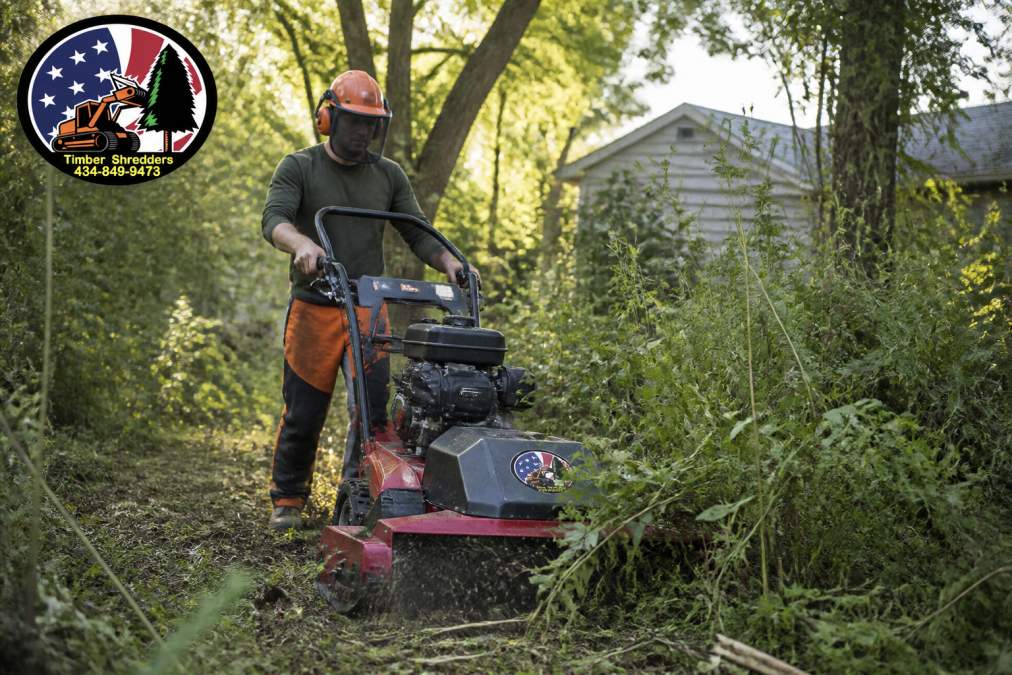
The real strength of this tool is versatility without complexity. You don’t need a tractor, special training, or professional licensing. Rental shops stock them widely, so you can test before buying. The limitation is that it doesn’t mulch fine enough for soil improvement, it cuts and leaves material that still needs cleanup. On rocky or very steep terrain, the fixed wheels can struggle.
This tool works best for properties where you need to restore access and improve appearance, but soil health is secondary. If your land has extensive stumps or very dense woody material, a walk-behind mower will clog or stall. That’s when you move to heavier equipment.
Skid Steer Attachments and Heavy-Duty Implements for Dense Vegetation
A skid steer loader paired with a forestry mulcher attachment becomes the workhorse for dense brush, saplings, and stumps. The Fecon Bull Hog and similar mulcher attachments grind material into fine mulch on-site, eliminating debris piles and improving soil simultaneously.
The Fecon Bull Hog Mulcher attaches to high-flow skid steers and works with a rotating drum equipped with sharp teeth that pulverize vegetation into mulch. The BH74SS model has a 61-inch working width and handles material up to 12 inches in diameter. It’s designed for professional contractors and serious landowners with 5+ acres of thick brush or forestry clearing work.
The advantage is efficiency and soil preservation. A skilled operator can clear an acre of dense brush in a few hours, leaving mulch that enriches rather not depletes the soil. The disadvantage is cost, a skid steer loader runs $25,000 to $85,000 depending on model, and the mulcher attachment adds another $27,000 or more. Rental is possible but expensive for multi-day jobs.
The Toro Dingo Compact Utility Loader offers a lighter-duty alternative with lower cost. It’s more maneuverable in tight spaces and less likely to get bogged down on softer ground. However, it doesn’t have the raw power of larger skid steers, so it struggles with very dense or woody material. It’s better suited to clearing smaller properties or working around structures where a full-size skid steer won’t fit.
Professional land clearing companies like Timber Shredders LLC use skid steers with mulcher attachments because the investment pays for itself through faster job completion and the ability to handle any vegetation type. For a one-time residential project, rental is the practical choice.
Handheld Brush Cutters and Clearing Saws for Precision Work
Handheld brush cutters give you control for targeted clearing around trees, structures, and fence lines where larger equipment can’t reach. The STIHL FS 361 C-EM and Milwaukee M18 FUEL represent the professional and cordless options.
The STIHL FS 361 C-EM is a gas-powered brush cutter with a 37.7cc engine, bike-handle design, and compatibility with multiple cutting attachments. It handles dense grass, thick weeds, and woody stems up to about 1 inch in diameter. The STIHL M-Tronic engine management system automatically adjusts fuel mixture for consistent performance across varying conditions. It’s the tool landscapers and groundskeepers rely on for precision work that a mower can’t reach.
The Milwaukee M18 FUEL Cordless Brush Cutter uses a rechargeable battery system, eliminating fuel mixing and engine maintenance. It’s lighter than gas models and produces zero emissions. The trade-off is runtime, battery-powered tools max out at 45-60 minutes of cutting before needing a charge. For small properties or finishing work around the edges of a larger project, this is fine. For full-day clearing on dense vegetation, gas-powered tools deliver more continuous power.
Both tools excel at precision. Neither will handle saplings thicker than an inch or two. Neither will clear large areas efficiently. They’re finishing tools, not primary clearing equipment. Use them after your main clearing pass to clean up edges, work around obstacles, and remove isolated woody growth.
Manual Tools for Sapling Removal and Invasive Species
Manual tools like the Uprooter and Brush Grubber remove saplings and invasive plants by the root without chemicals or heavy machinery. This approach matters when you’re managing invasive species or protecting surrounding vegetation that you want to keep.
The Uprooter uses a patented lever design to grip and pull small trees and woody plants from the ground, roots intact. It handles stems up to 2.25 inches in diameter and prevents regrowth because the entire root system comes out (peer-reviewed research). The Brush Grubber Original connects to an ATV or vehicle for pulling power, making it less physically demanding than hand tools. Both are chemical-free, which matters if you’re near water sources or managing land for conservation.
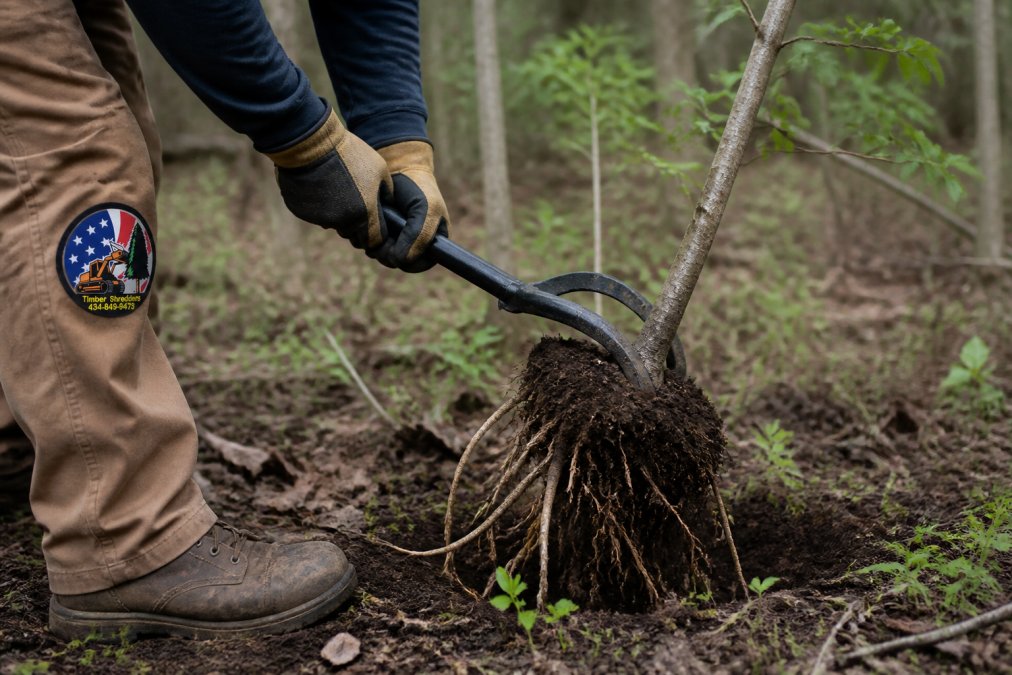
The limitation is scale. Manual tools work for scattered saplings or small infestations, not for clearing acres of dense brush. They’re also labor-intensive, expect to spend hours on a moderate-sized property. The real value is precision and environmental safety. If you’re removing invasive species like multiflora rose or autumn olive from a property you want to restore, manual tools let you target specific plants without herbicides.
Many landowners combine approaches: use a mower or mulcher for the bulk clearing, then follow up with manual tools to remove remaining saplings and treat invasive species. This hybrid approach gives you speed and thoroughness.
DIY vs Professional Land Clearing: When to Call an Expert
The decision between renting equipment for DIY clearing and hiring a professional contractor depends on property size, vegetation density, your physical ability, and whether you value your time.
DIY clearing with rental equipment makes sense for properties under 2 acres with light to moderate overgrowth. A day’s rental of a walk-behind mower or handheld brush cutter costs $75-$150 and covers most residential properties. You have control over the pace and can spread work across multiple weekends. The downside is physical labor, equipment learning curves, and the risk of damage if you hit rocks or stumps.
Professional clearing becomes practical for properties over 3 acres, dense woody vegetation, or when you need the work completed on a specific timeline. A professional contractor brings equipment matched to your actual conditions, insurance coverage, and experience handling unexpected obstacles. Timber Shredders LLC handles properties throughout Central Virginia where dense brush, stumps, and erosion-prone terrain make DIY risky or impractical.
The cost difference narrows when you factor in rental equipment, fuel, and your own labor. A professional crew can clear an acre of dense brush in one day with forestry mulching equipment. DIY clearing of the same property might take a full week of part-time work plus multiple equipment rentals.
Call a professional if any of these apply: your property has more than 5 acres of overgrowth, you have stumps or rocks that could damage equipment, you need soil preservation for future use, you want the work done within a specific timeframe, or you’re uncertain about equipment operation and safety. A free property assessment from a professional contractor clarifies your options without obligation.
Brush Removal Cost Per Acre and Budget Considerations
Brush removal pricing depends on vegetation density, equipment needed, and whether soil health matters for your project outcome. Understanding the factors helps you compare quotes and avoid surprises.
Light brush clearing on accessible property costs less than dense woody vegetation on slopes. A property with scattered saplings and grass might clear for $300-$600 per acre with a walk-behind mower or handheld equipment. Dense brush mixed with stumps and rocks could run $1,000-$2,000 per acre when forestry mulching is needed. Very heavy forestry clearing with large trees can exceed $2,500 per acre.
These ranges vary based on local equipment availability, contractor overhead, and site-specific challenges. A property with rock outcrops or hidden stumps costs more to clear because equipment moves slower and risks damage. A property on a steep slope costs more because equipment must work carefully to prevent erosion.
When comparing quotes, ask what’s included: debris removal, mulch left on-site, stump grinding, or just vegetation cutting. Ask whether the contractor will assess your property before quoting, a professional contractor like Timber Shredders LLC provides a comprehensive assessment and detailed estimate so you understand exactly what you’re paying for. Vague quotes that don’t account for actual conditions often hide unexpected costs.
Budget considerations also affect tool choice. Renting a walk-behind mower for a weekend costs $100-$150. Renting a skid steer with mulcher attachment costs $400-$600 per day. Buying a walk-behind mower runs $3,500-$4,500. Buying a skid steer starts at $25,000. For most residential properties, professional service or short-term rental beats ownership because you use the equipment once and avoid storage and maintenance costs.
Brush removal tools solve different problems at different scales. A walk-behind mower restores access to a few acres. A forestry mulcher handles dense brush while improving soil. Manual tools target invasive species with precision. The right choice depends on your property size, vegetation type, and whether you’re clearing for appearance, usability, or long-term land health.
When your property needs professional assessment and you want equipment matched to actual conditions, Timber Shredders LLC provides a free consultation and detailed estimate. We handle properties throughout Central Virginia with forestry mulching, land clearing, and driveway installation. Get A FREE Quote to see how professional clearing can transform your overgrown land into usable property, fast, reliably, and with soil health preserved.
Frequently Asked Questions
What is the best brush removal tool for a small residential property?
For small properties under 1 acre with light to moderate brush, a handheld brush cutter like the STIHL FS 361 or Milwaukee M18 FUEL offers maneuverability and control. For manual removal of individual saplings, an Uprooter or Weed Wrench removes plants by the root without disturbing soil. The best choice depends on vegetation density and your physical capability for handheld operation.
How do forestry mulching benefits compare to traditional brush removal methods?
Forestry mulching grinds vegetation into nutrient-rich mulch that stays on-site, improving soil health and reducing erosion compared to methods that remove debris entirely. Mulch also suppresses regrowth and retains moisture. Professional forestry mulching equipment like the Fecon Bull Hog or Toro Dingo with mulcher attachments deliver these benefits efficiently across large areas, though manual tools and smaller mowers cannot produce mulch.
When should I hire professional land clearing instead of DIY brush removal?
Hire professionals for properties over 2-3 acres, dense woody vegetation, stumps requiring removal, or terrain with rocks and obstacles. DIY works for small areas with light brush and saplings. Professional equipment handles invasive species, soil health preservation, and debris management more efficiently.
What is the typical brush removal cost per acre for professional services?
Professional brush removal costs vary based on vegetation density, terrain, equipment required, and debris removal. Light brush clearing costs less than dense woodland with stumps. For accurate pricing for your specific property, contact a professional land management service for a comprehensive property assessment and detailed estimate.
This article was written using GrandRanker