Table of Contents
- What Is Forestry Mulching and How Does It Work
- Forestry Mulching vs. Bulldozing: Key Differences
- Environmental Impact and Soil Health Benefits
- How to Prepare Land for Forestry Mulching
- Understanding Forestry Mulching Cost Per Acre
- Wildfire Prevention and Fuel Load Reduction
- Real Applications for Central Virginia Property Owners
- Conclusion
Last Updated: August 9, 2026
What Is Forestry Mulching and How Does It Work
Forestry mulching grinds trees, brush, stumps, and vegetation into mulch in a single pass, leaving nutrient-rich material on-site to decompose and improve soil health. Unlike traditional methods that haul debris away or burn it, this approach uses specialized equipment, typically a forestry mulcher attachment mounted on an excavator or skid steer, with rotating cutting heads equipped with carbide teeth that break down material into uniform pieces.
The result is a cleared property with immediate soil benefits: organic matter begins decomposing, returning nutrients to the soil while reducing erosion and compaction that bulldozing would cause. A property that might take weeks to clear with traditional methods can often be completed in days with forestry mulching.
The mulch layer created by forestry mulching isn’t just a byproduct, it’s actively working for your property. As it decomposes over months, it feeds the soil with organic matter that improves water retention and nutrient availability. This is why pasture and landscaping efforts often succeed faster on mulched land compared to bare, compacted soil left behind by bulldozers.
Forestry Mulching vs. Bulldozing: Key Differences
Bulldozing moves material off-site or into piles for later removal or burning, leaving behind compacted, bare soil that often requires expensive remediation. Forestry mulching keeps everything on-site, converting it into a protective layer that improves the land.
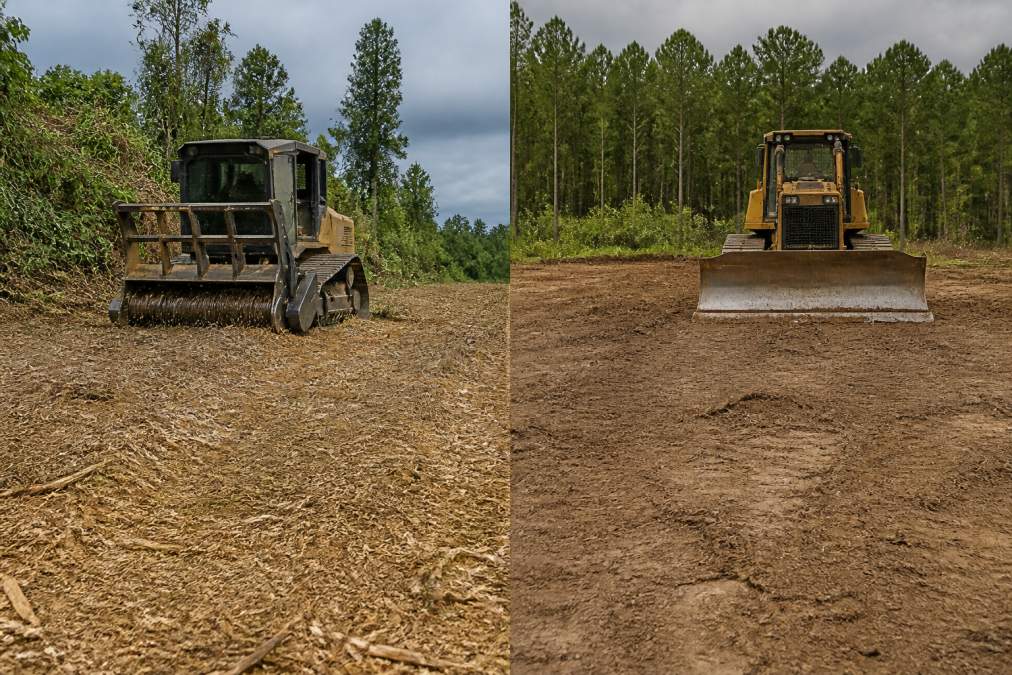
Bulldozers compact the ground, crushing topsoil structure and making it harder for water to infiltrate and roots to establish. Forestry mulching improves soil structure by adding organic matter without heavy machinery damage. Cost-wise, bulldozing requires multiple steps: clearing, debris hauling or burning permits, stump grinding, and soil remediation. Forestry mulching consolidates most of this into one operation, reducing timeline and contractor fees.
For properties needing cleared land ready for pasture, development, or recreational use, forestry mulching delivers faster results with better soil conditions.
| Aspect | Forestry Mulching | Bulldozing |
|---|---|---|
| Soil Impact | Improves with organic matter | Compacts and damages |
| Debris Handling | On-site mulch layer | Haul away or burn |
| Timeline | Days to weeks | Weeks to months |
| Follow-up Work | Minimal | Extensive remediation |
| Cost Structure | Single operation | Multiple services |
| Environmental Impact | Reduces erosion, improves health | Leaves bare, exposed soil |
Bulldozing leaves compacted soil that sheds water instead of absorbing it. This leads to erosion, poor drainage, and failed pasture seeding. Many property owners discover this problem months after clearing, when they’re trying to establish grass or crops on land that’s been hardened by heavy machinery.
Environmental Impact and Soil Health Benefits
Forestry mulching returns carbon and nutrients that would otherwise be lost. The decomposing organic matter feeds soil microorganisms, improves water retention, and reduces the need for added fertilizer, especially important for pasture or agricultural use.
Erosion control is significant. Bare soil exposed by bulldozing erodes quickly, particularly on sloped terrain common in Central Virginia. The mulch layer acts as a protective blanket, absorbing water, reducing runoff, and keeping soil in place. Soil structure recovery happens faster because you’re not starting from zero; the mulch layer provides habitat for beneficial microorganisms, earthworms, and fungi that rebuild soil naturally.
The mulch layer also provides shelter and food sources for insects, small mammals, and ground-nesting birds. According to USDA guidance on soil health and erosion control, maintaining organic matter in the topsoil layer is critical for long-term land productivity. Forestry mulching aligns with these principles by preserving and enhancing that organic matter.
How to Prepare Land for Forestry Mulching
Preparation begins with a comprehensive property assessment. Walk the site with your contractor to identify obstacles: buried utilities, large rocks, old metal debris, or structures needing protection. Clear communication about your end goal, driveway, pasture expansion, wildfire mitigation, or building site prep, ensures the contractor understands your needs.
Remove or mark hazards before equipment arrives. Buried metal, old fencing, large rocks, or debris that might damage equipment should be identified. Check property lines and easements to confirm the contractor has permission to work in all areas and knows about utility lines or easements affecting the work plan.
Site Preparation Checklist:
- Schedule property walk-through with contractor
- Identify and mark underground utilities (call 811 before work begins)
- Note obstacles: large rocks, metal debris, old structures
- Confirm property lines and easement locations
- Remove or protect items that shouldn’t be mulched
- Plan equipment access routes and staging areas
- Discuss final grade and mulch depth requirements
- Clarify timeline and weather-dependent delays
The most common delay in forestry mulching projects is discovering utilities or obstacles during work. A 30-minute property assessment conversation with your contractor prevents hours of stopped work and unexpected costs.
Understanding Forestry Mulching Cost Per Acre
Pricing depends on vegetation density, terrain difficulty, equipment access, and what you’re clearing. Dense woods with steep slopes and limited equipment routes cost more per acre than sparse brush with easy access.
Vegetation type and density are primary cost drivers. Rocky terrain affects pricing as equipment moves slowly over obstacles. Slope and terrain accessibility matter too; steep hillsides require careful positioning and slower work speeds. Equipment access influences costs significantly, wide driveways and clear staging areas allow efficient positioning, while narrow lanes and uneven ground increase time and cost.
For accurate pricing, request a quote specifying what’s included: mulching only, or mulching plus grading and cleanup? Are there stump removal or rock relocation costs? Contact Timber Shredders LLC for a free quote. A professional assessment of your specific property gives you an accurate number rather than generic per-acre estimates.
Properties under 2 acres with moderate vegetation density and good equipment access. Larger, more complex properties with dense brush, steep terrain, or significant rock obstacles typically require on-site assessment for accurate pricing.
Wildfire Prevention and Fuel Load Reduction
Forestry mulching directly addresses wildfire risk by removing dense brush, dead trees, and accumulated vegetation that serves as fuel. Defensible space, the zone around your home where vegetation is thinned and dead material removed, is critical for wildfire protection. Forestry mulching clears this space efficiently in a single operation.
Fuel load reduction is particularly important in wooded areas where dead trees and fallen branches accumulate. This dead material burns hot and fast, creating dangerous fire behavior. Forestry mulching removes this hazard, converting it to mulch that won’t fuel a fire. The mulch layer created is not a fire hazard once settled; as it decomposes, it becomes part of the soil, eliminating the fuel source entirely.
Many Central Virginia property owners combine forestry mulching with other wildfire prevention strategies: creating firebreaks, thinning tree canopies, and removing ladder fuels. Forestry mulching handles the heavy lifting, clearing dense vegetation quickly.
Real Applications for Central Virginia Property Owners
Overgrown driveways are common in Central Virginia; years of neglect leave properties with brush encroaching on access. Forestry mulching restores driveway width and sightlines in days.
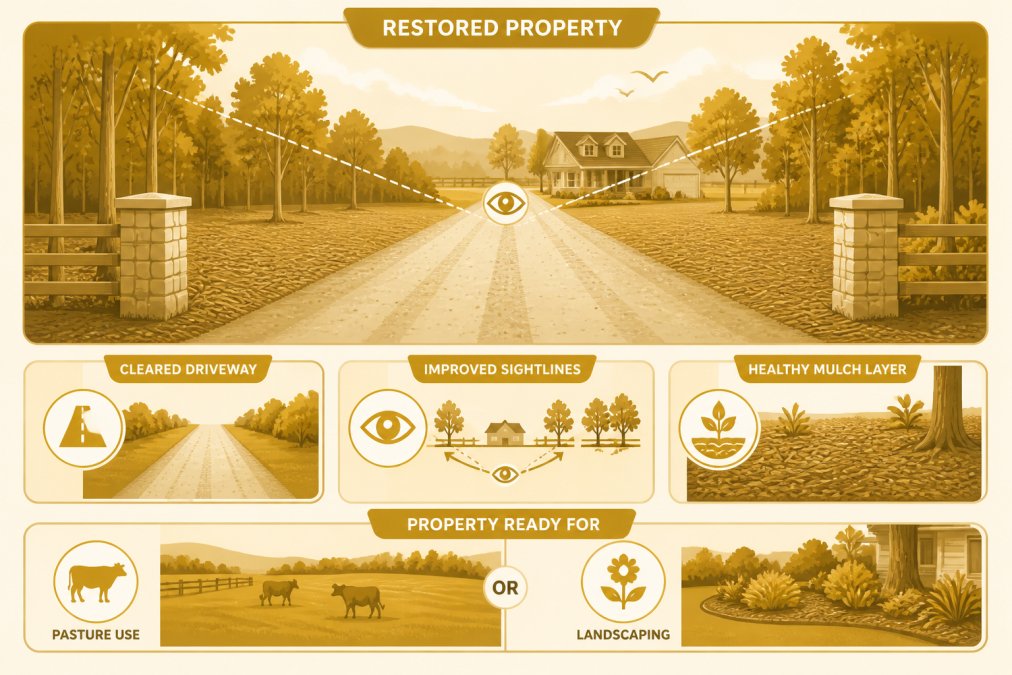
Pasture expansion is another frequent need. Bulldozing leaves compacted soil that takes years to recover for pasture use. Forestry mulching clears the land and improves soil structure simultaneously, meaning pasture establishment succeeds faster. Property development and site preparation benefit significantly, builders need cleared, level sites ready for construction, and forestry mulching leaves land in better condition than bulldozing.
Recreational property access improves through forestry mulching. Clearing trails, widening paths, and opening sightlines for hunting or hiking becomes faster and more effective. Wildfire mitigation on rural properties relies heavily on forestry mulching for thinning dense brush, removing dead trees, and creating defensible space.
Forestry mulching services offer Central Virginia property owners a modern alternative to traditional land clearing. The process improves soil health, reduces erosion, and gets your property ready for use faster than bulldozing. Whether you’re reclaiming an overgrown driveway, expanding pasture, preparing a building site, or reducing wildfire risk, forestry mulching delivers results with environmental benefits.
Get a FREE Quote from Timber Shredders LLC to see how forestry mulching can transform your property. Our team provides comprehensive property assessment, professional equipment, and experienced operators to ensure your project is completed efficiently with clear planning and reliable service from start to finish.
Frequently Asked Questions
How does forestry mulching prevent soil erosion compared to bulldozing?
Forestry mulching grinds vegetation and stumps into fine mulch that remains on-site, creating a protective layer that stabilizes topsoil and reduces erosion. The mulch layer acts as a barrier against water runoff and wind damage. Bulldozing, by contrast, removes all vegetation and organic matter, leaving bare ground exposed to erosion. Studies show that the mulch layer from forestry mulching also improves nutrient cycling and soil structure, making your land more usable for pasture or future development without the erosion problems traditional clearing creates.
What’s the typical price range for forestry mulching cost per acre in Virginia?
Forestry mulching pricing depends on several factors including brush density, tree size, stump volume, terrain difficulty, and site accessibility. Properties with thick brush and old stumps cost more to clear than lightly overgrown land. Rather than guessing at a price, the best approach is to request a free property assessment and quote from a professional service. They’ll evaluate your specific acreage and conditions to give you an accurate estimate. This prevents surprises and lets you compare true apples-to-apples pricing with other contractors.
Can forestry mulching equipment handle rocky terrain and old stumps without getting stuck?
Modern forestry mulching equipment is designed to handle challenging conditions including rocks, old stumps, and uneven terrain. Professional operators know how to navigate difficult sites and adjust their approach based on ground conditions. However, every property is unique. Before starting work, a professional assessment identifies potential obstacles like large boulders, deeply rooted stumps, or soft wet areas. This upfront evaluation ensures the contractor can handle your specific property without unexpected delays or equipment problems mid-project.
Is forestry mulching truly sustainable for long-term land management?
Yes, forestry mulching is recognized as a sustainable land management practice because it returns organic matter to the soil, improves ecosystem health, and reduces the need for hauling and burning. The mulch layer supports nutrient cycling, prevents erosion, and creates conditions for healthy regrowth. Unlike traditional clearing that removes all biomass, forestry mulching works with natural processes. For property owners planning to use cleared land for pasture, development, or recreational trails, the improved soil health and reduced erosion make it a more sustainable choice that protects your investment long-term.
This article was written using GrandRanker