Table of Contents
- DIY Land Clearing vs Professional Services: A Comparison
- DIY Brush Clearing Tools and What They Can Actually Do
- Cost Analysis: What DIY Land Clearing Actually Costs
- Land Clearing Safety Regulations and Hidden Risks
- Forestry Mulching Cost Per Acre and Professional Efficiency
- When to DIY and When to Hire a Professional
- Site Preparation and Soil Health After Clearing
- Conclusion
Last Updated: August 30, 2026
DIY Land Clearing vs Professional Services: A Comparison
The decision between tackling land clearing yourself and hiring professionals isn’t just about cost, it’s about knowing what you’re capable of handling. DIY land clearing works well for small projects: removing brush from a fence line, clearing a few saplings from a garden bed, or maintaining an already-cleared area. But dense overgrowth, stumps, or significant acreage change the calculus dramatically. Equipment costs, safety risks, and time investment often exceed professional service charges, before accounting for mistakes that damage soil health or create liability issues.
This guide breaks down what you can realistically handle yourself, what equipment actually does what it claims, and when calling a professional makes financial and practical sense.
DIY Brush Clearing Tools and What They Can Actually Do
Hand Tools for Small Areas
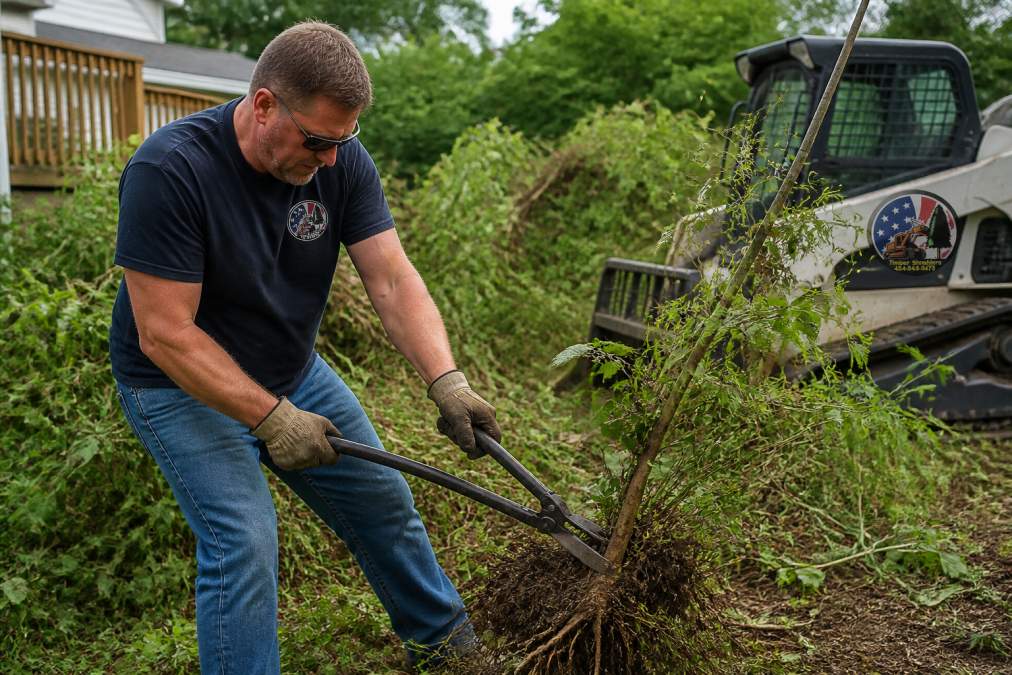
Hand tools work for small-scale brush removal on loose soil. A brush grubber, designed to grip and pull brush and saplings up to 3 inches in diameter, costs between $40 and $135 (consumerreports.org). It prevents regrowth by pulling roots, but requires significant physical effort and becomes impractical for areas larger than a few hundred square feet.
For small fence-line maintenance or clearing around garden beds, hand tools make sense. They’re affordable and don’t require rental. But brush covering more than a few hundred square feet enters territory where equipment rental becomes worth considering.
Equipment Rental: When DIY Gets Serious
Field and brush mowers handle dense vegetation, tall grass, and small saplings effectively. Rental costs typically run $150 to $300 per day. These machines cut vegetation at ground level but don’t remove stumps or roots.
Forestry mulchers, skid steers with forestry mulcher attachments, rent for roughly $1,270 per day for compact models, scaling to $14,000 per week for high-horsepower dedicated mulchers. Transport adds $500 to $1,500. A forestry mulcher shreds trees, brush, and stumps into fine mulch, eliminating debris disposal and returning nutrients to soil.
The problem is operational skill. These machines require experience to operate safely. Rental companies typically require proof of experience or charge additional training fees. You’re liable for any damage, hitting a hidden rock can cost thousands in repairs.
For most DIY landowners, equipment rental makes sense only if you have 1-2 acres of moderate brush, you’re comfortable operating heavy machinery, and you have time to learn the equipment. Otherwise, rental cost, transport, insurance, and learning curve often exceed what a professional would charge.
Cost Analysis: What DIY Land Clearing Actually Costs
The true cost of DIY land clearing extends beyond equipment rental to include time, disposal, and remediation.
Time as a Hidden Cost
Hand tool clearing of dense brush takes roughly 4-6 hours per quarter-acre. A field mower reduces that to 2-3 hours per acre, but you still need to remove stumps, roots, and debris. A forestry mulcher can clear 1-3 acres per day with an experienced operator. Over a 2-acre project, professional completion (1-2 days) versus DIY hand-tool work (40-60 hours spread over weeks) compounds significantly. Your time has value, and extended timelines delay using the land.
Debris Disposal: The Overlooked Cost and Regulatory Minefield
Without on-site mulching, you face a disposal decision with both cost and legal implications.
Dumpster Rental: A 20-cubic-yard dumpster costs $300-$600 per week. For a 2-acre clearing project, expect 8-15 tons of debris, requiring multiple loads. Delivery and pickup add $100-$200.
Chipping and Hauling: Wood chipper rental ($50-$150 per day) reduces debris volume before dumpster disposal but requires additional equipment time and operator skill.
Open Burning: This appears free but carries significant regulatory and liability costs. Many jurisdictions restrict or prohibit open burning of land-clearing debris. Some require burn permits ($0-$50) or prohibit burning entirely. Burning without a permit in jurisdictions that require one incurs fines of $100 to $1,000+. If your burn escapes and damages neighboring property, you’re liable for all damages, potentially tens of thousands of dollars. Most homeowner insurance excludes coverage for intentional burning damage. Contact your local fire marshal or county extension office to confirm regulations before burning.
Composting and On-Site Mulching: Chipped debris can be composted or left in windrows to decompose naturally over 6-12 months, but requires storage space.
Remediation Costs
Poorly executed clearing can compact soil, expose erosion-prone areas, or leave root systems that prevent new growth. If your goal is pasture, building, or landscaping, soil damage becomes expensive to fix.
Compacted soil may require renting a soil aerator ($100-$200 per day) or hiring a grading contractor ($1,500-$3,000). Erosion control blankets, silt fencing, or replanting cover crops adds another $500-$2,000 depending on acreage.
Professional operations use forestry mulching to avoid this. The mulch layer protects soil structure, suppresses weeds, and adds organic matter as it decomposes.
Real-World Cost Comparison
Equipment rental ($1,270-$2,000 for a week), transport ($500-$1,500), fuel ($200-$400), disposal or burning permits ($0-$50), dumpster rental or chipping ($300-$600), and labor valued at $20/hour for 40-60 hours ($800-$1,200) totals $3,500-$6,000 for a 2-3 acre DIY project. At that price point, professional services become competitive while avoiding liability, equipment damage risk, and potential soil damage remediation costs.
Land Clearing Safety Regulations and Hidden Risks
DIY land clearing carries genuine safety hazards. Operating heavy machinery without proper training causes serious injury. Forestry mulchers and skid steers have blind spots, and moving terrain changes visibility constantly.
Underground utilities, electrical lines, gas lines, water pipes, can be struck during clearing. Calling 811 before any digging is required by law in most areas (call811.com). Hitting a gas line or electrical conduit can be fatal.
If someone is injured on your property during your clearing project, your homeowner’s insurance may not cover it. Professional land clearing companies carry liability insurance specifically for this work. You’re personally liable if you’re doing it yourself.
Environmental regulations also apply. Some areas restrict clearing near wetlands, streams, or sensitive habitats. Clearing in a protected area without a permit incurs significant fines. Professional operators know these regulations and obtain necessary permits before starting.
Forestry Mulching Cost Per Acre and Professional Efficiency
Professional forestry mulching typically costs between $800 and $2,000 per acre, depending on vegetation density, terrain accessibility, and local market rates. That price includes equipment, operator, site assessment, and on-site mulching, no separate disposal fees.
A professional operation can clear 1-3 acres per day. The mulch layer left behind, typically 2-4 inches, protects soil, suppresses weeds, and improves water retention.
For comparison, DIY hand tools on 2 acres take 40-60 hours spread over weeks. Equipment rental for a forestry mulcher plus transport and fuel often reaches $2,000-$3,000 for a week-long project. Professional services eliminate the learning curve, reduce your personal liability, and deliver a finished product with soil health benefits built in.
| Approach | Equipment Cost | Time Required | Disposal | Soil Health | Liability |
|---|---|---|---|---|---|
| Hand tools | $40-$150 | 40-60 hours per 2 acres | Manual removal | Minimal impact | On you |
| Equipment rental | $1,270-$2,000/week | 20-30 hours per 2 acres | Your responsibility | Risk of compaction | On you |
| Professional service | $800-$2,000/acre | 1-3 days per 2 acres | Included, mulched | Improved | Professional coverage |
When to DIY and When to Hire a Professional
The decision comes down to three factors: project size, vegetation density, and your comfort with risk.
DIY makes sense if you’re clearing less than half an acre of light brush with no stumps, you have time to spread the work over several weekends, and you’re comfortable with hand tools or renting basic equipment. This scenario, a fence line, a small overgrown area near the house, or maintaining an already-cleared space, is where hand tools and modest equipment rental pay off.
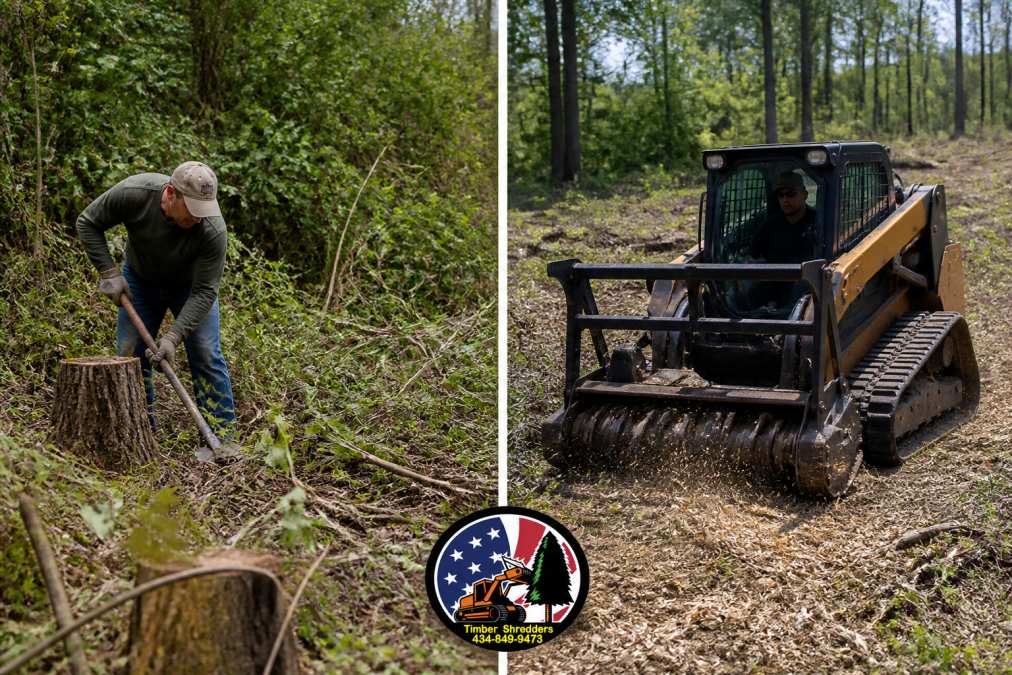
Hire a professional if you’re dealing with more than 1 acre, dense brush mixed with trees and stumps, steep or hard-to-access terrain, or if you need the work completed quickly. Professional land clearing also makes sense if soil health matters for your next use, pasture, building, or landscaping. The mulching process preserves soil structure in ways DIY equipment rental typically doesn’t.
At Timber Shredders LLC, a professional assessment costs nothing, we evaluate your land, access points, vegetation type, and terrain to give you an honest estimate of what’s realistic to DIY versus what’s worth outsourcing.
Site Preparation and Soil Health After Clearing
What happens after clearing matters as much as the clearing itself. Bare, compacted soil erodes, becomes hydrophobic, and takes years to recover fertility. If your plan is to use the land for pasture, building, or landscaping, post-clearing soil condition determines success or failure.
Why Bare Soil Erodes and How to Prevent It
When vegetation is removed, soil loses its protective cover. Exposed topsoil is vulnerable to water and wind erosion, especially on slopes. A single heavy rain can wash away 1-2 inches of topsoil from unprotected slopes (peer-reviewed research). Over a season, erosion can remove 5-10 tons of soil per acre.
Compaction from equipment reduces soil porosity, decreasing water infiltration and increasing runoff. Compacted soil also restricts root penetration, making it harder for new plants to establish.
DIY clearing leaves bare soil exposed. You’ll need to address erosion control immediately after clearing. Options include:
Erosion Control Blankets (ECB): Biodegradable mats that hold soil in place while vegetation re-establishes. Cost: $0.50-$1.50 per square yard. For a 1-acre slope, expect $2,000-$4,000 installed.
Silt Fencing: Temporary sediment barriers installed along downslope edges. Cost: $1-$3 per linear foot installed. A 1-acre property may require $200-$1,200. Silt fencing must be maintained every 2-4 weeks during the rainy season.
Mulch Application: A 2-4 inch layer of wood mulch protects soil, reduces erosion, suppresses weeds, and improves water retention. Cost: $15-$30 per cubic yard delivered and spread. A 1-acre area requires roughly 40-80 cubic yards, totaling $600-$2,400.
Cover Crops: Fast-growing plants (annual rye, clover, buckwheat) planted immediately after clearing stabilize soil and add organic matter. Cost: $50-$200 for seed and application. Cover crops establish in 4-8 weeks.
Professional Forestry Mulching vs. DIY Soil Outcomes
Professional forestry mulching leaves behind a 2-4 inch layer of fine mulch that protects soil from erosion, suppresses weeds, retains moisture, and gradually decomposes to improve organic matter and soil structure. This mulch is created on-site from cleared material with no additional cost or disposal burden.
DIY clearing typically leaves bare land. You’ll need to purchase and apply erosion control measures separately, adding $600-$2,400+ to your project cost and extending your timeline by weeks or months.
Soil Compaction and Remediation
If heavy equipment was used during DIY clearing, soil compaction is likely. Signs include standing water, slow grass growth, and hard, crusty soil surface.
Remediation options include soil aeration ($500-$1,500 per acre for professional work), tilling and amendment ($500-$1,500 per acre), or deep ripping for severe compaction ($1,000-$2,500 per acre).
Grading, Drainage, and Site Preparation for Future Use
Bare land after clearing often has drainage problems: low spots that collect water, slopes that shed water toward structures, or areas prone to ponding. Professional operations assess and improve drainage patterns during or immediately after clearing.
DIY clearing typically leaves the land in whatever condition it was in. If you’re planning to build, establish pasture, or create a usable yard, poor drainage becomes a problem later. Correcting drainage after the fact costs $2,000-$5,000+ depending on scope.
Timeline for Post-Clearing Soil Recovery
If you’re clearing land for a specific use, plan for a recovery window:
- Immediate (0-4 weeks): Install erosion control, apply mulch or plant cover crops, establish drainage improvements.
- Short-term (1-3 months): Monitor for erosion, maintain silt fencing, allow temporary vegetation to establish.
- Medium-term (3-12 months): Cover crops mature; mulch begins decomposing; soil structure gradually improves.
- Long-term (1-3 years): Soil organic matter increases, compaction gradually alleviates, and land is ready for permanent use.
Professional clearing with forestry mulching compresses this timeline. The mulch layer provides immediate erosion protection and begins improving soil immediately, so land can often be used for building or pasture within 2-4 months instead of 1-3 years.
Conclusion
DIY land clearing saves money only on very small projects. For anything larger than a few hundred square feet, equipment rental, transport, disposal, and your own time often exceed what professional services cost. Add in the risks, equipment damage, soil degradation, liability, and safety hazards, and the financial case for DIY weakens further.
Frequently Asked Questions
Q: Is it cheaper to clear land yourself?
A: For small areas under 0.5 acres with light brush, DIY hand tools cost $40-$150 upfront. For larger properties, equipment rental starts at $1,270 per day for a skid steer with forestry mulcher, plus transport and fuel. Professional services eliminate rental logistics and operator skill requirements, but pricing depends on acreage, vegetation density, and site accessibility. Request a free quote to compare actual costs for your property.
Q: What are the main safety risks of DIY land clearing?
A: DIY land clearing exposes you to chainsaw injuries, falling trees, heavy equipment rollovers, and eye/respiratory hazards from dust and debris. Most states require operators of heavy equipment to carry liability insurance and follow OSHA guidelines for site safety. Hand tool use can cause muscle strain and cuts. Professional operators are trained in land clearing safety regulations, carry insurance, and use proper personal protective equipment, significantly reducing accident risk.
Q: How much does forestry mulching cost per acre with professional services?
A: Professional forestry mulching cost per acre varies based on vegetation density, terrain accessibility, and debris volume. Dense brush with stumps typically costs more than light overgrowth. Factors affecting pricing include site preparation requirements, soil health restoration, and post-clearing grading. Contact a professional service for a property assessment and detailed quote, most offer free estimates to evaluate your specific land conditions.
Q: What happens to topsoil and soil health after clearing?
A: DIY methods using heavy equipment or aggressive hand clearing can compact soil, expose it to erosion, and damage root systems that hold soil in place. Professional forestry mulching leaves nutrient-rich mulch on-site, protecting topsoil and improving soil structure for future use. Post-clearing erosion control, such as installing silt fencing or applying mulch, is essential for preventing runoff and maintaining land usability for pasture or construction.
The real cost of land clearing isn’t just the equipment you rent or the hours you invest. It’s whether your land is usable and healthy when you’re done. Timber Shredders LLC handles the entire process, from initial property assessment and professional equipment operation to on-site mulching and site preparation, so your land is cleared efficiently and ready for whatever comes next. Get a free quote and let us show you what professional land clearing actually costs.
This article was written using GrandRanker