Table of Contents
- Why Debris Disposal Method Matters Before You Clear
- 6 Land Clearing Debris Disposal Options Compared
- Forestry Mulching Benefits Beyond Simple Disposal
- What Drives Land Clearing Debris Removal Cost
- EPA Guidelines for Vegetative Debris Compliance
- How to Choose the Right Disposal Method for Your Site
- Conclusion: Turn Debris Into an Asset
- Frequently Asked Questions
Last Updated: September 8, 2026
Clearing brush, trees, and stumps is only half the battle; the other half is debris disposal. Land clearing debris disposal options range from on-site recycling to hauling to a permitted facility, and the choice affects your timeline, soil, and budget. Below, we break down the six most practical disposal methods, including costs, rules, and environmental trade-offs.
The biggest mistake landowners make is treating debris as trash. In reality, vegetative debris is a resource that determines whether your cleared land stays productive or degrades over time.
Why Debris Disposal Method Matters Before You Clear
Your disposal strategy should be locked in before the first tree falls. Debris volume and type dictate which methods are feasible, and many counties require permits for hauling or burning that take time to secure.
A cleared lot covered in brush piles is not usable land. If clearing for pasture, a driveway, or construction access, debris must be reduced so equipment can move freely and the ground can be graded. Leaving stumps and root balls intact undermines site preparation goals.
6 Land Clearing Debris Disposal Options Compared
Every disposal method falls into one of two categories: keep the material on-site or move it off-site. On-site methods like forestry mulching and chipping return organic matter to your land, while hauling removes it entirely. Your choice depends on debris volume, site access, and whether you value soil enrichment over a clean slate.
On-Site Forestry Mulching: The Soil-First Choice
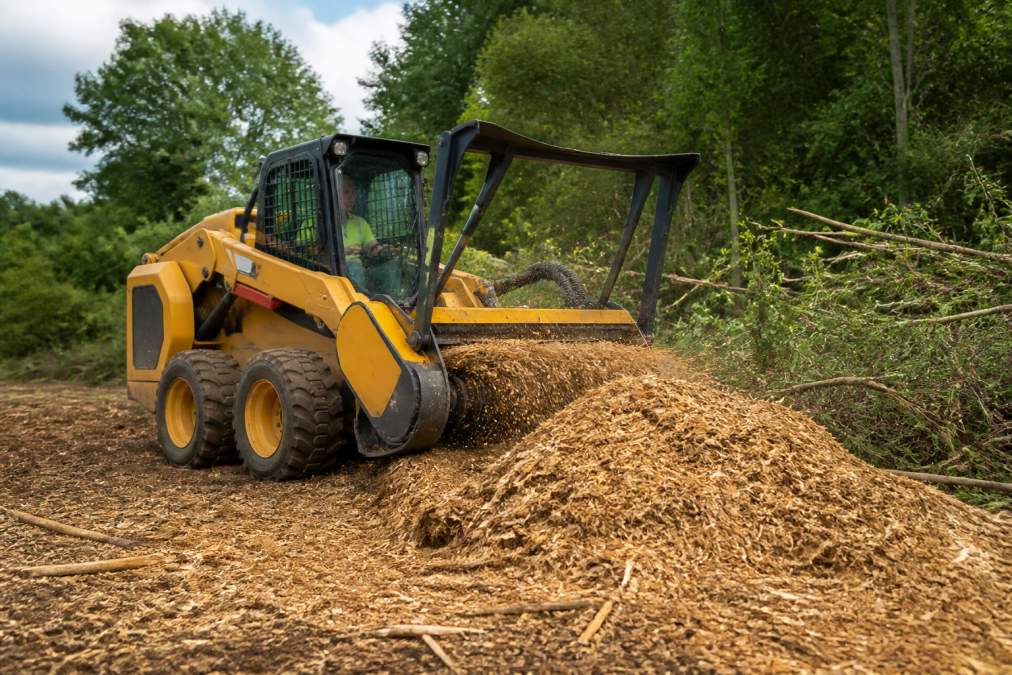
Forestry mulching is the most efficient land clearing debris disposal option for most residential and rural properties. A single machine grinds standing trees, brush, and stumps into wood chips that stay on site, handling clearing and disposal in one pass.
The mulch layer suppresses weed regrowth and retains soil moisture. As chips break down, they add organic matter to the topsoil, which matters for pasture or planting. No permits are required since nothing leaves the property and no burning occurs.
Hauling to a Permitted Landfill or C&D Facility
When you need the ground completely bare, hauling debris to a permitted landfill or C&D facility is the standard route. Clean vegetative debris is often accepted as inert waste, but fees are calculated by weight, making this the most expensive option for large acreage.
Load size and haul distance drive the cost. A single tree removal can produce several tons, and trucking that volume adds up quickly. Many facilities restrict what they accept, so stumps and root balls may require separate handling at a dedicated grinding facility.
Chipping and Grinding for Reuse or Removal
Chipping and grinding sits between mulching and hauling. A chipper processes brush into wood chips for pathways or compost, while a grinder reduces larger material like stumps into a form easier to haul or spread.
If you chip on site, you still need a use for the material. Wood chips can be spread as mulch, sold to a composting facility, or hauled away. Grinding stumps below grade leaves the site clean but does not enrich the soil the way a full mulch layer does.
Controlled Burning: Rules and Real Risks
Burning is the cheapest disposal method but carries the most regulatory baggage. Many localities restrict open burning of vegetative debris, and some prohibit it entirely during fire season. EPA air quality regulations also apply, and violating them can result in fines.
Beyond legal hurdles, burning destroys the organic matter your soil needs. The ash provides some minerals, but the carbon and structure mulch would have added are lost to smoke. Near structures or roads, fire risk alone often disqualifies this method.
Forestry Mulching Benefits Beyond Simple Disposal
The case for forestry mulching goes beyond convenience. By keeping debris on site, you avoid landfill fees, reduce truck traffic, and eliminate illegal dumping risk. The mulch layer also protects soil from erosion during heavy rain on freshly cleared slopes.
Soil health improves measurably as chips decompose. Earthworms and microbes break down wood fiber, releasing nutrients slowly into the root zone. For landowners converting brushland to pasture, the ground is ready to support grass sooner than a site stripped bare by bulldozers and hauling.
Ask your contractor whether the mulch layer will be left at full depth or partially incorporated into the soil. For pasture conversion, a shallower layer that breaks down faster is often better than a thick mat that suppresses grass seed germination for a season.
What Drives Land Clearing Debris Removal Cost
Most articles stop at saying “it depends.” This section gives you the framework for comparing financial trade-offs between hauling, renting a chipper, or on-site burial with a forestry mulcher. The right choice isn’t which is cheapest per ton, it’s which gives the best return on your total project budget.
The Cost Per Ton of Hauling
Hauling is the only method where you pay for weight. A typical load of mixed brush and small trees weighs 3 to 5 tons per dump truck. Tipping fees at a permitted C&D facility commonly range from $40 to $80 per ton (the EPA). Add trucking costs of $75 to $150 per hour, and a single day of hauling can run $1,000 to $2,500 before paying for the loader or labor.
Stumps change the math entirely. Many facilities cap the diameter they accept or charge a premium because stumps require separate grinding. For stumps larger than 24 inches across, expect a surcharge or a dedicated stump disposal facility that may be farther away.
The Cost Per Hour of Renting Equipment
Renting a chipper or grinder shifts your cost from weight to time. A towable chipper for 6-inch material rents for $250 to $450 per day at national chains. A larger, tracked grinder for stumps and whole trees runs $800 to $1,500 per day. Rental rates are daily, not hourly, if the machine sits idle, you’re paying for it.
You also need a way to feed the machine. A skid steer or compact track loader rental adds $300 to $600 per day, plus delivery fees. You are responsible for wear and tear: replacement blades and teeth for a mid-size chipper run $200 to $500.
The Flat-Rate Cost of Professional On-Site Mulching
Professional forestry mulching is typically quoted per acre or per hour, not per ton. The key advantage is that this price includes disposal, no tipping fees, no dump truck charges, no rental pickup deadlines.
A Simple Decision Matrix for Your Budget
| Scenario | Hauling | Chipper Rental | Professional Mulching |
|---|---|---|---|
| Under 1 acre, light brush | $400-$800 | $300-$600 | $1,500-$3,000 |
| 1-3 acres, mixed trees and stumps | $2,000-$5,000 | $1,200-$2,500 (plus labor) | $2,500-$6,000 |
| Over 3 acres, heavy stumps | $8,000+ (impractical) | $4,000+ (multiple days) | $5,000-$12,000 |
The hidden cost of DIY rental is your own labor. Clearing an acre of dense brush by hand-feeding a chipper takes 20 to 40 person-hours. At $50 per hour, that’s $1,000 to $2,000 of unpaid work never appearing on a rental receipt. Professional mulching compresses that timeline into a single day of machine time.
For most projects over one acre, professional on-site mulching is the cost-competitive option once you factor in tipping fees, equipment delivery, and your own labor. Hauling only wins when you have a small volume and the receiving facility is close. Rental only wins when you have the time and the physical capacity to feed the machine yourself.
The Cost of Getting It Wrong
A failed DIY disposal attempt has a real price. If you rent a chipper and discover your stumps are too large, you still pay the rental fee plus a second trip with a grinder. If a facility rejects your load for treated lumber or root balls with excessive soil, you pay the trip cost twice. Fines for burning without checking air quality permits routinely start at $1,000.
EPA Guidelines for Vegetative Debris Compliance
The EPA sets the federal framework for how vegetative debris may be handled, and state environmental agencies enforce those rules. Open burning of land clearing debris is regulated under air quality standards, and certain materials like treated lumber are classified as C&D debris that cannot be burned or spread on site (the EPA). The EPA guidelines on vegetative debris management outline what qualifies as clean wood versus construction waste.
State and local rules add another layer. Some jurisdictions classify large volumes of stumps and root balls as nonhazardous special waste, requiring disposal at specific facilities. Checking with your local planning office before you clear avoids a stop-work order or citation for illegal dumping.
Hauling debris to an unpermitted site to save money is illegal dumping. Penalties can include fines that far exceed the cost of proper disposal, and you remain liable for the material even after it leaves your property. Always verify that the receiving facility holds a valid permit.
How to Choose the Right Disposal Method for Your Site
Choosing a disposal method is about running your property through a sequence of filters that eliminate options one by one. The following five-step framework translates regulatory and operational realities into a clear decision path.
Step 1: Inventory What Is Actually in Your Pile
Walk the site and separate debris into three categories:
- Clean vegetative material, branches, leaves, brush, and trees without nails, wire, or treatment.
- Stumps and root balls, these are heavier, often contain soil and rocks, and face separate disposal restrictions.
- Construction debris, fencing, treated lumber, concrete, or metal that may have been hidden in the overgrowth. This material is governed by different rules and cannot be chipped, mulched, or burned.
A rough volume estimate matters too. A single mature oak tree produces 2 to 3 cubic yards of chipped material. A half-acre of dense brush can generate 50 to 100 cubic yards. If your pile exceeds 20 cubic yards, manual methods like a small garden chipper become impractical.
Step 2: Check Your Local Zoning and Permitting Rules
Before comparing costs, you must know which options are legal on your property. The federal EPA sets air quality standards, but your local county or municipal code determines enforcement. Here is a practical how-to for checking local rules:
- Find your county or city code online. Search for “[your county] code of ordinances vegetation” or “[your county] open burning regulations.” Most codes are available through sites like Municode or eCode360.
- Look for the chapter on fire prevention or air pollution control. This is where open burning restrictions live. Note whether burning is allowed year-round or only during specific seasons.
- Call your local planning or zoning office. Ask: “Do I need a permit to haul vegetative debris off my property?” and “Are there restrictions on burying or grinding stumps on site?” Many jurisdictions require a land disturbance permit if moving more than one acre of earth.
- Check with your local fire marshal if burning is on your list. Even where legal, you may need a burn permit and must follow setback rules from structures and property lines.
A common mistake is assuming that because your neighbor burned brush last year, you can too. Local ordinances change, and fire season restrictions can be enacted at any time. The cost of a phone call is zero; the cost of a citation for illegal burning can exceed $5,000.
Step 3: Assess Site Access and Terrain
Your disposal method must match your equipment reality:
- Can a dump truck reach the pile? If your clearing site is behind a narrow gate or down a steep slope, hauling becomes impractical or impossible.
- Is the ground firm enough for heavy equipment? A tracked mulcher exerts less ground pressure than a loaded dump truck, making it the better choice on wet or soft ground.
- Is there a flat area to stage a chipper? Chippers need a stable surface and a clear feed path. If your site is all slope, rental chippers become a safety hazard.
Step 4: Match the Method to Your End Use for the Land
The final use of your cleared land should drive your disposal choice:
| End Use | Recommended Method | Why |
|---|---|---|
| Pasture or hayfield | On-site mulching, shallow layer | The mulch layer retains moisture and adds organic matter; grass seed can germinate through a 2-3 inch layer within one season |
| Construction pad or building site | Hauling or grinding below grade | You need a stable, compactable surface; a thick mulch layer will decompose and cause settling |
| Driveway or access road | Chipping for reuse as base | Wood chips can be laid as a temporary driving surface, but they will break down and require topping |
| Wildlife habitat or woodland edge | On-site mulching, full depth | The thick mulch suppresses invasive weeds while native species establish |
| Sale or future development | Hauling to C&D facility | A clean, bare site is easier to survey and market; leftover debris complicates due diligence |
Step 5: Decide DIY Versus Professional
If your debris is mostly brush under 4 inches in diameter and you have a weekend available, a rental chipper is a reasonable DIY path. If your debris includes stumps over 12 inches across, trees over 20 feet tall, or material requiring a skid steer to move, equipment costs and safety risks shift the balance toward hiring a professional.
A good rule of thumb: if you need to rent more than one piece of equipment, professional service is likely more efficient. A professional forestry mulching contractor brings a single machine that cuts, grinds, and disposes in one pass, no separate chipper, loader, and dump truck required.
Run every disposal option through these five filters, debris type, local regulations, site access, end use, and equipment needs, before you compare prices. The method that survives all five filters is the right one for your property, regardless of what is cheapest on paper.
Conclusion: Turn Debris Into an Asset
The best land clearing debris disposal options keep your property working for you rather than turning your land into a temporary dump. On-site mulching converts brush and stumps into a soil-building layer, while hauling and burning remove material at higher cost or risk. The decision comes down to what you want the land to do after clearing.
Timber Shredders LLC pairs professional equipment with experienced operators to handle the full scope of your project, from the initial property assessment to the final pass. We restore access and visibility while improving soil health, so your cleared land is ready for pasture, construction, or a new driveway. Get a FREE quote.
Frequently Asked Questions
Is on-site mulching a better alternative to hauling debris away?
For most residential and rural properties, yes. On-site forestry mulching eliminates hauling fees and landfill tipping charges, and it returns organic matter directly to your soil. Hauling makes sense when you need the land completely clear of all material, when debris volume is small, or when you want to sell logs for timber. Compare the cost of equipment operation against per-ton hauling rates and disposal fees before deciding.
Can land clearing debris be burned on-site?
Burning is legal in many rural areas but is strictly regulated. You need a permit from your local fire marshal or department of forestry, and open burning is banned in many counties during ozone season or drought conditions. The EPA regulates burning of vegetative debris under clean air rules, and some states classify large piles as nonhazardous special waste. Check your local municipal codes before striking a match, and consider that mulching or chipping is often faster and safer.
How do I choose between a dumpster rental and professional debris removal services?
Dumpster rental works well for smaller, clean-out projects where you can load the debris yourself and the material is accepted at your local landfill. Professional removal services, including forestry mulching contractors, make sense for acres of brush, stumps, and mixed debris. They bring equipment that processes material on site, saving you days of manual labor. Get quotes for both approaches and factor in your time, equipment rental costs, and hauling fees.
What is the cheapest way to dispose of land clearing debris?
On-site chipping or mulching is typically the most cost-effective method because it eliminates hauling and landfill fees entirely. The equipment cost is a one-time expense, and the resulting wood chips can be spread across the property for soil enrichment. Burning is cheap only if you ignore the cost of permits, fire watch, and the risk of escaped fires. Hauling to a permitted landfill is usually the most expensive option once you add trucking and tipping fees.