Table of Contents
- What Forestry Mulching Does to Invasive Plants
- Species-Specific Results: Which Invasives Die and Which Come Back
- Preventing Invasive Plant Regrowth After Clearing
- Herbicide Application With Forestry Mulching: An Integrated Approach
- Post-Mulch Restoration: Replanting Native Species
- Equipment Limitations and When Mulching Is Not Enough
- Frequently Asked Questions
Last Updated: September 12, 2026
What Forestry Mulching Does to Invasive Plants
The short answer to the question does forestry mulching kill invasive plant species is: it depends on the plant. A tracked machine with a rotating drum grinds standing woody vegetation into mulch on the spot (fs.usda.gov). This guide from Timber Shredders LLC breaks down what it destroys, what survives, and how to hold the line.
Here’s the critical distinction most landowners miss: forestry mulching is not a kill method. It’s a reset button.
The machine shreds above-ground biomass into a mulch layer that suppresses some regrowth and feeds soil organisms. But the root systems of many invasive species survive, and the seed bank is untouched. That gap between what you see and what’s actually dead is the difference between a cleared property and one that looks identical in 18 months.
Above-Ground Control: What Gets Destroyed
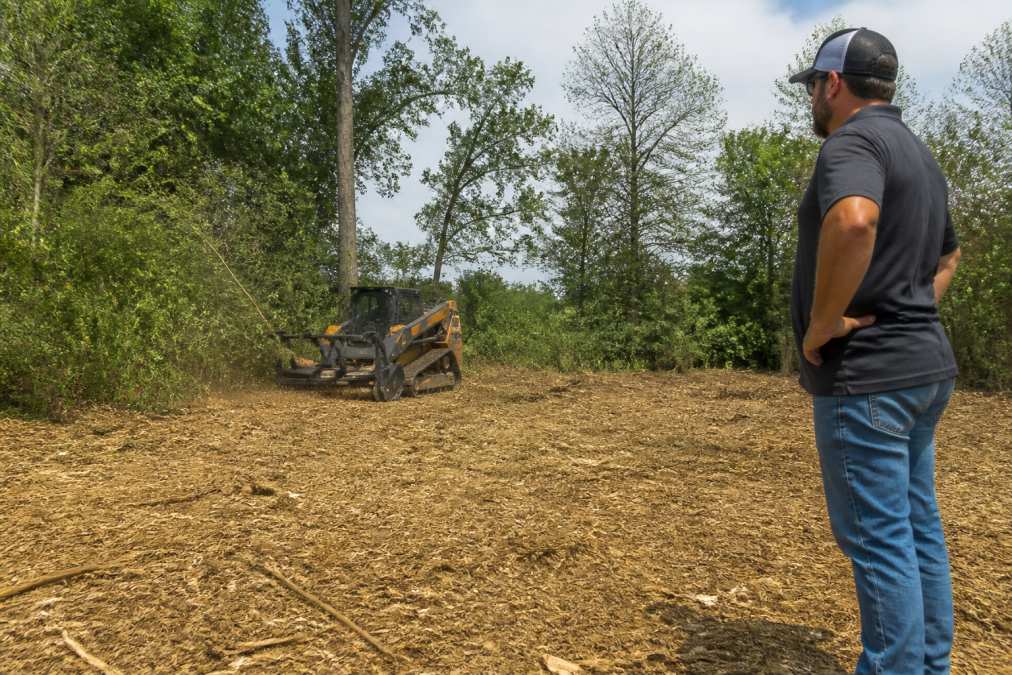
Everything above the soil line gets ground into chips. Stems, trunks, canes, vines, and leaf mass become a mulch layer a few inches deep. For shallow-rooted species and young woody vegetation, that often kills the plant outright.
The mulch layer blocks light from reaching the soil surface, suppressing germination of many seeds in the top inch or two, and moderates soil temperature and moisture, favoring the fungal and microbial activity behind nutrient cycling.
But a mulch layer is not a barrier. It’s a temporary obstacle.
What Survives: Roots, Rhizomes, and the Seed Bank
The root system is where the story changes. Species that spread through rhizomes, tubers, or deep taproots treat mulching as a pruning event, pushing up new shoots from stored reserves within weeks.
Then there’s the invasive seed bank. Many invasive plants produce thousands of seeds per plant, viable in soil for years (invasivespeciesinfo.gov). Mulching disturbs the surface layer, triggering germination by exposing buried seed to light and temperature swings.
Species-Specific Results: Which Invasives Die and Which Come Back
There is no universal answer to does forestry mulching kill invasive plant species because efficacy varies dramatically by species, the gap most service-provider content skips, and the one that determines whether your project succeeds. Here’s how common woody invasives respond to a single pass.
Species That Often Die From Mulching Alone
These plants regenerate primarily from seed or shallow surface roots, so grinding the crown and top few inches of root collar removes their recovery mechanism.
- Autumn olive (Elaeagnus umbellata). Nitrogen-fixing shrub with shallow lateral roots. Repeated cutting is a recognized control method, and mulching that severs the root crown below the soil line often kills it. Watch for bird-dispersed seed germination in the mulch.
- Multiflora rose (Rosa multiflora). Regrows from root crowns and seed but does not spread aggressively by rhizome. Cutting at the base and grinding the crown is effective; expect a flush of seedlings from the seed bank.
- Japanese barberry (Berberis thunbergii). Shallow-rooted, does not sucker from deep roots. Mulching that removes the crown is frequently sufficient, though deer-dispersed seed will germinate in disturbed soil.
- Young buckthorn (Rhamnus cathartica) and glossy buckthorn (Frangula alnus). Seedlings and saplings under roughly an inch in diameter often die when the root collar is ground out. Mature buckthorn is a different story, see below.
- Tree-of-heaven (Ailanthus altissima) seedlings. Small stems can be killed by grinding, but any established root system will sucker aggressively. Treat it as a re-sprouter, not a candidate for mulching alone.
Species That Reliably Re-Sprout After Mulching
These plants store energy in rhizomes, stolons, or deep taproots, and cutting top growth triggers a regenerative response. Mulching sets them back but does not kill them.
- Common buckthorn and glossy buckthorn (mature). Regrows vigorously from cut stumps and a persistent seed bank viable for years. A single pass typically produces denser, multi-stemmed regrowth.
- Japanese knotweed (Reynoutria japonica). Spreads through an extensive rhizome network extending well beyond the visible stand (PubMed). Grinding the canes spreads rhizome fragments, and each fragment can produce a new plant. This species is widely regarded as requiring herbicide integration.
- Kudzu (Pueraria montana). Deep, tuberous root system with running vines. Mulching knocks back top growth but tubers survive and re-sprout. Repeated defoliation over multiple seasons is required to exhaust root reserves.
- Tree-of-heaven (mature). Root suckers can emerge dozens of feet from the parent stem. Cutting without herbicide typically stimulates more suckering.
- Oriental bittersweet (Celastrus orbiculatus). Regrows from root fragments and a long-lived seed bank. Vines left in the mulch layer can re-root at nodes.
- Privet (Ligustrum spp.). Produces abundant seed and re-sprouts from cut stumps. Mulching alone rarely provides lasting control.
- Russian olive (Elaeagnus angustifolia). Regrows from root crown and root suckers, especially in riparian sites.
- Chinese privet and other Ligustrum species behave similarly, expect stump sprouting and heavy seedling recruitment.
Why the Difference Matters
A common mistake is assuming a clean-looking result means the plant is dead. Above-ground removal and root mortality are two separate outcomes. Cut a rhizomatous plant like knotweed or kudzu and you often stimulate denser regrowth than before.
This is why species identification should happen before the machine shows up. A stand of multiflora rose and barberry may be a one-pass job with light follow-up; knotweed or mature tree-of-heaven is a multi-year integrated program, and mulching is only the opening move.
Walk the site with a species list before scheduling the machine. Photograph leaves, stems, and any fruit or seed heads. Your state’s cooperative extension office or a regional invasive plant council can confirm identification and flag species that require herbicide integration.
A Quick Decision Rule
If the plant spreads by seed and shallow roots, mulching alone has a real chance of killing it. If it spreads by rhizome, stolon, tuber, or root sucker, assume it will come back and plan accordingly.
Preventing Invasive Plant Regrowth After Clearing
Preventing invasive plant regrowth after clearing requires a planned follow-up schedule, not a single treatment. The first 12 months decide the outcome.
Treat mulching as site preparation, not eradication: knock back the standing vegetation, then occupy the ground before invasives reclaim it. Three things drive success:
- Monitor aggressively. Walk the site every few weeks during the first growing season. Catch re-sprouts while small and their root reserves are low.
- Re-treat on a schedule. A single follow-up pass rarely finishes the job. Plan repeated spot treatment over at least two growing seasons.
- Occupy the ground. Bare soil invites reinvasion. Establishing desirable vegetation is the most durable regrowth management there is.
Skipping the first-season follow-up is the most expensive mistake in this process. Invasive plants that re-sprout and go to seed can rebuild a seed bank that takes years and repeated treatments to exhaust. One missed season can undo the entire project.
Timing Your Mulching Around Seed Set
Seasonal timing is one of the biggest levers you control.
The principle is simple: mulch before seed set. If you cut invasive plants after they’ve produced viable seed, you’re spreading the problem while you clear it. The mulch layer may suppress some germination, but you’ve just added fresh seed to the bank.
Late-season mulching, after seed dispersal, mostly resets the clock without reducing the seed load. Early-season mulching, before flowering and seed production, prevents that season’s seed contribution entirely. For root-resprouters, timing also affects how much stored energy the plant has when you cut it.
The practical takeaway: identify your target species’ seed-set window and schedule the work ahead of it. This decision influences how many follow-up treatments you’ll need.
Herbicide Application With Forestry Mulching: An Integrated Approach
Herbicide application with forestry mulching works best as part of an integrated pest management plan, not as a replacement for mulching or an afterthought. The two methods address different parts of the problem.
Mulching handles standing woody vegetation and above-ground biomass. Herbicide, applied correctly, targets what mulching can’t reach: the root systems of species that reliably re-sprout.
Two common sequencing approaches:
- Cut-stump or immediate post-cut treatment: applying herbicide to freshly cut surfaces while the plant is still actively translocating. Timing matters because the vascular system must be functioning to move the product to the roots.
- Foliar treatment on regrowth: letting the plant push fresh, vigorous growth, then treating the leaves when it’s most actively growing. This is often the more practical option after mulching, since you’re treating small, accessible re-sprouts rather than mature stands.
A few rules that matter more than product choice:
- Always follow the label. It’s a legal document, not a suggestion.
- Match the method to the species. Foliar treatment works well on some plants and poorly on others with waxy or hairy leaves.
- Treat when the plant is actively growing, not dormant.
- Coordinate with your state’s cooperative extension office for species-specific guidance and local restrictions.
The most effective window for foliar treatment on many woody invasives is late summer into early fall, when plants are translocating energy downward to their roots. Herbicide applied then moves with that flow instead of sitting on the surface. Confirm timing for your specific species before you spray.
Post-Mulch Restoration: Replanting Native Species
Post-mulch restoration converts a cleared site into a stable one. Without it, you’re just holding ground with repeated treatments forever.
Native plant restoration does two jobs at once: it occupies the niche invasives would otherwise fill, and it rebuilds the habitat and herbaceous layer that support pollinators, birds, and beneficial insects. A site left bare stays vulnerable.
What to plant depends on your goals and site conditions:
- For pasture conversion: establish a grass and legume mix suited to your soil and drainage.
- For woodland health: prioritize native understory species and seedlings that match the existing canopy.
- For habitat restoration: focus on a diverse mix of native flowering plants and shrubs that provide cover and forage.
Match species to your soil, light, and moisture conditions. A plant that struggles won’t outcompete anything. Your cooperative extension office can recommend species suited to your site and region.
Equipment Limitations and When Mulching Is Not Enough
Mulching has real limits, and knowing them prevents expensive surprises. A forestry mulcher is powerful, but it isn’t right for every site, and the machine’s configuration matters as much as the site itself.
Drum vs. Disc Mulching Heads
Two head designs dominate the market, and they behave differently on invasive stands.
- Drum heads use a cylindrical rotor with fixed or swinging teeth. They produce a finer, more uniform mulch, handle mixed vegetation and dirt contact better, and are the more common choice for land clearing and right-of-way work. On dense invasive stands, the finer chip size creates a tighter mulch mat that suppresses germination more effectively.
- Disc heads use a flat spinning disc with knives. They cut faster in light, uniform material and are more productive in open brush, but tolerate dirt, rocks, and mixed debris poorly and leave a coarser, less uniform mulch. On heavy, multi-stemmed invasive thickets, disc heads struggle to achieve the fine chip size that gives the mulch layer its suppression value.
For invasive species work, head choice affects both productivity and the quality of the mulch mat you leave behind. A finer mat suppresses more seed germination; a coarser mat leaves more gaps for regrowth.
Machine Size and Bite Size
Mulcher capability is usually described by horsepower and cutting width. A few rules of thumb:
- Compact carriers (roughly 60-90 hp) with a mulching head handle light brush, saplings, and thin-stemmed invasives. They’re maneuverable and good for selective work, but bog down in dense, multi-stemmed stands.
- Mid-size carriers (roughly 100-160 hp) are the common workhorse for land clearing. They handle most invasive thickets and small trees, but productivity drops sharply in heavy stem density.
- High-horsepower carriers (roughly 200 hp and up) are used for large-scale clearing, mature stands, and continuous production work.
“Bite size”, how much material the head removes per pass, is controlled by travel speed and rotor speed. Slower travel and higher rotor speed produce a finer mulch; faster travel leaves coarser material and more stem fragments capable of re-sprouting.
Where Mulching Falls Short
- Steep or wet ground. Traction and stability become safety issues, and some slopes can’t be worked safely by a tracked machine.
- Heavy rock and buried debris. Large rocks, old foundation remnants, and hidden stumps can stop a project or require a different approach. Drum heads tolerate incidental dirt contact better than disc heads.
- Very large diameter trees. Mulchers handle brush and smaller woody vegetation well; mature timber typically needs a different method.
- Deep-rooted, rhizomatous species. These often need herbicide integration or repeated treatment, not mulching alone.
- Dense monoculture stands of re-sprouters. A thick knotweed or kudzu stand may require multiple passes in the same season just to keep the machine productive.
Matching Equipment to the Job
A few practical pairings:
- Light, mixed brush with scattered invasives: compact carrier with a drum head, single pass, light follow-up.
- Dense multi-stemmed thickets (buckthorn, privet, autumn olive): mid-size carrier with a drum head, slow travel for a fine mulch mat, planned follow-up.
- Rhizomatous species (knotweed, kudzu, tree-of-heaven): mulching as site prep only, with herbicide integration and multi-season monitoring. Head choice matters less than the follow-up plan here.
- Rocky or debris-laden ground: drum head over disc head, or a different method entirely.
Here’s the practical takeaway: an honest site assessment before work starts separates a smooth project from a mid-job surprise. A machine that gets stuck or hits unexpected rock costs time and money. Knowing the ground, and matching head design and machine size to the species and density, means the right equipment and plan show up on day one.
Forestry mulching is the most efficient way to reset a site, but it’s one tool in an integrated plan. The properties that stay clear are the ones where the right machine and head, timed follow-up, herbicide where needed, and native replanting work together.
Frequently Asked Questions
Does forestry mulching kill invasive plant species permanently?
No. Forestry mulching kills the above-ground growth of most invasive plants, but species with deep root systems or rhizomes, such as kudzu, tree of heaven, and multiflora rose, often re-sprout within weeks. The mulch layer does suppress some seeds and weakens root reserves over repeated treatments. For permanent control, combine mulching with herbicide application and native replanting. Most properties need two to three follow-up treatments over 18 to 24 months to achieve lasting suppression.
What are the downsides of forestry mulching for invasive control?
The main downsides are re-sprouting, soil disturbance that can wake the invasive seed bank, and limited effectiveness on species that spread by root fragments. Mulching also leaves a thick layer of woody debris that can temporarily tie up nitrogen as it decomposes. On wet or steep sites, the equipment may not be able to reach every area. These limitations do not make mulching a bad choice, but they mean it works best as one part of an integrated vegetation management plan rather than a one-time fix.
Should invasive plants be treated with herbicide before forestry mulching?
For many invasive species, a foliar herbicide application three to six weeks before mulching improves results significantly. The herbicide translocates into the root system and weakens the plant before the machine cuts it down. This is particularly effective on woody vegetation like autumn olive and bush honeysuckle. Cut-stump treatment immediately after mulching is another option for stems the machine leaves behind. Always follow label directions and check with your state’s cooperative extension for timing recommendations in your area.
How does forestry mulching affect soil health and the invasive seed bank?
Forestry mulching leaves a mulch layer that protects topsoil from erosion, moderates soil temperature, and feeds nutrient cycling as it breaks down. Unlike a bulldozer, the machine does not scrape away the topsoil, so the herbaceous layer and beneficial soil organisms stay largely intact. However, the disturbance can trigger germination of dormant invasive seeds already in the soil. Monitoring the site for new seedlings in the first two growing seasons and removing them early keeps the seed bank from re-establishing invasive dominance.
Most invasive species don’t die from a single mulching pass, and pretending otherwise sets you up for regrowth. Timber Shredders LLC builds the whole plan: professional forestry mulching, a thorough property assessment, and clear project planning from estimate to completion so you can reclaim your property and keep it clear. Get started with Timber Shredders LLC and get a free quote for your land clearing project.