Table of Contents
- Why Clearing Wooded Land for Farming Needs a Plan
- Land Clearing Methods for Agriculture: Pros and Cons
- Assessing Your Land: Soil, Slope, and Permits
- Forestry Mulching Cost per Acre vs. Other Methods
- DIY vs. Hiring a Professional Land Clearing Service
- Soil Health Improvement After Land Clearing
- Pasture Establishment: Steps After the Trees Are Gone
- Next Steps: Get Your Free Property Assessment
- Frequently Asked Questions
Last Updated: September 5, 2026
Why Clearing Wooded Land for Farming Needs a Plan
Converting timberland into productive pasture or cropland fails more often from poor planning than from difficult terrain. Clearing heavily wooded land for farming is the process of removing trees, stumps, and brush to convert forested acreage into usable agricultural land. A thoughtful plan protects your topsoil, respects local regulations, and prevents erosion issues. The most common failure is treating every acre the same, when slope, soil type, and tree species all demand different approaches.
Before you price equipment or call contractors, walk the property and answer three questions: How steep is the ground? What is the soil like beneath the leaf litter? And what do local zoning rules require for agricultural conversion? The answers will shape every decision that follows, from which clearing method you choose to whether you need permits.
Below, we’ll walk through the methods available, and the steps you must take after the trees are gone to ensure your soil actually grows grass or crops.
Land Clearing Methods for Agriculture: Pros and Cons
Several methods can clear wooded land, and each leaves the property in a different condition. Heavy machinery like bulldozers and excavators removes trees quickly but can disturb soil structure, while forestry mulchers grind vegetation in place and leave the root system largely intact below grade.
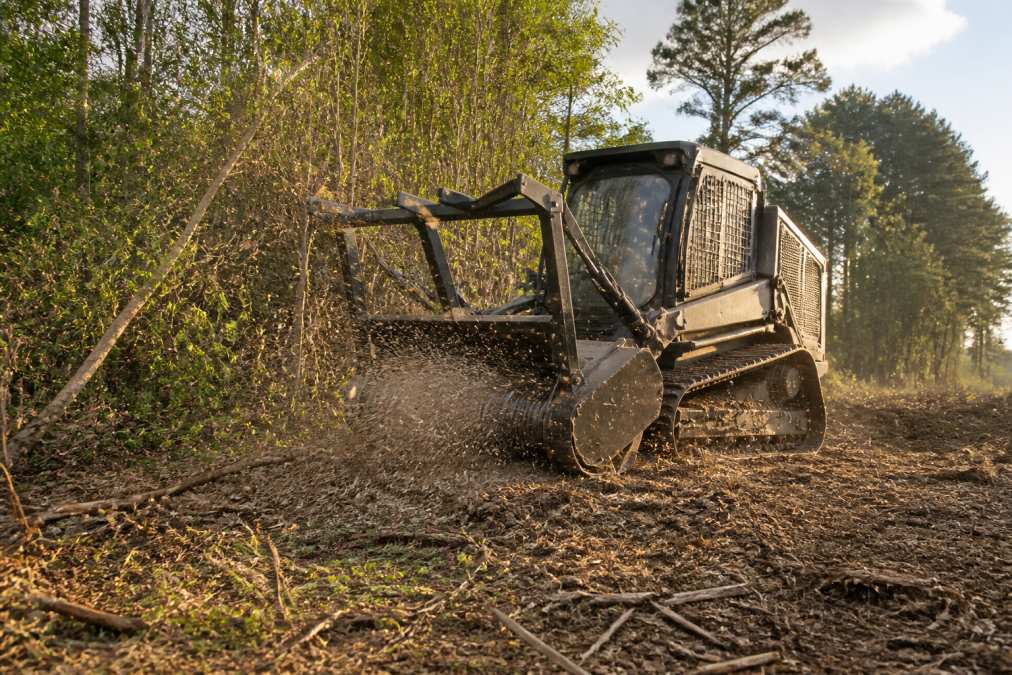
The choice between methods comes down to your end goal. If you need a clean, smooth surface for row crops, you may need bulldozing followed by grubbing. If you’re establishing pasture and want to preserve topsoil, mulching is often the better route.
Forestry Mulching vs. Bulldozing
Forestry mulching grinds standing trees and brush into mulch on site, leaving the soil structure intact. A mulcher’s rotating drum shreds vegetation down to ground level, and the resulting wood chips decompose and return organic matter to the soil. This method excels on slopes where bulldozers would cause erosion.
Bulldozing, by contrast, pushes trees over and often strips the topsoil layer along with them. It is faster on large, flat acreage with big timber, but the disturbance can expose subsoil that is poor for growing. The apparent speed advantage disappears when you factor in the cost of replacing lost topsoil.
Stump Removal and Grubbing Options
After the trees come down, stumps remain the biggest obstacle to farming. Grubbing is the mechanical removal of stumps and roots using an excavator or dozer with a root rake, and it is the standard approach when you need a tillable surface. Stump grinding is a cheaper alternative that shreds the stump below grade, but it leaves roots in the soil that can interfere with tilling for years.
For pasture land, grinding stumps to depth is often sufficient, since grass roots can grow around the remaining material. For cropland, grubbing is the more reliable choice. A skid steer with a grapple attachment can handle smaller stumps and debris cleanup on residential parcels.
Assessing Your Land: Soil, Slope, and Permits
A professional land clearing service starts with a property assessment before any equipment is scheduled. Slope determines whether you can safely operate heavy equipment and how vulnerable your soil is to erosion after clearing.
Soil quality is equally critical. Forest soils are often acidic and low in phosphorus, conditions that are fine for trees but hostile to pasture grasses. A soil test through your local cooperative extension office tells you the pH and nutrient levels you need to correct.
Zoning Regulations and Permitting
Clearing heavily wooded land for farming often triggers local oversight that new landowners don’t expect. Skipping this step is the fastest way to turn a farm project into a legal dispute. Here is the sequence most landowners should follow:
1. Confirm your property’s zoning and agricultural status. Your county planning or zoning office can tell you if your parcel is in an agricultural district, a rural residential zone, or under a conservation easement. Some jurisdictions require a special use permit or a land disturbance permit before you can clear more than one acre. A land survey is often necessary to confirm boundaries before equipment arrives, since clearing past your line can create costly disputes with neighbors.
2. Check for wetland and waterway restrictions. The U.S. Army Corps of Engineers regulates dredging and filling in wetlands under Section 404 of the Clean Water Act. If your wooded tract contains seasonal streams, vernal pools, or low-lying areas that hold water, you may need a jurisdictional determination before clearing. The Natural Resources Conservation Service (NRCS) and your local soil and water conservation district can help identify whether your land falls under these rules.
3. Investigate burning and debris disposal rules. Many rural counties allow open burning of cleared vegetation only during specific windows and require a permit from the state forestry commission or local fire marshal. Some states, like those in the Southeast, have seasonal burn bans during high-fire-risk months. If burning is restricted, you will need to budget for hauling debris to a disposal site or chipping it on location.
4. Review erosion and sediment control requirements. Most states require a Stormwater Pollution Prevention Plan (SWPPP) for any land disturbance exceeding a certain acreage threshold, often one acre. This plan must identify erosion control measures like silt fencing, straw blankets, or sediment basins before clearing begins. Your local soil and water conservation district can provide templates and often offers free technical assistance.
5. Understand federal cost-share and conservation programs. The NRCS administers the Environmental Quality Incentives Program (EQIP), which can provide financial and technical help for practices like prescribed grazing, riparian buffers, and forest stand improvement. In some cases, converting forest to pasture may disqualify you from certain programs, so it pays to consult with your local NRCS office before you clear.
Permitting is not optional. Fines for unpermitted land disturbance can run into the thousands of dollars, and you may be ordered to restore the land to its original condition at your own expense. A few hours at the county planning office is cheap insurance.
The USDA Natural Resources Conservation Service guidance on conservation practices offers a starting point for understanding federal programs that may support or restrict your conversion plans. Your county extension agent can also connect you with the right local agencies, since rules vary dramatically even between neighboring counties.
Forestry Mulching Cost per Acre vs. Other Methods
Pricing for land clearing varies widely by region, density of vegetation, and accessibility. Mulching leaves no slash piles to burn or haul, which eliminates a significant disposal expense. Bulldozing creates large debris piles that must be burned, buried, or trucked off site, and each of those options carries its own cost. When comparing quotes, ask contractors what is included: stump removal, debris disposal, and final grading are frequently excluded from base prices. The Virginia Cooperative Extension resources on land clearing and pasture establishment provides practical guidance on what post-clearing work your soil will actually need.
DIY vs. Hiring a Professional Land Clearing Service
The DIY route tempts many landowners because renting equipment seems cheaper than hiring a crew. The math changes when you account for the learning curve, the risk of equipment damage, and the hours required to clear even a single acre of dense woods. Mistakes can mean rutted soil, damaged trees you wanted to keep, or worse.
A professional service brings equipment matched to the job and operators who understand how to protect your topsoil. At Timber Shredders LLC, the process begins with a comprehensive property assessment, followed by clear project planning and estimates so you know the scope before work starts. The goal is to reclaim your property fast while leaving the land in condition for pasture, not a compacted mess that requires expensive remediation.
Soil Health Improvement After Land Clearing
Clearing is only the first phase of converting woods to farmland; the soil needs active rehabilitation before it will support healthy grass or crops. Heavy equipment compacts soil, forest floors harbor different microbial communities than pasture soils, and the nutrient profile of a wooded site is rarely suitable for forage or row crops.
Start with a Comprehensive Soil Test
Forest soils are typically acidic, with a pH around 4.5 to 5.5, while most pasture grasses prefer a pH between 6.0 and 6.5. A standard soil test through your cooperative extension office costs $10 to $25 and measures pH, phosphorus, potassium, calcium, magnesium, and organic matter content. Guessing at lime and fertilizer rates wastes money and can leave your new pasture thin and weedy for years.
When you receive your test results, look beyond pH. Forest soils are often deficient in phosphorus, which is critical for root development in new grass seedlings. Your extension report will recommend pounds of actual phosphorus (P2O5) and potassium (K2O) per acre, not just a bag count. Take those numbers to your local farm supply store and have them blend a custom fertilizer, or apply separate products to match the recommendation.
Correcting pH with Agricultural Lime
Applying agricultural lime raises soil pH, but the type and timing matter. Calcitic lime adds calcium without affecting magnesium levels, while dolomitic lime supplies both calcium and magnesium. Your soil test will indicate which is needed. Pelletized lime is easier to spread with a standard fertilizer spreader but costs more per ton than ag lime. The general rule is to apply lime 4 to 8 weeks before seeding, since it takes time to react with the soil. A typical recommendation for converting forest soil to pasture is 1 to 2 tons per acre, but only your soil test can tell you the exact rate.
Rebuilding Organic Matter and Soil Structure
Heavy machinery, especially bulldozers, can compact soil to the point where roots cannot penetrate and water pools on the surface. The wood chips left by forestry mulching break down over several seasons, improving soil structure and water retention, but they also tie up nitrogen temporarily as they decompose. Plan to apply extra nitrogen in the first year if you mulched heavily.
For compacted soils, a subsoiler or ripper pulled behind a tractor can break up the hardpan layer without inverting the soil profile. This is different from a moldboard plow, which turns the soil over and buries organic matter. Subsoiling to a depth of 12 to 18 inches, when the soil is dry enough to shatter, restores drainage and root penetration while preserving the topsoil you worked to protect.
Seeding a Cover Crop Immediately
Seeding a cover crop immediately after clearing protects bare soil from erosion and suppresses weeds while you prepare the final seedbed. Annual ryegrass or oats are fast-establishing options that hold soil in place over winter. Legumes like crimson clover add nitrogen but require a higher pH to thrive, so they are better suited to the second season after lime has had time to work. Erosion control measures like silt fencing or straw blankets may be required on slopes during this vulnerable period.
Take a second soil test 6 to 12 months after your initial lime and fertilizer application. Soil chemistry changes as amendments react, and a follow-up test tells you whether your adjustments worked or need fine-tuning before you invest in permanent pasture seed.
The [Virginia Cooperative Extension resources on land clearing(/land-clearing-permit-central-virginia/) and pasture establishment | ext.vt.edu] provides practical guidance on what post-clearing work your soil will actually need, including sample soil test reports and amendment calculators.
Pasture Establishment: Steps After the Trees Are Gone
Establishing pasture begins with final grading to smooth ruts and remove any remaining debris, then addressing soil fertility based on your test results. Work lime and fertilizer into the top few inches of soil, then choose a grass mix suited to your region and drainage.
The sequence matters: clear, grade, amend, seed, and then manage grazing carefully in the first year. New pasture should not be grazed until grasses are well established, typically after several months of growth. Mowing at the right height encourages tillering and thickens the stand.
| Phase | Key Action | Typical Timing |
|---|---|---|
| Clearing | Forestry mulching or grubbing | Late summer to early fall |
| Soil test | Test pH and nutrients | Immediately after clearing |
| Amendment | Apply lime and fertilizer | 4-8 weeks before seeding |
| Seeding | Plant pasture mix | Early fall or spring |
| Establishment | Mow and control weeds | First full growing season |
Next Steps: Get Your Free Property Assessment
Clearing heavily wooded land for farming is a multi-stage project, but the process becomes manageable when you break it into phases: assess, clear, amend, and establish. The landowners who succeed plan for soil health from day one rather than treating clearing as the finish line.
Timber Shredders LLC provides professional land management solutions for residential and rural properties throughout Central Virginia, specializing in forestry mulching, land clearing, and driveway installation. Our simplified process starts with a comprehensive property assessment and clear project planning, so you know exactly what your land needs before we begin.
Frequently Asked Questions
How much does it cost to clear 1 acre of heavily wooded land?
Costs vary significantly based on tree density, terrain, and the method used. Pricing for forestry mulching often depends on the specific project, as it completes stump removal and debris disposal in one pass, and it preserves topsoil. Get at least three itemized quotes and ask what happens if you encounter unexpected rocks or stumps mid-project. A written contract should specify debris handling and site restoration.
How long does it take to clear 1 acre of wooded land?
The time it takes to clear land depends on vegetation density and terrain. Bulldozing with a root rake may be faster on open ground but leaves you with stump removal and debris disposal tasks. Slopes, wet ground, and large-diameter trees slow any equipment. Ask your contractor for a timeline estimate based on a site visit, not a phone call.
Do I need permits to clear wooded land for agricultural use?
Most jurisdictions require permits before clearing land, even for agricultural conversion. Zoning regulations may protect wetlands, stream buffers, or steep slopes. Some states require a conservation plan for operations receiving agricultural tax breaks. Contact your local planning or zoning office before any equipment arrives. A professional clearing service can often guide you through the permitting process as part of the project.
How do I improve soil health after clearing land for farming?
Start with a soil test to establish a baseline for pH and nutrient levels. Forestry mulching leaves organic matter that breaks down and feeds soil biology, unlike bulldozing which strips topsoil. Add lime or fertilizer based on test results, then plant a cover crop to prevent erosion and build structure. Wait at least one growing season before planting your main crop or pasture grasses.
Getting your wooded acreage ready for farming is a significant investment of time and money. Working with an experienced team that protects your topsoil and handles the details makes the difference between a productive pasture and a costly disappointment. Timber Shredders LLC uses professional equipment and experienced operators to restore access and visibility while improving overall soil health. Get a free quote and start your property assessment today.
This article was written using GrandRanker