Table of Contents
- Understanding Site Prep for Central Virginia Construction
- Permitting and Virginia DEQ Construction Stormwater Permit Requirements
- Site Planning, Layout, and Property Survey
- Soil Testing for Construction Virginia and Subsurface Investigation
- Land Clearing, Grading, and Earthworks
- Drainage, Stormwater Runoff, and Site Stabilization
- Site Preparation Checklist for Homeowners and Developers
- Land Clearing Costs in Virginia and Cost Estimation Breakdown
Site Prep for Central Virginia Construction: Complete Guide
Last Updated: August 4, 2026
Site prep for central virginia construction is the foundation that determines whether your building project succeeds or fails. Get it wrong, and you’re looking at delayed timelines, cost overruns, and structural problems that emerge months after construction begins. At Timber Shredders LLC, we’ve worked with property owners and developers throughout Central Virginia, and we’ve seen firsthand how proper site preparation separates projects that run smoothly from those that spiral into chaos.
This guide walks you through every critical step of site prep for central virginia construction, from initial planning through final stabilization. We’ll cover permitting requirements, soil testing, land clearing, drainage systems, and the specific regulatory nuances that apply to your county. Below, you’ll find actionable checklists, cost considerations, and insider tips that most contractors won’t tell you until problems emerge on-site.
Understanding Site Prep for Central Virginia Construction
Site preparation is the process of readying raw land for building. It involves evaluating the property’s existing conditions, obtaining permits, clearing vegetation and debris, testing soil integrity, establishing proper drainage, and stabilizing the ground to support foundations, utilities, and construction equipment.
In Central Virginia specifically, site prep demands attention to three major factors: the region’s varied topography (ranging from flat piedmont areas to more rolling terrain), Virginia’s strict environmental regulations, and county-specific requirements that vary from Albemarle to Henrico to Louisa. Poor site preparation leads to foundation settling, water damage, erosion problems, and regulatory fines. Professional site prep costs money upfront, but it prevents exponentially larger expenses later.
Start your site prep assessment at least 90 days before your planned construction start date. This gives you time to obtain permits, conduct testing, and address any unexpected soil or drainage issues without rushing through critical decisions.
Permitting and Virginia DEQ Construction Stormwater Permit Requirements
Before moving a single shovel of dirt, you need permits. Virginia’s Department of Environmental Quality (DEQ) administers stormwater regulations for construction sites, and non-compliance carries serious penalties.
Virginia DEQ Construction Stormwater Permit Requirements apply to projects that disturb one acre or more of land. If your site prep involves grading, excavation, or land clearing that exposes soil, you’ll likely need a Stormwater Pollution Prevention Plan (SWPPP) and a permit.
The Virginia DEQ construction stormwater permit process requires you to:
- Prepare a detailed SWPPP that identifies erosion and sediment control measures
- Submit the permit application with site plans showing stormwater runoff paths
- Install erosion control devices before ground disturbance begins
- Conduct regular inspections during construction
- Document compliance and maintain records
The timeline for permit approval typically ranges from 10-30 days, depending on application completeness and local backlog. Common mistakes include underestimating the scope of disturbance or failing to identify all stormwater discharge points.
Skipping the Virginia DEQ construction stormwater permit because your project seems “small” is a costly gamble. Violations result in fines up to $10,000 per day of non-compliance, plus mandatory project shutdown until corrective action is completed.
County-Specific Regulatory Nuances in Central Virginia
Central Virginia’s counties, Albemarle, Charlottesville, Fluvanna, Goochland, Henrico, Louisa, Orange, and surrounding areas, each maintain their own zoning codes, grading ordinances, and stormwater standards.
Albemarle County enforces strict hillside development standards and requires geotechnical assessments for slopes exceeding 25%. Henrico County maintains detailed grading and erosion control standards with mandatory inspections at specific construction phases. Louisa County requires detailed site plans for commercial or multi-unit development with longer permitting timelines (45-60 days). Fluvanna County prioritizes groundwater protection and requires detailed well and septic system designs.
Contact your specific county’s planning and zoning department before finalizing your site design. A 30-minute conversation with the zoning administrator can prevent weeks of redesign work later.
Site Planning, Layout, and Property Survey
A professional property survey is non-negotiable. It identifies property lines, existing easements, utility locations, and natural features like streams or wetlands.
Site planning involves three core elements: Building Layout (where the structure sits, accounting for setback requirements and drainage), Access and Circulation (how construction equipment reaches the site and where materials stage), and Utility Coordination (locating water, sewer, electric, gas, and communications lines). Call 811 before any ground disturbance; it’s free and legally required.
A comprehensive site plan should include topography (showing elevation changes), existing vegetation, proposed grading contours, drainage patterns, and utility locations.
Request a detailed topographic survey if your property has slopes greater than 10%. Topography drives grading costs, drainage design, and foundation requirements.
Soil Testing for Construction Virginia and Subsurface Investigation
Soil conditions determine how deep you can dig, what foundation type you need, how well water drains, and what compaction is achievable.
Soil testing for construction Virginia typically includes Geotechnical Assessment (evaluating soil composition, bearing capacity, and settlement characteristics), Perc Testing (measuring how quickly water drains through soil, essential for septic system design), and Subsurface Investigation (boring or test pits revealing soil layers, groundwater depth, and potential contaminants).
Most Central Virginia properties require at least a basic geotechnical assessment and perc test. The cost ranges from a few hundred dollars to several thousand, depending on property size and complexity. This is money well spent; foundation problems cost tens of thousands to repair.
Understanding Perc Testing and Geotechnical Assessment
Perc testing measures how many inches of water percolate through soil in one hour. Virginia’s Department of Health requires specific perc rates for septic system approval. If your property fails the perc test, you have limited options: engineered septic systems (expensive), alternative treatment systems, or connecting to municipal sewer if available.
Geotechnical assessment analyzes soil composition, density, moisture content, and bearing capacity. This determines whether your foundation can safely support the structure weight. In areas with poor soil (high clay content, low bearing capacity), you may need deeper foundations or special construction methods.
Central Virginia’s soil varies dramatically. Piedmont areas often have dense clay soils with poor drainage but good bearing capacity. Areas closer to streams may have silt or sandy soils with better drainage but lower bearing capacity. The Blue Ridge foothills feature bedrock close to the surface, which complicates excavation but provides excellent foundation support.
If your perc test fails or your geotechnical assessment reveals poor bearing capacity, don’t panic, but do budget for solutions. Engineered septic systems, deeper foundations, or soil stabilization add cost but are standard in areas with challenging conditions.
Land Clearing, Grading, and Earthworks
Once permits are approved and soil testing is complete, physical site preparation begins. Land clearing removes trees, brush, stumps, and debris. Grading reshapes the land to accommodate buildings, roads, and drainage.
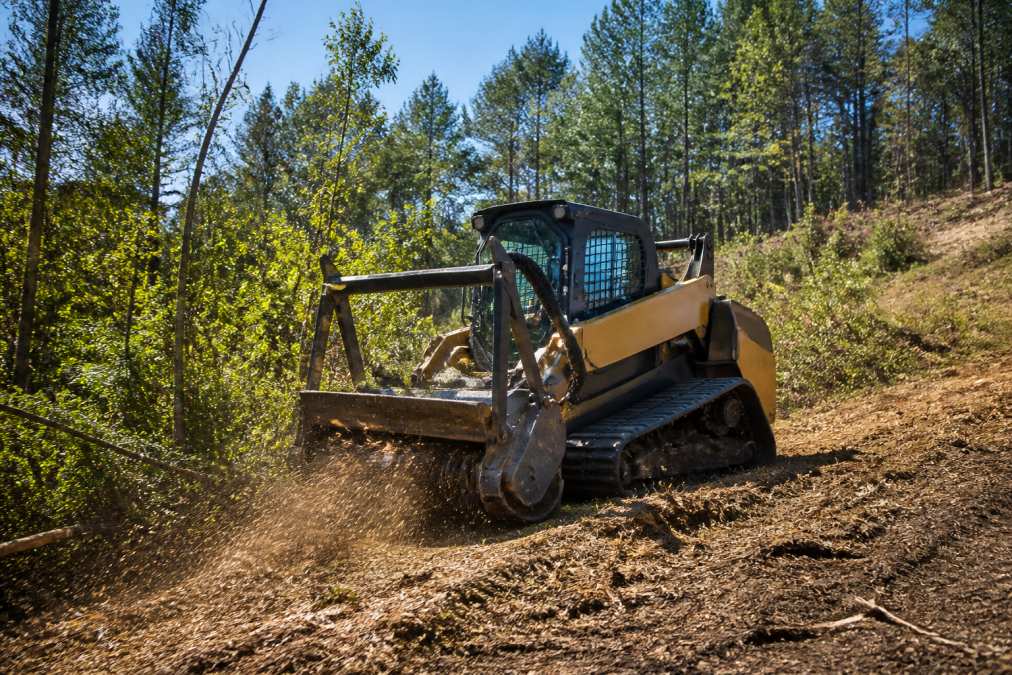
Land clearing in Central Virginia often involves dense brush, mature trees, and rocky soil. Forestry mulching, grinding vegetation in place, preserves soil structure and eliminates debris piles.
Grading accomplishes several goals: creating building pads, establishing drainage slopes, compacting soil, and removing poor-quality material. Proper grading requires equipment operators with experience reading contours and understanding how water moves across terrain.
Earthworks includes excavation for foundations, utility trenches, and drainage systems. Trench safety is critical; OSHA standards require proper sloping or shoring for any trench deeper than 5 feet. Compaction is essential, soil must be compacted to specified density (typically 95% of maximum dry density) to prevent future settling.
Erosion Control and Sediment Management During Excavation
Erosion and sediment control protects water quality and prevents regulatory violations. During excavation and grading, exposed soil erodes easily, and sediment enters storm drains and streams.
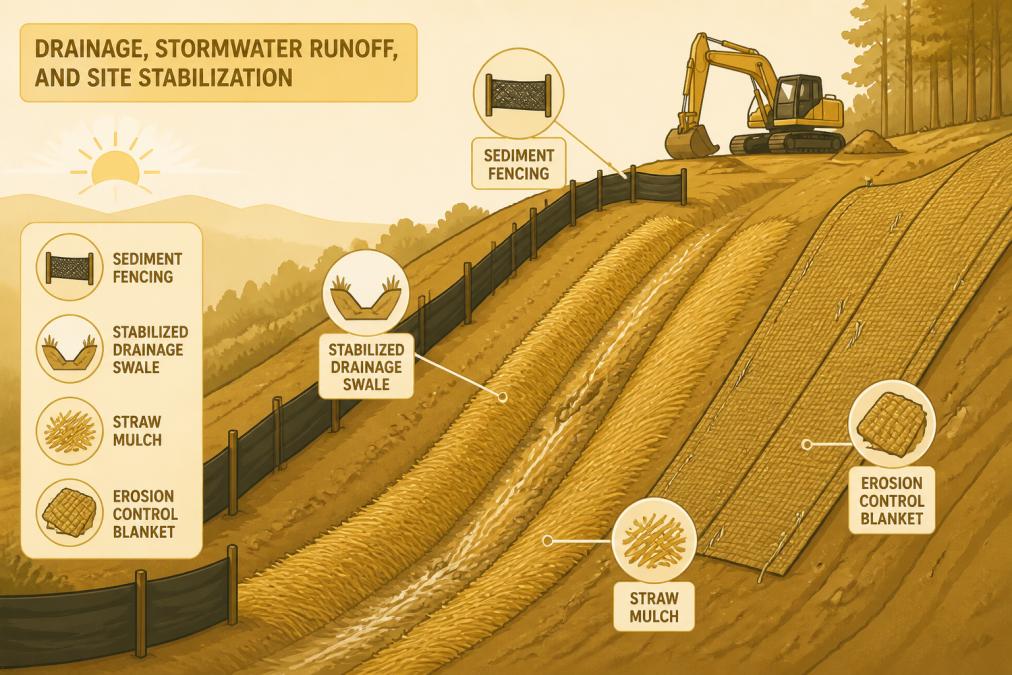
Erosion control uses physical barriers: sediment fencing, silt fence, erosion control blankets, and inlet protection. Sediment management removes sediment-laden water through sediment basins, sediment traps, and street sweeping.
Virginia DEQ regulations require erosion and sediment control measures to be installed before ground disturbance begins. Installation after work has started is ineffective and constitutes non-compliance. Sediment control requires active management throughout construction, not “set it and forget it.”
Drainage, Stormwater Runoff, and Site Stabilization
Proper drainage prevents water from pooling near buildings, eroding slopes, or flooding neighbors’ properties. Site drainage directs water away from structures through grading, swales, and French drains. Stormwater runoff from developed sites increases significantly compared to undisturbed land, requiring managed discharge. Site stabilization involves establishing vegetation or other covers on exposed soil to reduce erosion.
Central Virginia’s terrain creates drainage challenges. Properties with slopes shed water quickly, potentially causing erosion. Flat properties may have poor natural drainage, requiring engineered solutions. Properties near streams must manage runoff carefully to avoid violating stream buffer regulations.
Retention ponds or bioretention areas may be required to manage stormwater volume. Design must account for Central Virginia’s rainfall patterns; the region receives 40-45 inches annually, with intense storms in spring and early summer. Proper drainage also protects building foundations by preventing water pooling and hydrostatic pressure.
Site Preparation Checklist for Homeowners and Developers
Before construction begins, verify that all site prep tasks are complete:
| Task | Status | Responsible Party | Deadline |
|---|---|---|---|
| Property survey completed | ☐ | Surveyor | Before permitting |
| Permits obtained (building, stormwater, grading) | ☐ | Developer/Owner | Before ground disturbance |
| Soil testing completed (geotechnical, perc test) | ☐ | Engineer/Soil evaluator | Before final design |
| Utilities located and marked (call 811) | ☐ | Utility locating service | Before excavation |
| Erosion control installed | ☐ | Contractor | Before disturbance |
| Land clearing completed | ☐ | Contractor | Per schedule |
| Grading and compaction finished | ☐ | Contractor | Per schedule |
| Drainage systems installed | ☐ | Contractor | Before stabilization |
| Site stabilization completed (seeding/mulch) | ☐ | Contractor | Within 14 days of disturbance |
| Final inspection passed | ☐ | Building official/DEQ | Before building work begins |
Each item represents a critical gate; don’t proceed to the next phase until the current phase is verified complete and compliant.
Land Clearing Costs in Virginia and Cost Estimation Breakdown
Site prep costs vary dramatically based on property size, existing conditions, and complexity.
Land clearing costs depend on vegetation density, tree size, and debris handling. A lightly vegetated one-acre property might cost a few hundred dollars to clear. A densely wooded three-acre property could cost several thousand. Forestry mulching typically costs less than traditional bulldozer clearing because it eliminates hauling and disposal fees.
Grading and earthworks costs scale with property size and topography complexity. Flat properties require minimal grading. Sloped properties with significant elevation changes require more equipment time and material handling. Rock or clay soils that resist excavation cost more than sandy soils.
Soil testing and permitting add several hundred to a few thousand dollars. Drainage system installation ranges from simple swales (low cost) to engineered retention ponds (significant cost). Erosion control costs depend on site size and slope.
A realistic site prep budget for a typical residential property in Central Virginia ranges from several thousand dollars for straightforward projects to $15,000-$30,000+ for complex sites with significant grading, poor drainage, or difficult soil conditions. The most cost-effective approach is investing in proper planning upfront.
Environmental Sustainability Practices in Site Prep
Modern site prep increasingly incorporates sustainability practices that reduce environmental impact while often lowering long-term costs.
Forestry mulching preserves topsoil and organic matter, improving soil health. The mulch layer suppresses weeds and retains moisture. Native vegetation stabilization uses native plant species to stabilize slopes and manage stormwater, requiring less maintenance than simple seeding. Permeable surfaces for driveways and parking areas allow water infiltration, reducing stormwater runoff. Stormwater infiltration through rain gardens or bioretention areas filters runoff naturally. Minimal disturbance practices limit clearing and grading to only necessary areas, preserving existing vegetation and soil structure.
These sustainability practices typically increase upfront costs by 5-15% but deliver environmental and financial benefits over the property’s lifetime.
Site preparation is not glamorous, but it’s absolutely essential. Getting it right requires understanding your specific property conditions, navigating regulatory requirements, and coordinating multiple specialists. Timber Shredders LLC brings professional land management expertise to this critical phase, from initial property assessment through final site stabilization. Our team handles land clearing, grading, and site stabilization using equipment and methods that preserve soil health while meeting all regulatory standards. Ready to start your project on solid ground? Get a FREE quote from Timber Shredders LLC and let’s build your site prep plan together.
Frequently Asked Questions
What exactly is included in site prep for construction in Central Virginia?
Site prep for Central Virginia construction typically includes property survey and topography mapping, soil evaluation and perc testing, land clearing and grubbing, grading and compaction, erosion control and sediment management, drainage and stormwater runoff planning, utility connection preparation, and foundation preparation. The specific scope depends on your project type, property size, and local zoning requirements. Professional site prep ensures compliance with Virginia DEQ regulations and prevents costly problems during construction.
Do I need a Virginia DEQ construction stormwater permit for my project?
Most construction projects disturbing one acre or more require a Virginia DEQ construction stormwater permit. Even smaller projects may need permits depending on your county’s local ordinances and proximity to sensitive areas. Contact your county planning department or DEQ regional office to confirm requirements for your specific property. Skipping this step can result in fines and project delays, so verify early in the planning process.
How much does soil testing for construction cost in Virginia?
Soil testing for construction Virginia includes certified soil evaluation, perc testing, and geotechnical assessment. Costs vary based on property size, soil complexity, and test type. For accurate pricing on your specific project, request a free site assessment. Soil testing prevents expensive foundation problems and ensures your site drainage design meets Virginia requirements. It’s one of the most important investments you can make before breaking ground.
Will forestry mulching damage my topsoil like a bulldozer would?
Professional forestry mulching preserves topsoil far better than traditional land clearing methods. The process grinds vegetation in place rather than scraping and removing it, leaving nutrient-rich mulch on site that improves soil health. This approach also reduces erosion risk and sediment runoff, which is critical for Virginia DEQ compliance. Inexperienced operators using wrong equipment can cause problems, which is why choosing qualified professionals matters for protecting your land.
This article was written using GrandRanker