Table of Contents
- Typical Timeline for Land Clearing Per Acre
- Factors That Affect Land Clearing Speed
- Residential vs. Commercial Clearing Timelines
- Land Clearing Cost Per Acre and Budget Planning
- Forestry Mulching vs Bulldozing: Speed and Results
- Site Preparation for New Construction Projects
- Seasonal Impact and Permitting Considerations
- Conclusion
Last Updated: August 18, 2026
Typical Timeline for Land Clearing Per Acre
Most residential land clearing projects take between 3 to 5 working days per acre, depending on vegetation density, site access, and equipment used. Commercial or heavily wooded sites may require 5 to 10 days per acre or longer. At Timber Shredders LLC, we’ve found that property owners often underestimate clearing timelines, a single acre of thick brush, old stumps, and tangled vegetation can consume a full week of professional equipment operation. The difference between fast and slow projects comes down to three factors: vegetation density, equipment access, and underground surprises. Understanding realistic timelines matters because it affects your budget, planning, and project schedule. Weather interruptions, equipment repositioning, and debris removal can extend timelines beyond initial estimates.
Factors That Affect Land Clearing Speed
Vegetation Density and Tree Size
Dense vegetation and large trees are the primary drivers of clearing time. A quarter-acre of light brush might take a few hours, while the same area packed with 40-year-old oaks and dense understory could take 2-3 days. Small trees (under 6 inches diameter) process quickly with forestry mulching equipment. Medium trees (6-12 inches) take significantly longer. Large timber (over 12 inches) requires additional processing time or separate heavy equipment. Mixed vegetation creates the longest timelines because equipment must work in multiple passes.
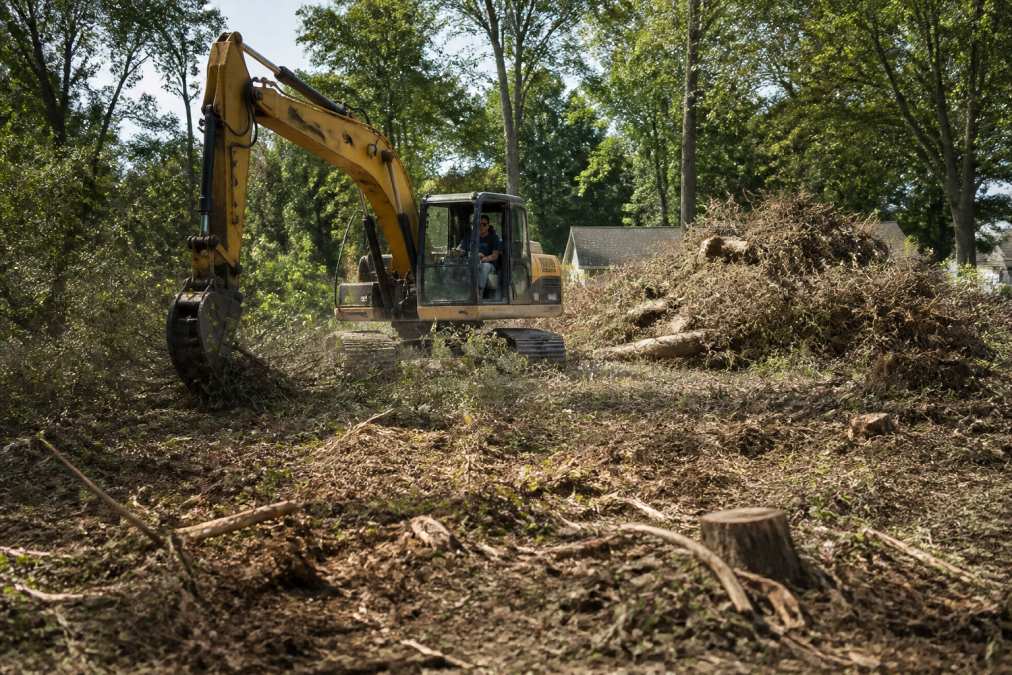
An acre with scattered trees across open ground clears faster than one where trees and brush cover nearly every square foot. When vegetation is so dense that equipment can barely move through it, operators must work more slowly to avoid getting stuck or damaged.
Site Access and Topography
Equipment can only work if it can reach the property and move across it. Poor site access is one of the biggest timeline killers. Narrow, rough, or nonexistent driveways require preliminary work just to create access routes. Steep terrain slows clearing significantly, bulldozers and excavators on slopes operate cautiously to prevent rollover, and forestry mulching equipment must work in careful passes. Existing obstacles like fences, power lines, structures, or utility markers force operators to work around them, adding time and complexity.
Soil Conditions and Hidden Obstacles
Rocky soil, clay, or compacted earth slows equipment operation. Rocks and boulders encountered during clearing can damage equipment or force manual removal. Properties with extensive rocky terrain often take 25-40% longer than similar-sized lots with sandy or loamy soil. Hidden obstacles, old fence posts, metal debris, concrete foundations, or buried rocks, discovered mid-project force work stoppages for removal or repositioning. Wet or muddy soil extends timelines dramatically; equipment gets bogged down and risks getting stuck. Projects in spring or after heavy rain often take 50% longer than the same work in dry conditions.
Residential vs. Commercial Clearing Timelines
Residential land clearing typically involves smaller properties (0.5 to 5 acres) with mixed vegetation and moderate obstacles. Most residential projects take 2 to 10 working days total, depending on acreage and site conditions. A typical 1-acre residential lot with moderate brush and a few trees clears in 3 to 5 days.
Commercial and development projects are larger in scale (5 to 50+ acres) and often involve site preparation for construction. A 10-acre commercial site might take 3 to 4 weeks of continuous work. While per-acre timelines can be faster for large commercial jobs due to equipment efficiency across larger continuous areas, the total project duration is much longer. Residential projects often encounter more obstacles and utilities that slow work, while commercial sites typically require more precise grading and debris management despite larger equipment.
Land Clearing Cost Per Acre and Budget Planning
Understanding Cost Variables
Land clearing cost per acre varies dramatically based on site-specific conditions. A straightforward brush clearing on accessible land might cost $500-$1,500 per acre, while dense timber removal on steep terrain with poor access can exceed $3,000-$5,000 per acre. Only professional site evaluation yields accurate pricing.
Primary cost drivers include:
- Vegetation density and tree size: Light brush clears faster and cheaper than dense timber. Small trees cost significantly less than large timber. Mixed vegetation requiring multiple equipment passes increases costs.
- Site access: Properties requiring preliminary work to create equipment access routes cost more. Narrow driveways, steep slopes, or no existing access add $500-$2,000+ to project costs.
- Soil conditions: Rocky soil, clay, or compacted earth slows equipment operation and increases wear, raising costs by 20-40%. Hidden obstacles discovered during work can add unexpected expenses.
- Debris removal and disposal: Some contractors include hauling debris off-site; others charge separately. On-site chipping is cheaper than removal but leaves material to manage.
- Forestry mulching vs. bulldozing: Forestry mulching costs 10-30% more per acre than bulldozing but leaves soil in superior condition and eliminates separate debris removal costs.
- Equipment requirements: Specialized equipment costs more to operate than standard equipment.
DIY Equipment Rental vs. Professional Contractor
Many property owners consider renting equipment and clearing land themselves. Equipment rental costs range from $150-$700/day depending on equipment type. A typical 1-acre residential project might require 3-5 days of equipment rental, plus fuel, operator time, and disposal fees, totaling $2,000-$5,000 before your labor and disposal costs. Professional contractor costs for the same project: $1,500-$3,500 total, including labor, equipment, and debris removal.
Why DIY rarely saves money:
- Operator skill gap: Inexperienced operators work slowly, risk equipment damage, and may damage your property. Professionals complete work 2-3 times faster.
- Equipment damage liability: Rental agreements hold you liable for damage. Hitting hidden rocks or utilities can cost $500-$5,000+ in repairs. Professionals carry insurance.
- Disposal costs: Renting dump trucks or paying disposal fees adds $300-$1,500 to DIY projects.
- Permitting and compliance: Professional contractors know local requirements. DIY clearing violating regulations can result in fines or work stoppages.
- Time investment: Professionals complete 1-acre projects in 3-5 days. DIY projects stretch over weeks or months, delaying your plans.
DIY clearing is viable only for very small projects (under 0.25 acres) with light brush, no trees, and flat terrain. For anything larger or more complex, professional clearing saves money and delivers superior results.
Budget Planning and Cost Surprises
Reputable contractors provide detailed estimates after site evaluation. Avoid contractors quoting only per-acre rates without visiting your property. Add 10-20% to your estimated clearing cost for unexpected conditions discovered during work.
Debris management options:
- Hauling off-site: $300-$800 per truckload. A 1-acre project might generate 2-4 truckloads.
- On-site chipping: $200-$400/day equipment rental. Material stays on-site as mulch.
- Burning: Free but requires permits and is prohibited in many areas during fire season.
- Leaving piles: Cheapest option but leaves land unusable.
Clarity on debris handling prevents budget overruns. Larger projects (5+ acres) can cost $10,000-$30,000+. Some contractors offer payment plans or coordinate with construction lenders.
Forestry Mulching vs Bulldozing: Speed and Results
Forestry mulching uses specialized equipment that grinds vegetation into fine mulch material on-site, processing 0.5 to 1.5 acres per day depending on vegetation density. The mulch stays on-site, enriching soil, reducing erosion, and improving future usability. Equipment operates with minimal soil disturbance, preserving topsoil and reducing compaction.
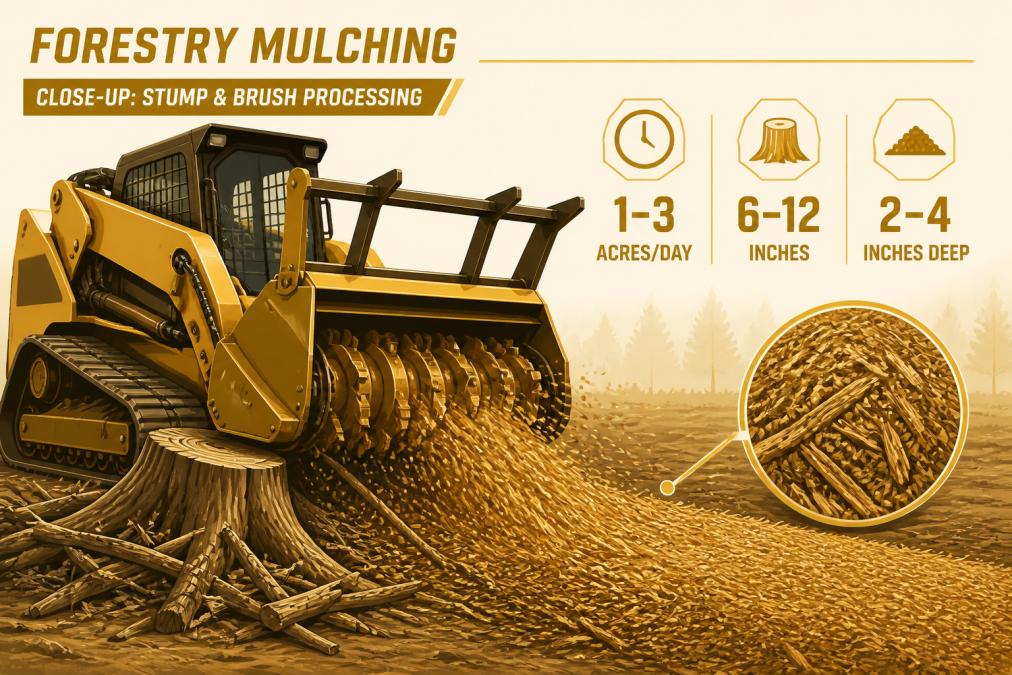
Bulldozing is faster, capable of clearing 1.5 to 3 acres per day, but leaves land in rougher condition. Bulldozers push vegetation into piles requiring separate removal. The process causes significant soil compaction and disturbance, requiring extensive remediation before construction or pasture use. For residential properties seeking improved soil health and land usability, forestry mulching delivers better long-term results despite taking longer. For large commercial development where land will be regraded anyway, bulldozing’s speed advantage makes sense. Timber Shredders LLC specializes in forestry mulching because it delivers superior outcomes for residential and rural properties.
Site Preparation for New Construction Projects
Construction projects require site preparation beyond simple vegetation removal, including grading, soil stabilization, debris removal, and potential environmental compliance. Site preparation timelines for construction typically run 1 to 3 weeks for residential projects. The clearing phase itself represents only part of the total site preparation timeline.
Proper site preparation prevents costly construction delays. Inadequate clearing or grading discovered after construction begins can halt work for weeks. Professional land clearing contractors coordinate with builders to ensure the site is truly ready before construction equipment arrives. Soil compaction and erosion control become critical for construction sites. Forestry mulching leaves soil in better condition for construction, reducing post-clearing preparation work.
Seasonal Impact and Permitting Considerations
Seasonal Timing and Virginia’s Climate Impact
Seasonal timing significantly affects land clearing timelines and equipment performance in Virginia.
Spring (March-May): Spring rainfall and snowmelt create saturated soil conditions that severely hamper equipment operation. Heavy clay soils become nearly impassable when wet. Equipment sinks, loses traction, and risks getting stuck, forcing operators to work at 40-60% normal speed or suspend work entirely. Contractors typically experience 3-5 week delays on spring projects. Late spring (May) after soil dries offers excellent clearing windows.
Summer (June-August): Dry ground allows equipment to operate at full efficiency. Visibility is excellent for identifying hazards. Most contractors schedule their heaviest workload for June through August because soil conditions are optimal. A project that might take 10 days in spring can often be completed in 5-7 days during summer.
Fall (September-November): Soil moisture is moderate and temperatures comfortable. Early fall (September-October) is ideal. Late fall (November) brings increasing rain and occasional early frost, reducing equipment traction.
Winter (December-February): This region rarely experiences sustained frozen conditions. Instead, winter typically brings wet, muddy soil interspersed with freeze-thaw cycles that create treacherous footing. Most contractors experience 25-50% timeline extensions during winter months and often pause projects during heavy snow or ice events.
Forestry mulching equipment, which relies on precise ground contact and traction, is most affected by wet soil. Plan equipment selection around your target season.
Local Permitting and Environmental Compliance
Permitting requirements vary significantly by locality, and failing to identify them early can delay projects by 4-12 weeks.
Tree preservation ordinances exist in many municipalities. Some localities require permits to remove trees above a certain diameter (often 6-8 inches). Certain tree species may be protected year-round. Removal of protected species without a permit can result in fines of $500-$5,000 per tree.
Wetland and water resource protection is regulated under state and federal law. If your property contains wetlands, streams, or drainage areas, clearing within 100 feet typically requires permits from the state Department of Environmental Quality and may require Army Corps of Engineers approval. These reviews can add 6-8 weeks to your timeline.
Erosion and sediment control (ESC) permits are required for land-disturbing activities on properties larger than 1 acre in most jurisdictions. This permitting step typically adds 2-4 weeks and requires a licensed professional to prepare the plan.
Stormwater management may be required if your project will alter drainage patterns. New construction sites almost always trigger stormwater requirements, adding 4-8 weeks depending on site complexity.
Protected species considerations: If your property contains habitat for state or federally protected species, clearing may be restricted or require surveys. Tree clearing during nesting season (typically April-August) may be prohibited.
Utility locating (Call 811): Before any ground disturbance, you are legally required to call 811 to have underground utilities marked. This is free and typically takes 2-3 business days. Hitting unmarked utilities can cause serious injury, death, or expensive damage.
Add 4-12 weeks to your overall project timeline for permitting, depending on local requirements and site complexity. Identify permit requirements during your initial planning phase. Contact your county planning department or hire an environmental consultant to identify all applicable permits before scheduling clearing work.
Frequently Asked Questions
How long should it take to clear one acre of land?
Most residential land clearing projects take 1 to 3 days per acre, depending on vegetation density, stump removal needs, and site access. Light brush clearing on accessible terrain may take just one day, while heavily wooded acreage with mature timber and extensive grubbing can extend to 3 or more days. Site evaluation before work begins helps establish realistic timelines specific to your property.
What's the land clearing cost per acre in this region?
Land clearing cost per acre depends on vegetation type, site conditions, equipment requirements, and debris removal. Factors like tree size, stump density, soil stability, and site accessibility all influence final pricing. Contact Timber Shredders LLC for a free quote on your specific property, pricing varies significantly based on a site-by-site assessment rather than a flat per-acre rate.
Is forestry mulching faster than traditional bulldozing?
Forestry mulching typically completes faster than traditional bulldozing for most residential properties. The mulching process clears, grinds, and stabilizes soil in a single pass, eliminating separate debris hauling. Bulldozing requires stump removal, brush piling, and debris disposal as separate steps. Speed depends on acreage and vegetation density, but mulching often saves 1 to 2 days per project while improving soil health.
How does seasonal timing affect land clearing projects?
Spring and fall typically offer ideal clearing conditions, soil is firm enough for equipment access without being frozen or waterlogged. Summer heat can harden ground and increase dust, while winter wet conditions may delay work if the site becomes muddy. Spring clearing also allows soil stabilization before summer erosion. Local permitting timelines and vegetation growth cycles also shift with season, so planning ahead ensures faster project completion.
This article was written using GrandRanker