Table of Contents
- What Professional Land Grading Actually Does
- Average Cost of Land Grading Per Acre
- Key Factors That Influence Grading Costs
- Land Grading Drainage Solutions and Water Management
- DIY vs Professional Land Clearing: The Real Comparison
- Is Professional Land Grading Worth It? The Value Proposition
- Frequently Asked Questions
Last Updated: September 3, 2026
What Professional Land Grading Actually Does
Professional land grading reshapes your property’s surface to improve drainage, accessibility, and usability by creating intentional slopes that direct water away from structures and prevent pooling. Poor drainage causes water to accumulate around building foundations, leading to erosion, structural damage, and costly repairs. Proper grading prevents this by establishing finished grades that channel surface runoff away from vulnerable areas.
The process involves excavation, soil displacement, and contouring to achieve specific elevations. Heavy machinery moves earth strategically, removing high spots and filling low areas to create a landscape that naturally sheds water while maintaining usable terrain for your intended purpose.
According to the U.S. Environmental Protection Agency’s stormwater management guidance, proper site grading is fundamental to controlling surface runoff and preventing water-related property damage. At Timber Shredders LLC, we’ve seen firsthand how professional grading transforms properties that were previously unusable due to poor drainage or overgrown conditions. The difference between amateur and professional work comes down to understanding topography, soil composition, and local drainage patterns, knowledge that prevents costly mistakes.
Average Cost of Land Grading Per Acre
The cost of professional land grading varies significantly based on property size, terrain complexity, and local soil conditions. Pricing depends on square footage requiring work, excavation needs, soil type and compaction requirements, and whether the project includes drainage solutions like French drains or backfilling.
For residential properties in Central Virginia, grading projects range considerably based on specific scope. A small residential lot requiring basic leveling costs less than a multi-acre property with steep topography and poor drainage. Rural properties with thick brush, stumps, and rocks present additional complexity that increases labor and equipment time.
A professional evaluation identifies soil displacement requirements, drainage challenges, and equipment access constraints that directly affect your final cost. This is why transparent contractors provide comprehensive estimates after assessing your specific property conditions. Hidden costs emerge when contractors underestimate the work, unexpected rocks, clay layers, or poor soil compaction discovered mid-project can add significant expenses. Request a detailed estimate that accounts for potential complications to prevent costly surprises.
Key Factors That Influence Grading Costs
Several variables determine what you’ll actually pay for professional land grading.
Terrain and topography directly impact grading complexity. Relatively flat property with minor elevation changes costs less than steep, rolling terrain requiring extensive excavation and backfilling. Significant slopes demand more equipment time and skilled operator attention to achieve proper finished grades without creating erosion risks.
Soil composition matters significantly. Clay-heavy soil requires different handling than sandy or rocky terrain. Soil compaction varies by composition, and some areas need additional preparation to create stable, usable ground. Testing soil conditions before starting reveals these requirements and prevents mid-project surprises.
Existing vegetation and debris add to project scope. Properties with thick brush, old stumps, and scattered rocks require clearing before grading can begin. Timber Shredders LLC handles both clearing and grading, simplifying the process and reducing overall timeline and cost.
Drainage requirements determine whether basic grading suffices or if you need additional solutions. Properties with water pooling issues may require French drains, sub-surface drainage systems, or contouring that directs runoff to proper outlets. These additions increase cost but prevent far more expensive water damage later.
Equipment access influences labor intensity and timeline. Properties with narrow driveways, dense vegetation blocking access routes, or difficult terrain require careful equipment positioning. Some sites demand smaller machinery or hand-clearing before heavy equipment can operate effectively.
Square footage being graded directly scales your costs. A quarter-acre residential lot costs less than a three-acre property, though per-acre rates often decrease on larger projects due to equipment efficiency.
Land Grading Drainage Solutions and Water Management
Proper drainage is the primary reason professional grading is worth the cost. Water management determines whether your property remains usable or becomes a liability, and increasingly, whether your project complies with local law.
Standing water destroys property value and creates maintenance nightmares. It erodes topsoil, kills vegetation, attracts pests, and compromises foundation integrity if pooling occurs near structures. Professional grading eliminates pooling by creating slopes that channel surface runoff away from problem areas.
Slope and grade are the foundation of water management. A finished grade sloping away from your home at roughly 1 percent grade (one foot of drop per 100 feet of distance) provides effective drainage without creating erosion problems. Professional graders understand how to achieve this balance, steep enough to shed water, gentle enough to remain stable.
French drains and sub-surface drainage systems handle water that percolates through soil. These solutions work alongside surface grading to manage both runoff and groundwater, particularly valuable on properties with clay soils or high water tables where surface grading alone won’t prevent saturation.
Permitting and regulatory compliance have become critical components of professional grading. Many jurisdictions require grading permits for projects exceeding certain acreage thresholds, often as low as one-quarter acre in urban or suburban areas. Local requirements vary significantly. Some municipalities require erosion and sediment control plans before grading begins, mandating specific practices like silt fencing, sediment basins, or stabilization blankets. Others enforce post-construction stormwater management standards that dictate how graded surfaces must handle runoff. Homeowners’ associations frequently impose additional restrictions on grading work, requiring approval before any earth-moving occurs. Professional contractors navigate these requirements as part of their service, obtaining necessary permits and designing grading solutions that satisfy local stormwater regulations, building codes, and HOA restrictions. This permitting expertise prevents costly rework and legal complications that DIY approaches often trigger.
Stormwater management design has become increasingly sophisticated. Properties in areas designated as impaired watersheds face stricter runoff standards. Some jurisdictions now require post-construction stormwater quality treatment, meaning graded surfaces must incorporate features like bioswales, rain gardens, or permeable surfaces that filter runoff before it leaves your property. Professional graders understand these requirements and integrate them into the grading design.
Erosion control is another critical aspect of professional grading, often mandated by local law. Improper work exposes soil, accelerates erosion, and creates runoff problems for neighboring properties, exposing you to liability claims. Professional grading includes stabilization techniques, hydroseeding, erosion blankets, or strategic vegetation placement that protect newly graded surfaces and satisfy regulatory erosion control standards.
The real cost of inadequate drainage isn’t just inconvenience, it’s structural damage plus regulatory penalties. Foundation repairs from water infiltration cost $10,000 to $25,000 (fema.gov). Fines for unpermitted grading or non-compliant stormwater management can add thousands more. Professional grading preventing these issues is an investment that pays for itself many times over.
DIY vs Professional Land Clearing: The Real Comparison
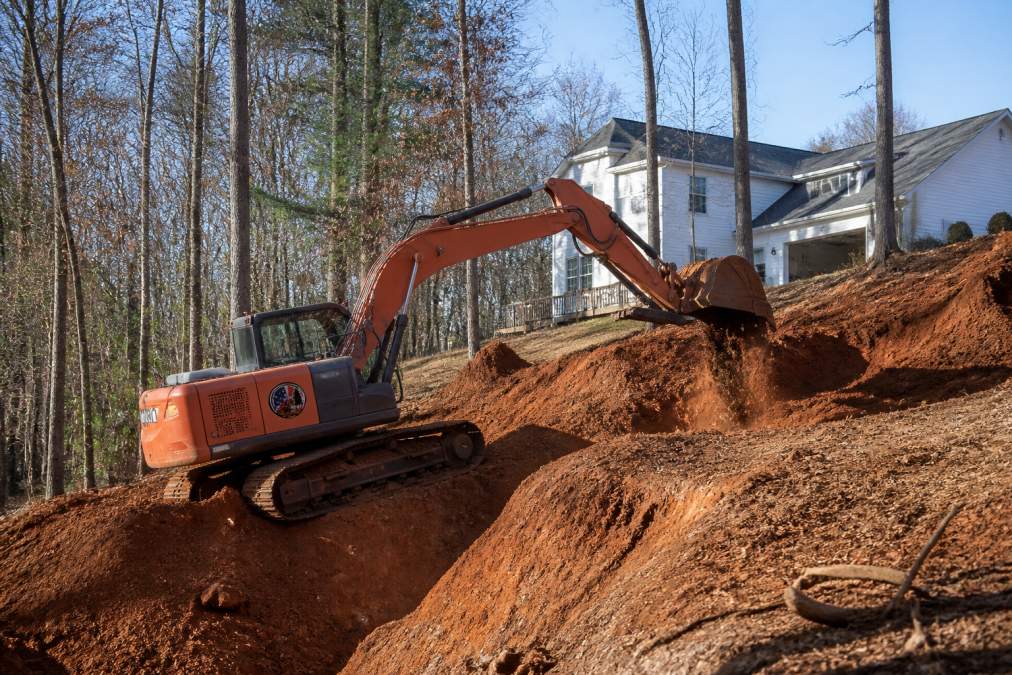
The temptation to handle grading yourself is understandable when facing contractor quotes. But DIY grading creates more problems than it solves, often at a higher total cost than professional work.
Equipment limitations are the first obstacle. Proper grading requires heavy machinery, excavators, dozers, motor graders, that cost $300 to $500 per day to rent. Operating this equipment safely demands training and experience. A mistake with heavy machinery damages property, creates safety hazards, or causes injury. Beyond rental costs, you’re responsible for fuel, transportation, and operator liability if damage occurs.
Soil compaction is where most DIY attempts fail. Compacting soil properly requires specific equipment and technique. Soil must be compacted in 4- to 6-inch lifts at optimal moisture content (astm.org). Most DIY approaches skip this step or perform it inadequately. The result: inadequate compaction causes settling within 6 to 18 months, creating new low spots, disrupting drainage, and requiring expensive professional remediation.
Topographic knowledge separates professional work from amateur efforts. Understanding how water flows across terrain, calculating proper slopes, and identifying drainage problem areas requires experience and often site survey data. DIY approaches often miss critical issues until problems manifest, typically after heavy rain when water pools unexpectedly or erodes newly graded surfaces.
Permitting and regulatory violations create serious consequences for DIY projects. Unpermitted work can result in fines ($500 to $5,000+ depending on jurisdiction), work stoppages, or requirements to restore the property to pre-grading condition at your expense. If your grading causes erosion damage to neighboring properties or violates local water quality standards, you face liability claims on top of regulatory fines. Professional contractors handle permitting as part of their service.
Soil composition challenges often derail DIY efforts. Clay-heavy soil behaves differently than sandy or rocky terrain. Without soil testing and professional assessment, DIY graders often discover mid-project that their approach won’t work, requiring equipment changes, technique adjustments, or professional intervention.
Timeline favors professional work significantly. A contractor with proper equipment completes a typical residential grading project in 2 to 5 days. A homeowner with rented equipment typically requires 2 to 4 weeks of part-time work, extended by weather delays and learning curve mistakes. Your property remains disrupted longer with DIY approaches.
Quality outcomes differ dramatically. Professional grading creates stable, properly drained terrain that functions as designed for years. DIY grading often produces temporary improvements that degrade quickly, requiring expensive fixes. The difference becomes visible within the first year.
The real question isn’t whether you can physically move dirt, it’s whether you can do it correctly, legally, and in a way that lasts. Professional land grading is worth the cost specifically because it prevents the mistakes that cost far more to fix.
Is Professional Land Grading Worth It? The Value Proposition
Professional land grading delivers value that extends far beyond the initial project cost.
Property usability is the immediate benefit. Land that was previously inaccessible, waterlogged, or unstable becomes functional. A three-acre property with drainage problems becomes usable pasture. A building site with poor drainage becomes ready for construction.
Foundation protection prevents catastrophic damage. Water infiltration into basements or crawl spaces costs $10,000 to $25,000 to remediate. Professional grading preventing this damage pays for itself through prevention alone.
Soil health improves with proper grading and drainage. Well-drained soil supports healthier vegetation, better pasture quality, and more stable terrain. Waterlogged soil becomes compacted, eroded, and increasingly unusable.
Property value increases with improved drainage and accessibility. Buyers and appraisers recognize properties with good grading and drainage. Properties with water problems command lower prices.
Curb appeal and usability matter for residential properties. A well-graded property with proper drainage looks maintained and functional. Poor grading creates visible problems that signal neglect and reduce curb appeal.
Liability reduction comes from eliminating water management problems. A property with proper drainage eliminates water damage claims and liability from runoff affecting neighboring properties.
Long-term cost savings accumulate over years. Preventing foundation damage, erosion, and soil degradation saves thousands in future repairs.
The value proposition becomes clear when you compare the grading cost against the cost of water damage repairs, foundation remediation, or reduced property value from poor drainage. Timber Shredders LLC combines grading expertise with land clearing and site preparation services, addressing multiple property challenges in a single, coordinated project. This integrated approach often costs less than hiring separate contractors and delivers superior results.
Professional land grading is worth the cost when your property has drainage issues, accessibility problems, or plans for development. The investment prevents expensive water damage, improves soil health, and increases property usability and value. Get a comprehensive site assessment from Timber Shredders LLC to understand your specific grading needs, drainage challenges, and the actual cost for your property. Our team provides detailed estimates, handles permitting requirements, and delivers professional results using experienced operators and proven equipment. Get A FREE Quote today and discover how professional grading transforms your property.
Frequently Asked Questions
How much does it cost to regrade an acre of land?
The average cost of land grading per acre varies based on topography, soil conditions, and site complexity. Pricing depends on the slope of the terrain, whether excavation or leveling is needed, and the amount of soil displacement involved. For an accurate estimate specific to your property, contact a professional grading contractor who can assess your site and provide a detailed quote based on your exact needs.
What are the long-term benefits of professional land grading?
Professional land grading improves foundation integrity by directing surface runoff away from structures, prevents water pooling that leads to erosion, and enhances drainage through proper slope and subsurface solutions. Well-graded land increases curb appeal and property value, improves accessibility, and creates usable space for pasture or landscaping. The investment protects your property from costly water damage and foundation problems over time.
Can I DIY land grading on a large property, or do I really need professionals?
DIY land clearing on large properties presents significant challenges. Professional equipment handles soil compaction, excavation, and backfilling more efficiently and safely than manual work. Improper grading can cause erosion, drainage failures, and foundation damage. Professionals understand finished grade requirements, local grading permits, and stormwater management regulations. For properties over a few hundred square feet with complex topography, professional land grading typically delivers better results and avoids costly mistakes.
How does professional grading improve soil health and drainage?
Professional grading establishes proper slope and drainage patterns that prevent water pooling and surface runoff issues. Contractors use site surveys to design appropriate French drain systems and subsurface drainage solutions tailored to your soil composition. Proper grading reduces soil compaction in usable areas, improves water infiltration, and supports vegetation growth. This preparation is especially valuable if you plan to use the land for pasture, landscaping, or construction afterward.
This article was written using GrandRanker