Table of Contents
- What Residential Land Clearing Involves
- Forestry Mulching vs Bulldozing: Which Method Works Best
- Land Clearing Permit Requirements and Environmental Compliance
- Average Cost to Clear an Acre of Land
- Residential Site Preparation Services for New Construction
- Post-Clearing Maintenance and Land Management
- DIY vs Professional Land Clearing: What You Should Know
- Conclusion
Last Updated: August 8, 2026
What Residential Land Clearing Involves
Residential land clearing is the process of removing trees, brush, stumps, rocks, and other debris from a property to restore access, improve visibility, and prepare land for development or maintenance. It’s fundamentally about reclaiming your property so it works for you instead of against you.
The scope varies dramatically. A light clearing might mean removing fallen branches and overgrown brush from a fence line, while heavy clearing could involve dense woodland, multiple large trees, deep-rooted stumps, and years of accumulated debris. What separates residential land clearing from commercial forestry work is scale and purpose: you’re typically working with smaller acreage and the goal is property usability, not timber harvest.
Most residential properties in Central Virginia face one of three situations: overgrown areas blocking sightlines, preparation for new construction or landscaping, or wildfire risk management. Professional land clearing addresses not just vegetation removal but also grading for drainage, debris hauling, and soil restoration so the land can actually be used afterward.
Forestry Mulching vs Bulldozing: Which Method Works Best
Forestry mulching and bulldozing represent two fundamentally different approaches to land clearing, and the choice determines both your immediate results and your property’s long-term health.
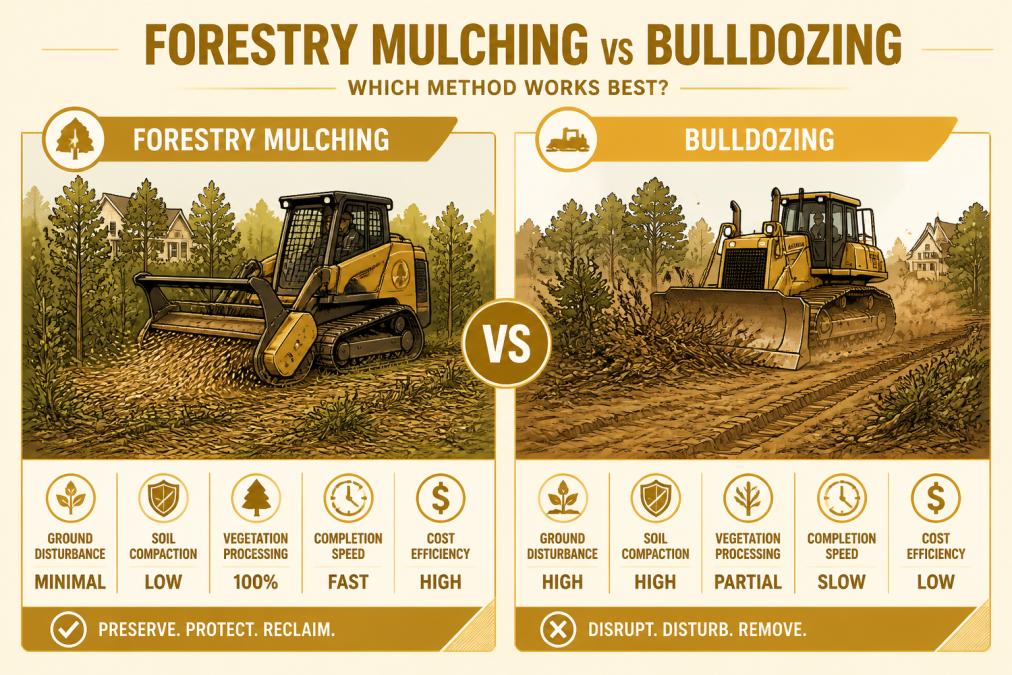
Forestry mulching uses specialized equipment that grinds vegetation, trees, brush, stumps, and roots into fine mulch while leaving it on-site. The equipment is relatively compact and tracks across the property with minimal ground disturbance. The mulch layer improves soil health over time by adding organic matter and improving moisture retention, making it ideal for residential properties where you want to preserve topsoil and avoid erosion.
Bulldozing removes everything and either hauls it away or pushes it into piles for later removal. It’s faster for certain situations and handles rocky terrain more easily, but it strips away topsoil, compacts remaining soil significantly, and often requires follow-up grading and hauling work.
Many property owners assume bulldozing is cheaper because it’s faster. In practice, the total cost often ends up similar or higher when you factor in debris hauling, topsoil replacement, and erosion control measures. Forestry mulching front-loads the work into one comprehensive pass.
After forestry mulching, your property is cleared and the mulch layer begins improving soil conditions. After bulldozing, you’ve got bare ground that needs grading, potentially needs topsoil replacement, and may have erosion issues during heavy rain. For residential properties where you want to use the land afterward, forestry mulching typically delivers better results. Bulldozing makes sense only in specific situations: extensive rock or clay that mulching equipment would struggle with, when you need absolute fastest clearing, or when removing structures. At Timber Shredders LLC, property owners consistently prefer the results and post-project land quality that forestry mulching delivers.
Land Clearing Permit Requirements and Environmental Compliance
Before you clear a single branch, you need to understand what permits and regulations apply to your property. This is where many DIY attempts go sideways and where professional land management companies add real value.
Permit requirements vary significantly by locality. Virginia state regulations govern forestry operations, but local county and municipal codes often add additional requirements. Some jurisdictions require permits for any tree removal above a certain diameter, while others require environmental assessments if your property is near wetlands, streams, or protected habitats.
The environmental compliance piece is substantial. If your property borders any water body, even a seasonal stream, federal Clean Water Act regulations may apply. Violating these rules doesn’t just mean fines; it can mean being forced to restore the property at your own expense, which is far more costly than getting it right initially.
Contact your local county planning and zoning office before you do anything. Ask specifically about tree removal permits, wetland setback requirements, and stormwater management rules for your parcel. According to [Virginia Department of Forestry guidance on land clearing(/affordable-land-clearing-services-guide/) | dof.virginia.gov], property owners should verify local requirements before engaging contractors. Professional land clearing contractors in Virginia are familiar with these requirements and factor compliance into their planning. This isn’t a cost you want to cut corners on, the penalty for non-compliance is always higher than the cost of doing it correctly from the start.
Average Cost to Clear an Acre of Land
Understanding what land clearing actually costs requires breaking down the variables that drive pricing, because “cost per acre” is meaningless without context.
The primary cost drivers are vegetation density, terrain, access, and what happens to the debris. A light clearing of an open pasture with scattered brush costs dramatically less than clearing a densely forested acre with large trees and deep stumps. Rocky terrain costs more because equipment moves slower. Poor access increases costs because equipment can’t work efficiently.
Based on research from Angi’s land clearing cost analysis, typical residential land clearing ranges from roughly $1,200 to $3,900 for a standard residential lot, with per-acre rates ranging from $500 to $5,600 depending on conditions. These figures reflect professional service pricing and include debris removal.
What you’re actually paying for is the equipment operator’s time, the equipment itself, and the disposal or management of cleared material. When you get quotes, ask specifically what’s included: does the price cover debris removal, or are you paying separately for hauling? Is grading included? Are permits and compliance work included? Timber Shredders LLC provides comprehensive property assessments before quoting, so you know exactly what you’re getting and what it costs.
Residential Site Preparation Services for New Construction
If you’re building on your property, site preparation is the bridge between raw land and a buildable lot. Proper site preparation starts with a survey and site assessment to identify property lines, drainage patterns, utilities, and soil conditions.
The actual preparation work includes vegetation removal, grading to establish proper drainage and level building pads, removal of rocks and obstacles, and sometimes soil amendment. For properties with significant topography, you may need retaining walls or terracing. For wet areas, you might need drainage systems or fill material.
The critical mistake is rushing this phase. Inadequate site preparation leads to drainage problems, foundation issues, or erosion that shows up months or years later. Professional site preparation contractors understand building codes and drainage requirements. They know how much slope you need for proper water runoff, how to identify and protect utility lines, and what soil conditions support different types of construction. For new construction in Central Virginia, working with a professional land clearing and site preparation company simplifies the entire process and ensures your builder gets a properly prepared site.
Post-Clearing Maintenance and Land Management
The work doesn’t end when the equipment leaves your property. What you do in the weeks and months after clearing determines whether you’ve truly reclaimed your land or just created a temporary improvement.
Immediately after clearing, your property is vulnerable to erosion. Bare soil erodes in heavy rain, and without vegetation to hold soil in place, you can lose topsoil quickly, especially on slopes. The first priority is addressing erosion through temporary erosion control measures like erosion cloth or silt fencing until vegetation can reestablish.
The second priority is managing regrowth. Cleared areas don’t stay clear automatically. Brush and saplings return, sometimes aggressively. Depending on what you want the land to do, you’ll need either active management through mowing or brush control, or replanting with desired vegetation. Many property owners find that professional guidance on post-clearing maintenance prevents costly mistakes. A cleared property that’s properly maintained becomes more valuable and usable.
DIY vs Professional Land Clearing: What You Should Know
The appeal of DIY land clearing is obvious: you save money and maintain control. The reality is more complicated, and understanding when professional work makes sense saves both money and frustration.
DIY clearing works for small, manageable projects. If you’ve got a half-acre with light brush and a few small saplings, renting equipment and handling it yourself is realistic. DIY clearing breaks down quickly as projects get larger or more complex. Dense vegetation, large trees, extensive stumps, rocky terrain, or difficult access all create problems. You’ll underestimate the time required, discover underground obstacles you can’t handle safely, and create erosion problems you then have to fix.
The safety factor is substantial. Operating heavy equipment requires skill and awareness. Chainsaws are inherently dangerous, especially when tired or working alone. Trees can fall unpredictably, and equipment can tip on slopes.
There’s also the debris problem. DIY clearing often results in piles of brush scattered across your property that still need to be hauled away. If you hire someone to haul it, you’ve now paid for two contractors instead of one.
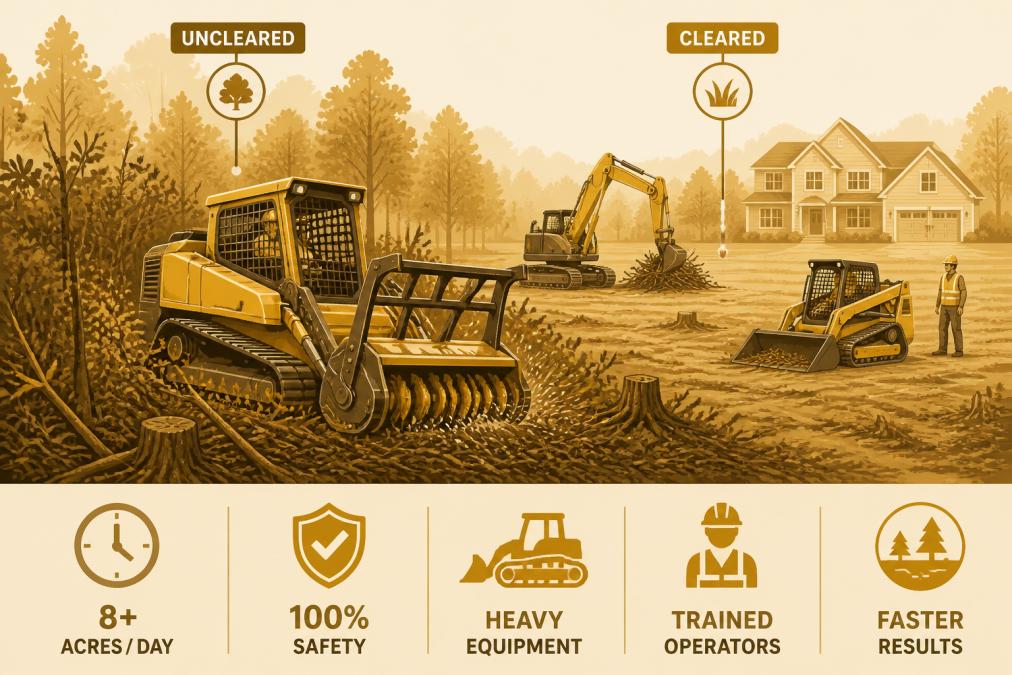
Professional land clearing handles all of this in one coordinated effort. Equipment is appropriate for the job, operators are trained and experienced, and the work is completed efficiently. The debris is managed as part of the project. The cost difference is often smaller than property owners expect, especially when you factor in equipment rental, your time, and the inevitable problems that emerge.
Clearing your property is an investment in usability, safety, and value. Whether you’re managing wildfire risk, preparing for construction, or simply reclaiming land that’s become overgrown, the approach you choose determines both the immediate results and the long-term condition of your property.
The right choice depends on your specific situation: the size of the area, the type and density of vegetation, your timeline, and what you want the land to do afterward. Professional land clearing contractors like Timber Shredders LLC provide comprehensive assessments that help you understand your options and choose the approach that delivers the best value. Get a free quote and see how professional land management can transform your property.
Frequently Asked Questions
What is the average cost to clear an acre of land?
The cost to clear an acre varies significantly based on vegetation density, terrain, and whether you’re removing stumps or debris. Professional land clearing typically ranges from $500 to $5,600 per acre, with most residential projects falling between $1,266 and $3,900 for typical lots. Factors like brush thickness, tree size, rock presence, and local permitting affect the final price. Contact a professional service for a site assessment and detailed estimate based on your specific property conditions.
Do I need a permit to clear land on my property?
Permit requirements depend on your location, the amount of vegetation being cleared, and what you’re clearing. Many municipalities require permits for tree removal, especially if trees exceed a certain diameter or if the property is near protected wetlands. Some areas have environmental regulations protecting native vegetation or wildlife habitat. Contact your local county or city planning office to determine what permits apply to your project before starting work.
How does forestry mulching compare to traditional bulldozing?
Forestry mulching grinds vegetation into mulch that stays on-site, improving soil health and reducing erosion. Bulldozing removes all material, which can compact soil and requires debris hauling. Forestry mulching preserves topsoil, reduces dust, and eliminates disposal costs. However, bulldozing works better for heavy rock removal or when you need completely bare ground. The right choice depends on your soil quality goals, property slope, and what you plan to do with the land afterward.
How long does a typical residential land clearing project take?
Timeline depends on property size, vegetation density, and equipment used. Small residential lots (under 1 acre) with moderate brush typically take 1-3 days. Larger properties with dense undergrowth, stumps, and rocks may take a week or more. Professional crews with forestry mulching equipment work faster than manual methods. Weather conditions and permit delays can extend timelines. A professional assessment of your specific property will give you a realistic completion schedule.
This article was written using GrandRanker