Table of Contents
- What Affordable Land Clearing Services Actually Cost
- Factors That Affect Your Land Clearing Price
- Land Clearing Permit Requirements You Need to Know
- Forestry Mulching vs Bulldozing: Which Method Saves Money
- Professional Land Clearing Services vs DIY: The Real Difference
- How to Choose an Affordable Land Clearing Service
- Common Hidden Costs and How to Avoid Them
- Conclusion
Last Updated: August 5, 2026
What Affordable Land Clearing Services Actually Cost
Professional land clearing services typically charge by the acre, though rates vary enormously based on vegetation density, terrain, and what happens to debris after cutting. A quarter-acre of light brush costs far less than a full acre of dense forest with mature trees and deep root systems. Equipment access matters too, if a skid steer can roll onto your property, costs stay lower. If the contractor must hand-carry tools through dense forest, costs climb.
Beyond the per-acre rate, you’re paying for debris management, grading, and site preparation. Does the contractor haul debris away, chip it into mulch, or leave it in piles? Does grading come included? These details separate a $400-per-acre quote from a $1,200-per-acre reality. You need a site assessment before any number means anything. At Timber Shredders LLC, we assess vegetation density, terrain, equipment access, and your actual needs before quoting.
Factors That Affect Your Land Clearing Price
Vegetation density and type is the first filter. Light brush clearing on open land is quick work. Dense forest with mature trees, thorny undergrowth, and tangled vines takes exponentially longer. Equipment needs scale with what’s actually growing there.
Terrain and accessibility matter as much as vegetation. Flat, open land is ideal. Steep hillsides, rocky outcrops, and boggy areas slow work and require specialized equipment. If heavy machinery can drive straight onto the property, costs stay lower.
Tree size and stump removal push costs up significantly. Small saplings clear quickly. Trees over 12 inches in diameter take longer to fell and remove. If stumps need grinding below ground level rather than just cutting flush, that’s additional equipment and time.
Debris management is where hidden costs hide. Hauling debris off-site costs truck time, fuel, and tipping fees. Chipping vegetation into mulch onsite costs less but requires specialized equipment. Burning (where permitted) is cheapest but has permit and liability implications.
Site preparation and grading beyond basic clearing adds to the bill. Leveling ground for construction, creating drainage, or preparing pasture requires grading equipment and operator time. Know what you actually need before comparing quotes.
Seasonal timing affects pricing. Spring and summer are peak season; contractors charge more due to high demand. Fall and winter often mean lower rates but weather can delay work.
Land Clearing Permit Requirements You Need to Know
Before any equipment shows up, check what permits your county requires. Most residential land clearing under 2-5 acres (depending on the county) doesn’t require a permit for vegetation removal alone. But if your project involves grading, drainage modification, or construction site preparation, permits become mandatory.
Wetland and stream buffer regulations are the most common permit trigger. If your property has streams, wetlands, or designated buffers, clearing in those areas requires environmental review. Virginia has specific setback requirements from waterways. Violating these brings state penalties.
Check your county’s planning and zoning office website for specific requirements. A contractor who ignores permit requirements isn’t saving you money, they’re creating legal liability you’ll inherit. The cost of a permit is trivial compared to fixing unpermitted work or facing fines.
Forestry Mulching vs Bulldozing: Which Method Saves Money
These are the two primary methods for large-scale land clearing, and they cost differently.
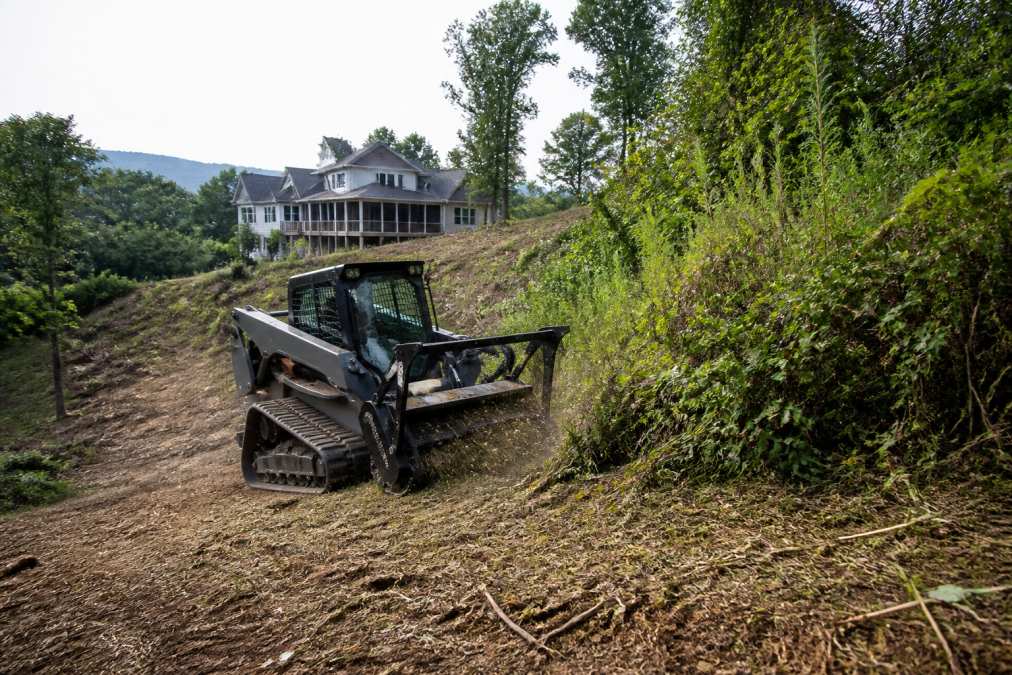
Forestry mulching uses specialized equipment that cuts vegetation and grinds it into chips onsite. The mulch stays on the ground, improving soil health and reducing regrowth. This method handles trees up to roughly 15 inches in diameter. No debris hauling means no disposal costs. The mulch layer suppresses weeds and erosion.
The tradeoff is equipment cost. A dedicated forestry mulcher is expensive to operate. For smaller properties or light clearing, this method doesn’t pencil out economically. For dense brush or moderate acreage, it often beats hauling costs.
Bulldozing uses a blade to push vegetation, stumps, and rocks into piles. Debris either gets hauled away, burned (if permitted), or left in windrows. This method handles any size tree and clears faster on open terrain. It’s the go-to for construction sites requiring bare, level ground.
The hidden cost is debris management. Hauling costs money. Burning requires permits. Leaving debris piles leaves your property unusable for months. For most residential land clearing in Central Virginia, forestry mulching wins on total cost when you factor in debris removal. For construction projects requiring bare ground and maximum speed, bulldozing makes sense despite disposal costs.
Professional Land Clearing Services vs DIY: The Real Difference
The gap between DIY and professional isn’t just about effort. It’s about equipment, speed, safety, and whether the job actually gets finished.
DIY clearing with hand tools works for small areas. A quarter-acre of light brush is manageable over several weekends. But clearing an acre by hand takes weeks of hard physical work. Stumps require digging and extraction. Debris still needs hauling or chipping. For most people, this approach is only realistic for properties under 0.5 acres with light vegetation.
Equipment rental changes the equation, and this is where DIY gets expensive fast:
- Brush hog or rotary cutter rental: $80-150 per day. Works for light brush on open, relatively flat terrain. Requires tractor access (rental adds $100-200/day if you don’t own one).
- Skid steer loader with forestry mulcher attachment: $250-400 per day. Handles dense brush and saplings up to 6 inches. Rental usually requires a 3-day minimum, so a small job costs $750-1,200 just for equipment.
- Dump truck rental for debris hauling: $150-300 per day, plus tipping fees ($50-150 per load). A single acre of dense forest can generate 3-5 truckloads.
The real DIY cost for a 1-acre moderate-density project typically runs:
- Skid steer rental (3 days): $900
- Dump truck rental (2 days) + tipping fees: $500
- Fuel and miscellaneous: $150
- Total: $1,550-2,000, plus 40-60 hours of your labor
If you value your time at $25/hour, you’re actually spending $2,550-3,500 total. Rental damage deposits ($500-1,000) come out of your pocket if something goes wrong.
Professional services bring equipment, experience, and liability insurance. Work is done in 1-2 days. No rental damage risk. No weeks of physical labor.
The decision framework:
- Under 0.25 acres, light brush: DIY with hand tools makes sense.
- 0.25-0.5 acres, light to moderate: Get a professional quote first; it may be cheaper.
- 0.5-2 acres, moderate to dense: Professional services almost always win on total cost.
- Over 2 acres or dense forest: Professional is the only realistic option.
Safety is the unspoken cost of DIY. Operating heavy machinery without experience creates injury risk. Chainsaws cause thousands of emergency room visits annually. Professional operators carry liability insurance and follow OSHA guidelines. If you get hurt on a rental, your homeowner’s insurance may not cover it.
How to Choose an Affordable Land Clearing Service
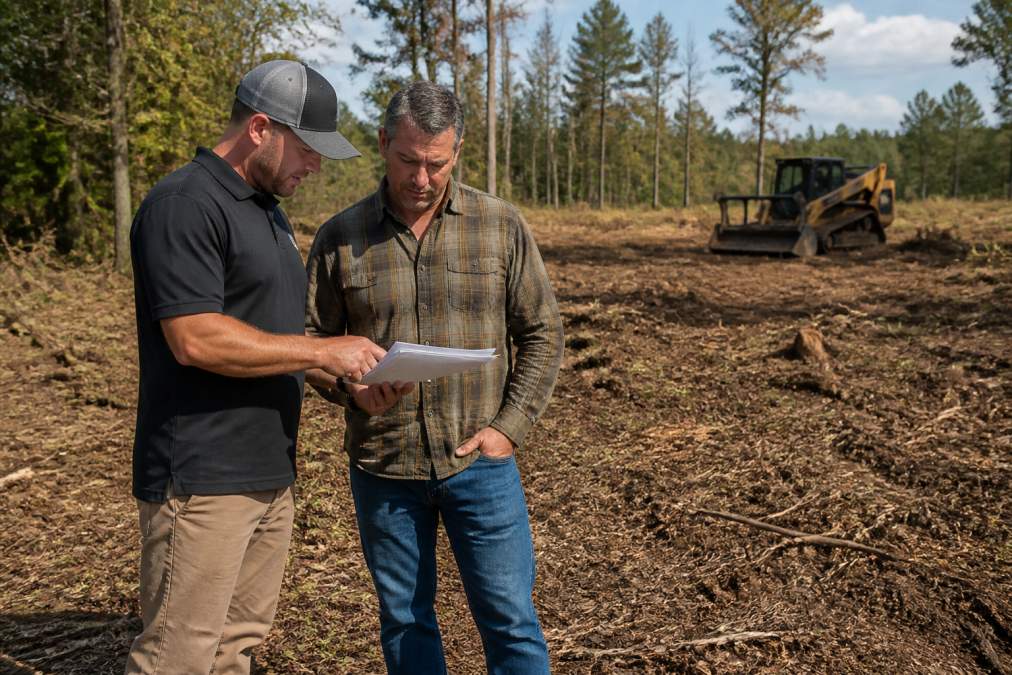
Get multiple estimates from contractors who’ve actually visited your property. Phone quotes without a site visit are guesses. A legitimate contractor assesses vegetation density, terrain, access, and debris management before quoting.
Ask what’s included in the quote. Does the price cover debris hauling, grading, stump grinding, and site cleanup? The cheapest quote often excludes these, making the final bill much higher. Detailed estimates prevent surprises.
Check references and insurance. A professional contractor carries liability insurance and can name past clients. Call them. Ask if work was completed on time, if cleanup was thorough, and if the contractor handled unexpected issues professionally.
Verify they understand local regulations. Ask if permits are required for your project and whether the contractor handles permitting. A contractor who knows local rules avoids problems.
Watch for red flags. Quotes dramatically lower than others usually mean something’s being cut. Contractors who push for upfront payment before work starts are risky. Those who can’t clearly explain what’s included are hiding something.
Common Hidden Costs and How to Avoid Them
Debris disposal is the most common surprise. Contractors quote per-acre clearing, then add hauling costs once they see actual debris volume. If your quote doesn’t explicitly include where debris goes and what that costs, ask for a separate line item. Tipping fees typically run $50-150 per ton. A single acre of dense forest can generate 15-25 tons.
Unexpected obstacles, rocks, old foundations, buried metal, stop work and require extra labor or equipment. Ask if the estimate includes contingency for unexpected obstacles. A professional contractor builds this in.
Stump grinding often costs extra. Some contractors quote cutting trees flush with the ground, then charge separately to grind stumps below ground. Clarify whether stumps are removed or just cut. Full stump removal typically adds $100-300 per stump for large trees.
Grading and site preparation are easy to overlook. If you need the land level for construction or pasture, grading costs extra. A cheap quote might include clearing only, leaving you with uneven, unusable ground.
Permit violations and fines are the worst hidden cost. A contractor who ignores permit requirements saves money upfront but creates legal liability for you. Virginia counties assess penalties ranging from $100-500 per day of violation.
Post-clearing soil degradation and erosion, the invisible cost most landowners ignore. When heavy machinery clears land, it compacts soil, removes vegetation that holds topsoil in place, and exposes bare earth to rain and wind. Within weeks, erosion begins. Topsoil washes downslope, fills ditches, and degrades the property’s usability. If your cleared land slopes toward a neighbor’s property or road, you’re liable for erosion damage.
What you must do immediately after clearing:
- Seed or mulch exposed soil within 7-14 days. Hydroseeding costs $500-1,500 per acre and prevents erosion. Leaving forestry mulch in place provides natural erosion control and costs nothing extra.
- Install erosion control measures if the property slopes significantly or is near waterways. Silt fences or erosion control blankets cost $500-2,000 depending on property size and slope. Many Virginia counties require these by regulation.
- Grade for drainage to prevent water pooling and runoff concentration. Grading to establish proper slope costs $300-800 per acre.
- Avoid compacted soil problems. Light tilling or aeration after clearing breaks up compaction and costs $200-500 per acre but dramatically improves long-term usability.
These post-clearing costs typically run $1,000-3,000 for a 1-acre property. Most landowners don’t budget for this because contractors don’t mention it.
To avoid these surprises:
- Get detailed written estimates specifying what’s included, what costs extra, and what contingencies exist.
- Ask about timeline and payment terms.
- Ask the contractor what happens to the soil after clearing. Will it be seeded? Mulched? Left bare? What’s the plan for erosion control?
- Request a post-clearing maintenance plan in writing.
- Check county stormwater regulations for your property size and slope.
- If the property slopes toward a neighbor or road, ask the contractor about drainage and erosion liability.
A contractor who provides clear, itemized estimates and discusses post-clearing soil management prevents both financial shock and long-term property damage.
Frequently Asked Questions
How much does it cost to clear 1 acre of land?
The cost to clear 1 acre of land ranges from $400 to $700 or more per acre, depending on vegetation density, terrain, and the clearing method used. Forestry mulching typically starts around $400 per acre, while full-service land clearing ranges from $700 per acre. Factors like stump removal, debris hauling, and site accessibility significantly impact the final price. Request quotes from local professionals for accurate estimates based on your specific property conditions.
Do I need a permit to clear my own land in Virginia?
Permit requirements vary by locality in Virginia. Most residential properties in Central Virginia require permits for significant land clearing, tree removal over a certain diameter, or work near property lines and wetlands. Contact your local county or city planning department before starting any clearing work. Professional land clearing services typically handle permit coordination as part of their service, ensuring compliance with local regulations and avoiding costly fines.
Is forestry mulching really better than bulldozing for soil health?
Yes. Forestry mulching converts vegetation into ground cover that returns nutrients to the soil and reduces erosion, while bulldozing removes topsoil and leaves bare ground vulnerable to runoff. The mulch layer also prevents regrowth and improves soil structure for future pasture or landscaping. If you plan to use your land for grazing or planting afterward, forestry mulching is the more sustainable choice and often costs 20-40% less than traditional clearing methods.
What should I look for in an affordable land clearing company?
Look for companies that offer free property assessments, provide detailed written estimates before starting work, use modern equipment appropriate for your property size, and guarantee cleanup upon completion. Verify they carry liability insurance and understand local permit requirements. Compare quotes from multiple providers, but be cautious of prices significantly below market rate, as they may indicate incomplete work or hidden costs. Ask for references from recent projects similar to yours.
Choosing the right land clearing service balances cost with quality and reliability. The cheapest option often creates problems later, unpermitted work, incomplete cleanup, or damaged soil. Timber Shredders LLC provides professional equipment, experienced operators, and comprehensive site assessment to deliver cleared property without hidden costs. Get a free quote and understand exactly what’s included before any work starts.
This article was written using GrandRanker