Table of Contents
- What Rural Driveway Installation Services Actually Involve
- Rural Driveway Materials: Comparing Your Options
- Base Preparation, Grading, and Compaction
- Rural Driveway Drainage: Managing Water and Erosion
- Driveway Permits and Regulations in Rural Areas
- Cost to Build a Rural Driveway: What Affects Pricing
- Maintenance, Winter Care, and Repairs
- Choosing a Driveway Installation Service for Your Rural Property
Last Updated: August 2, 2026
What Rural Driveway Installation Services Actually Involve
Driveway installation for rural properties requires far more planning and expertise than most homeowners realize. At Timber Shredders LLC, we’ve spent years helping Central Virginia landowners transform inaccessible properties into functional driveways that handle heavy equipment and seasonal weather challenges. The difference between a driveway lasting 5 years and one lasting 20 comes down to site assessment, material selection, and proper base preparation.
Rural driveways face unique challenges: natural topography, unpredictable drainage patterns, heavy seasonal traffic, and no municipal infrastructure support. A proper installation service starts by understanding your specific site conditions before equipment arrives.
Site Assessment and Planning
The foundation of every successful rural driveway begins with comprehensive site assessment, a detailed evaluation of soil composition, drainage patterns, slope, vegetation, and existing infrastructure like culverts or ditches. Professionals measure driveway length, width, and turnaround areas; identify water flow paths; check for underground utilities; and evaluate vegetation clearing needs. Many rural property owners skip this step and later face washouts or ruts within the first season. The site plan becomes your roadmap for the entire project, determining material choices and base depth requirements.
Land Clearing and Preparation
Most rural driveways require clearing before grading begins. Trees, brush, stumps, and rocks must be removed from the driveway path and several feet on either side for sight lines and maintenance access. Land clearing can involve forestry mulching, which grinds vegetation into mulch rather than creating debris piles. This approach, commonly used by Timber Shredders LLC, preserves soil health while eliminating mess. After clearing, preparation involves removing the top layer of organic material and unstable soil, which would otherwise compress unevenly under vehicle weight and create potholes.
Rural Driveway Materials: Comparing Your Options
Choosing the right surface material defines your driveway’s appearance, maintenance requirements, and lifespan.
| Material | Upfront Cost | Maintenance Level | Lifespan | Best For |
|---|---|---|---|---|
| Gravel/Crushed Stone | Lowest | High (annual regrading) | 3-5 years | Budget-conscious, good drainage needs |
| Recycled Asphalt | Low-Moderate | Moderate | 5-7 years | Eco-conscious, decent durability |
| Tar and Chip | Moderate | Moderate | 5-8 years | Rustic appearance, rural aesthetic |
| Asphalt | Moderate-High | Moderate | 15-20 years | Long-term durability, all-weather |
| Concrete | Highest | Low | 25-30+ years | Maximum durability, minimal maintenance |
Gravel and Crushed Stone
Gravel remains the most affordable driveway option for rural properties, but affordability comes with significant maintenance demands. The best gravel driveways use layering: larger crushed stone at the base for drainage and load-bearing, medium stone in the middle, and smaller pea gravel on top for finished appearance. Gravel excels where drainage is primary, its permeable nature means water flows through rather than pooling. For properties with high water tables or natural springs crossing the driveway, gravel often outperforms sealed surfaces that trap water underneath.
Asphalt and Recycled Asphalt
Asphalt provides a smooth, durable surface that handles freeze-thaw cycles better than gravel. Traditional asphalt requires professional installation with heated equipment, making it more expensive upfront but delivering superior performance over 15-20 years. Recycled asphalt pavement (RAP) offers an environmentally responsible middle ground, it’s compacted reclaimed asphalt that bonds naturally, creating a stable surface without new asphalt production. RAP costs less than new asphalt, drains better than sealed asphalt, and reduces landfill waste. Both options eliminate dust and mud issues common with gravel and handle snow removal better.
Concrete and Tar-and-Chip
Concrete offers maximum durability and minimal maintenance, making it ideal for rural properties where access is critical. A properly installed concrete driveway lasts 25-30 years or longer, requiring only occasional sealing and crack repair. Concrete’s primary drawback is upfront cost and potential cracking if installed on unstable base material. Tar-and-chip creates a rustic appearance by combining hot liquid asphalt with stone chips, costing less than full asphalt paving while offering better traction.
Base Preparation, Grading, and Compaction
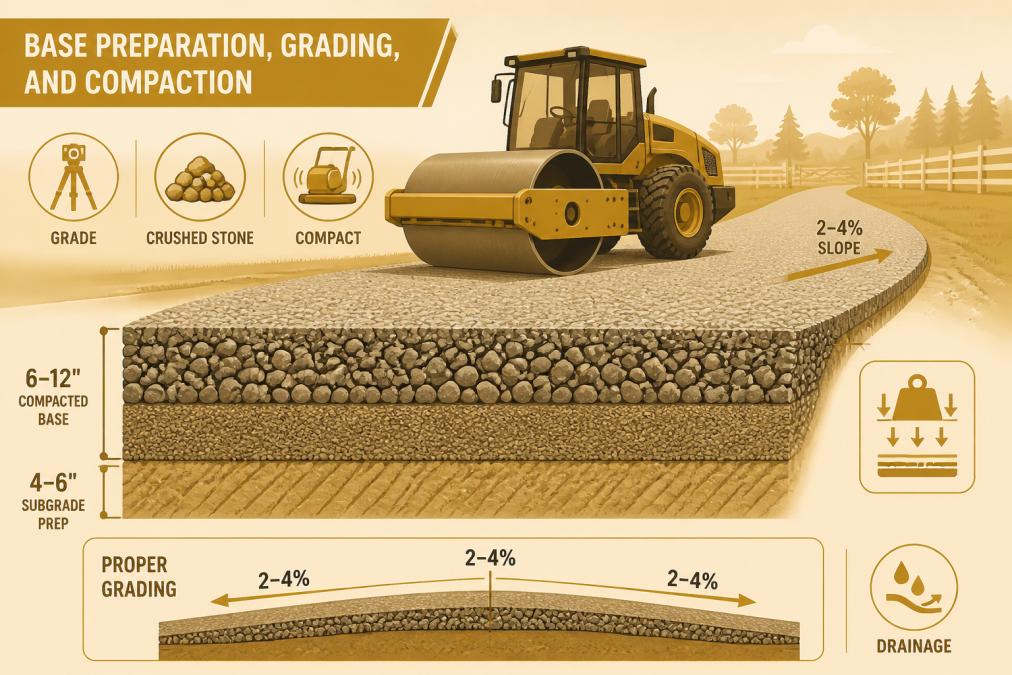
The base layer determines whether your driveway lasts five years or twenty. Many rural driveway failures trace back to inadequate base preparation, not poor surface material.
A stable base requires removing all organic material and unstable soil down to firm, undisturbed earth. Skipping this step guarantees potholes, ruts, and washouts within the first season.
Why Proper Grading Prevents Future Problems
Grading shapes the driveway to direct water away from the surface and surrounding structures. A properly graded driveway has a slight crown or slope that encourages runoff toward the edges, preventing water pooling and seepage into the base layer. Improper grading is the single most common cause of premature driveway failure. For rural properties with natural slopes, grading must account for existing topography, and professionals may install swales or ditches alongside the driveway to intercept slope water before it reaches the surface.
Compaction Standards and Load-Bearing Capacity
Compaction transforms loose aggregate into a stable, load-bearing base. Professional installation uses mechanical compactors to compress each layer to 95% standard proctor density, ensuring the base can support repeated heavy vehicle traffic without settlement. Compaction is particularly critical for rural driveways supporting farm equipment, delivery trucks, or emergency vehicles.
Rural Driveway Drainage: Managing Water and Erosion
Water is the enemy of rural driveways. Improper drainage causes more premature failures than any other factor. Rural properties frequently have natural drainage challenges: springs crossing the driveway path, seasonal wet areas, or slopes channeling water toward the driveway. Professional installation addresses these with culverts, ditches, swales, and geotextile fabric designed to manage water flow.
Culverts, Ditches, and Swales
A culvert is a pipe or tunnel allowing water to pass under the driveway rather than pooling on it. Culverts are essential where a driveway crosses a natural drainage path, seasonal stream, or ditch. Properly sized culverts account for the largest storm event your area typically experiences, and installation requires the culvert to sit at least 12 inches below the finished driveway surface to prevent collapse under vehicle weight.
Ditches alongside the driveway intercept slope water and direct it away from the surface. Swales are shallow, vegetated drainage channels that slow water flow and encourage infiltration. On rural properties, swales are often more effective than hard ditches because they reduce erosion and support vegetation that stabilizes banks.
Geotextile Fabric and Erosion Control
Geotextile fabric is a synthetic material placed between the subgrade and base aggregate, preventing fine soil particles from migrating into the aggregate layer. Erosion control fabric is installed on exposed slopes to prevent soil from washing away during heavy rain. Professional installation uses appropriate fabric weight and type for specific site conditions.
Driveway Permits and Regulations in Rural Areas
Rural driveway installation is subject to local regulations, though requirements vary significantly by county and locality. Many rural property owners are surprised to learn their driveway requires a permit.
Right-of-Way and Local Setback Requirements
Right-of-way is the strip of land owned by the government along public roads. Most jurisdictions prohibit driveway construction within the right-of-way without specific approval. Right-of-way width varies by road type: state highways often have 50-100 foot rights-of-way, while county roads may have 20-50 feet.
Setback requirements specify how far a driveway must be from property lines, utilities, or existing structures. Many rural properties require a driveway permit from the county road department or state highway department. Professional driveway installation services handle permit applications and ensure compliance with local regulations. Installing a driveway in a non-compliant location can result in orders to remove or reconstruct it to meet standards.
Cost to Build a Rural Driveway: What Affects Pricing
Rural driveway costs vary dramatically based on site conditions, material choices, and project scope. Understanding cost drivers helps you evaluate contractor quotes and avoid surprises.
Material Costs and Heavy Equipment Requirements
Material costs depend primarily on surface type and driveway length. Heavy equipment rental and operation represent a significant portion of rural driveway costs. Site clearing, grading, and compaction require excavators, dozers, graders, and compactors. Site conditions dramatically affect costs, a property with good drainage, minimal vegetation, and gentle slopes costs far less than one requiring extensive clearing, deep excavation, culvert installation, and complex drainage solutions.
Long-Term Cost of Ownership
Evaluating driveway costs requires considering maintenance expenses over the driveway’s lifespan. A cheap gravel driveway might cost $2,000 initially but require $500-1,000 annually in maintenance. Over 15 years, that’s $9,500-16,000 total cost. An asphalt driveway might cost $8,000-12,000 initially but only $200-300 annually in maintenance. Over 15 years, total cost is $11,000-16,500. Concrete driveways cost $12,000-20,000 initially but only $100-200 annually in maintenance. Over 25 years, total cost is $14,500-25,000, the highest upfront but lowest long-term when spread across decades.
Maintenance, Winter Care, and Repairs
Driveway maintenance prevents small problems from becoming expensive failures. The specific maintenance approach depends on surface material and climate.
Seasonal Maintenance Schedule
Gravel driveways require regrading every 1-2 years to restore crown and remove ruts. Asphalt driveways require sealing every 3-5 years to protect against UV damage and water infiltration, with cracks filled promptly to prevent water penetration. Concrete driveways benefit from sealing every 2-3 years. All driveway types require clearing debris, maintaining drainage features, and ensuring culverts and ditches remain clear of obstruction.
Winter Maintenance for Rural Driveways
Winter presents unique challenges for rural driveways. Snow and ice accumulation is more severe in rural areas with less wind exposure. Gravel driveways become nearly impassable during winter without active snow removal and sand application. Asphalt and concrete driveways handle winter better, though freeze-thaw cycles can accelerate cracking if water penetrates the base layer.
Never allow water to pool on your driveway during winter. Pooled water freezes and creates hazardous ice patches. More importantly, water seeping into the base layer and freezing expands, cracking the surface from below. Proper grading and drainage prevent this damage.
Choosing a Driveway Installation Service for Your Rural Property
Professional driveway installation requires specialized equipment, technical expertise, and understanding of local regulations. The difference between a competent contractor and a mediocre one shows up within the first season.
Timber Shredders LLC brings professional equipment and experienced operators to every rural driveway project throughout Central Virginia. The company’s simplified process begins with comprehensive property assessment that identifies site-specific challenges and opportunities. From that assessment, they develop a detailed project plan and clear cost estimate before any work begins. What distinguishes professional driveway installation is attention to base preparation and drainage. Timber Shredders LLC ensures proper grading, compaction, and water management rather than rushing to surface installation.
The company handles site clearing, land management, and driveway installation as an integrated process. If your property requires brush clearing or vegetation removal before driveway work begins, Timber Shredders LLC coordinates the entire project from initial assessment through final completion.
Red Flags and What to Expect
Avoid contractors who skip site assessment or provide estimates without visiting the property. Be wary of unusually low bids, as they may indicate corner-cutting on base preparation or material quality. Ask contractors about their approach to drainage and base preparation. Expect a professional contractor to provide a detailed project timeline, explain what happens if unexpected conditions are discovered, and commit to site cleanup and restoration.
Rural driveway installation services require more expertise and planning than most homeowners expect, but the investment in professional installation pays dividends through decades of reliable access. Timber Shredders LLC combines professional equipment, experienced operators, and comprehensive property assessment to deliver driveways that handle Central Virginia’s climate and terrain. From initial site assessment through final completion, their simplified process ensures clear planning, transparent pricing, and durable results. Get a free quote today and discover how professional driveway installation transforms property accessibility and usability.
Frequently Asked Questions
What’s the best material for a rural driveway that won’t wash away?
Gravel and crushed stone offer excellent drainage but require regular maintenance. Asphalt provides durability and low maintenance but costs more upfront. Concrete is the most durable long-term option. The best choice depends on your budget, traffic volume, and drainage conditions. Proper base preparation and compaction matter more than material choice, a poorly graded gravel driveway fails faster than a well-installed one.
Do I need a permit to install a driveway on my rural property?
Permit requirements vary by county and locality in Virginia. Most rural properties need permits if the driveway crosses a stream, affects right-of-way boundaries, or requires a culvert. Check with your local county building and zoning office before starting work. Failing to obtain required permits can result in fines and forced removal. Professional installers typically handle permit coordination as part of the service.
How much does it cost to build a rural driveway?
Costs depend on material choice, site conditions, length, and drainage requirements. Gravel driveways typically cost less initially but need regular resurfacing. Asphalt and concrete require larger upfront investment but last longer with less maintenance. Heavy equipment rental, site clearing, and culvert installation add to total costs. Get quotes from multiple contractors to compare pricing and understand what’s included in their estimates.
How do I prevent erosion and water damage to my rural driveway?
Install proper drainage infrastructure including culverts where the driveway crosses natural drainage paths, and create ditches or swales to direct water away from the surface. Use geotextile fabric under gravel layers to prevent soil mixing and erosion. Ensure correct grading with at least 2-3% slope for water runoff. Regular maintenance including regrading and resurfacing prevents small problems from becoming washouts. Professional site assessment identifies drainage risks before installation begins.
This article was written using GrandRanker