Table of Contents
- Mulching vs Hauling Debris: Key Differences Explained
- Comparison Table: Mulching vs Hauling at a Glance
- Forestry Mulching Benefits and Drawbacks
- Debris Hauling: Advantages and Trade-Offs
- Cost Comparison: Mulching vs Hauling Debris Removal
- Environmental Impact of Land Clearing: Mulching vs Hauling
- Site Preparation for Construction: Choosing the Right Method
- Safety Hazards and Regulatory Compliance
Last Updated: July 22, 2026
Mulching vs Hauling Debris: Key Differences Explained
When clearing land, property owners must choose between on-site processing or off-site removal. This decision shapes soil health, project timeline, equipment needs, and long-term land usability. Mulching keeps material on-site and transforms it into a resource; hauling removes everything and leaves bare soil. Understanding the operational and environmental realities of each method is essential for making the right choice.
What Is Forestry Mulching?
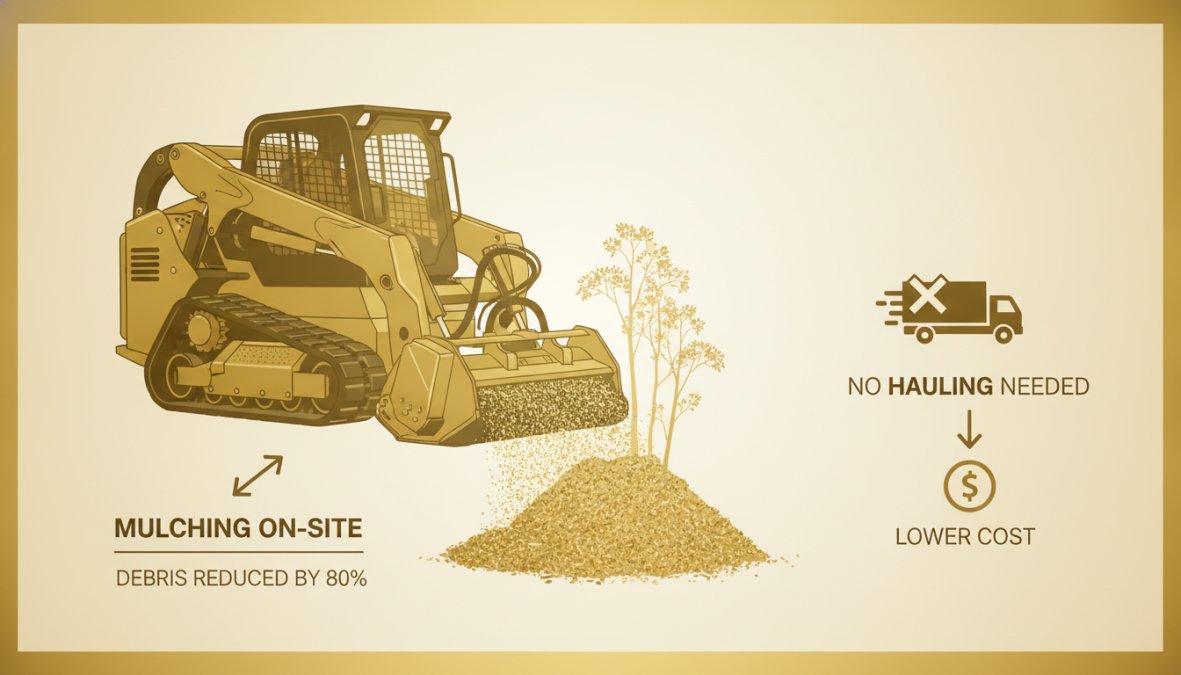
Forestry mulching is the process of grinding trees, brush, stumps, and vegetation into fine, uniform mulch directly on-site using specialized heavy equipment. A forestry mulcher attachment (typically mounted on a skid steer or excavator) uses rotating drums with carbide or steel teeth to process material into 2-4 inch mulch in a single pass, depositing it back onto the ground.
What Does Hauling Debris Away Involve?
Debris hauling is the manual or mechanical removal of cleared material from a property to an off-site location, typically a compost facility, landfill, or transfer station. The process requires cutting or grinding material into manageable sizes, loading it onto trucks, transporting it off-site, and paying disposal fees based on volume or weight. Hauling leaves the property bare, which can be advantageous for construction but removes organic matter that could benefit soil.
Comparison Table: Mulching vs Hauling at a Glance
| Factor | Forestry Mulching | Debris Hauling |
|---|---|---|
| On-Site Processing | Yes, material stays and becomes mulch | No, all material removed |
| Equipment Required | Specialized mulcher (skid steer/excavator) | Trucks, containers, disposal site access |
| Timeline | Single pass, typically 1-3 days | Multiple passes, 3-7 days or longer |
| Soil Health Impact | Adds organic matter, improves structure | Removes nutrients, leaves bare soil |
| Debris Disposal Cost | Minimal (no hauling fees) | High (per-ton or per-load fees) |
| Dust and Noise | Moderate during operation | Moderate during loading/hauling |
| Site Access After | Mulched ground ready for seeding/planting | Bare soil ready for construction |
| Best For | Pasture improvement, erosion control, restoration | Construction prep, complete site clearing |
Forestry Mulching Benefits and Drawbacks
Pros of On-Site Mulching
Nutrient recycling happens immediately. When brush and trees are converted to mulch on-site, organic matter stays in the soil system. This mulch breaks down over months and years, releasing nitrogen, phosphorus, and potassium back into the soil. Pastures treated with forestry mulching show improved soil structure within 12 months, less compaction, better water infiltration, and stronger grass growth.
Cost efficiency scales with property size. Hauling debris charges accumulate by the load or ton. A three-acre property with heavy brush can generate 50+ truckloads. At typical disposal rates of $200-400 per load, that’s $10,000-20,000 in costs. Forestry mulching operates on a flat daily or project rate, making it increasingly cost-effective as the cleared area grows.
Timeline compression is real. Hauling requires multiple passes: cut material, load trucks, wait for disposal, repeat. Forestry mulching does everything in one operation. Most three-acre projects take 2-3 days with a mulcher versus 5-7 days with traditional hauling.
Erosion control is built-in. The mulch layer protects bare soil from wind and water erosion, which is especially important on sloped properties or in areas with seasonal heavy rain.
Mulch from forestry equipment doesn’t compact like hauled-away material. The loose, aerated mulch layer allows water to infiltrate and roots to establish faster, enabling quicker pasture recovery than bare soil.
Cons and Limitations of Mulching
Mulch depth varies with operator skill. Poorly executed mulching can leave uneven coverage, thick piles in some spots, thin patches in others. Professional operators manage depth and distribution carefully, but it’s a variable to monitor.
Large stumps may require multiple passes. Extremely large or deeply rooted stumps sometimes need a second pass or manual removal, adding time and cost to the project.
Material size consistency isn’t guaranteed. Forestry mulchers create variable-sized pieces depending on feed rate and material type. Most mulch is suitable for soil integration, but larger pieces take longer to decompose.
Regulatory compliance varies by location. Some Virginia counties have specific rules about on-site processing, dust control, and noise limits. Professional operators understand local regulations, but it’s a real constraint for DIY attempts.
Debris Hauling: Advantages and Trade-Offs
Pros of Professional Debris Hauling
Complete site clearing leaves a blank canvas. If your project requires construction, driveway installation, or immediate landscaping, hauling removes all obstacles. The bare soil is ready for grading and foundation work without residual material.
Predictable timeline with no surprises. Hauling companies provide fixed estimates and timelines. You know exactly when material will leave the property, which is valuable when coordinating with other contractors.
Regulatory compliance is straightforward. Hauling to licensed disposal facilities ensures all material goes to appropriate locations with clear documentation.
No long-term mulch management required. The property is clean and ready for whatever comes next.
Cons of Hauling Away Yard Waste
Disposal costs compound quickly on large properties. A three-acre property might generate 40-60 truckloads. At $200-400 per load, this easily reaches $8,000-24,000 in disposal costs alone, before equipment and labor.
Soil loses valuable organic matter permanently. Nutrients and organic structure that could improve soil health are gone, leaving bare, often compacted soil that requires years of amendment.
Multiple passes extend project duration. Cutting, loading, transporting, and unloading material takes time. Weather delays or facility scheduling can stretch a project from days into weeks.
Environmental impact is negative. Organic material hauled to landfills decomposes anaerobically, producing methane. Material left on-site decomposes aerobically, sequestering carbon and building soil.
Bare soil left after hauling is vulnerable to erosion and compaction. If you’re not immediately beginning construction or replanting, you may need to seed a cover crop to prevent washout, adding cost and complexity.
Cost Comparison: Mulching vs Hauling Debris Removal
Pricing Factors for Mulching
Forestry mulching pricing depends on property size, vegetation density, terrain accessibility, and equipment availability. Professional mulching typically operates on a daily or project rate with a one-time mobilization charge. Most three-acre projects with moderate brush density cost significantly less than the disposal fees alone for comparable hauling.
Pricing Factors for Debris Hauling
Debris hauling costs are driven by volume, material type, and disposal location. Pricing models vary: per load ($200-500 per truck), by tonnage ($30-80 per ton), or by cubic yard ($15-40 per yard). A three-acre property with moderate brush might generate 40-80 truckloads, totaling $12,000-24,000 in hauling costs. Add equipment rental for cutting and loading ($500-2,000 per day for 3-5 days), and the total approaches $15,000-30,000. Disposal facility tipping fees ($20-50 per ton) add another layer.
Mulching a three-acre property typically costs $2,000-5,000 total, while hauling the same property costs $15,000-30,000 or more. The cost differential often justifies mulching on economic grounds alone, before considering soil health and timeline benefits.
Environmental Impact of Land Clearing: Mulching vs Hauling
Soil Health and Nutrient Recycling
Mulched soil improves measurably over time. Research documents how organic matter incorporation increases soil water-holding capacity by 25-40% and improves nutrient availability within 12 months. Mulch from forestry equipment provides this organic matter directly, eliminating the need for years of compost amendments.
Bare soil left after hauling is nutrient-depleted. The vegetation removed contained nitrogen, phosphorus, and potassium that would have cycled back into the system. Without that organic input, bare soil requires external fertilization, creating ongoing costs and environmental runoff concerns.
Soil structure recovery is faster with mulch. Compacted soil recovers more quickly when covered with mulch. The mulch protects the surface, reduces compaction from rainfall, and provides organic material that soil organisms use to rebuild structure.
Landfill Diversion and Sustainability
Mulching keeps organic material out of landfills. Yard debris represents approximately 5-6% of landfill volume nationally. Forestry mulching diverts this material entirely, reducing landfill pressure and associated methane emissions.
Hauling creates carbon footprint from transportation. Trucks hauling debris consume fuel and emit greenhouse gases. A typical three-acre clearing project generating 50+ truckloads represents significant transportation emissions.
Anaerobic decomposition in landfills produces methane. Organic material in landfills decomposes without oxygen, producing methane, a greenhouse gas 28-36 times more potent than carbon dioxide over 100 years. Material left on-site decomposes aerobically, producing water and carbon dioxide instead.
A single three-acre clearing project diverted to mulching instead of landfill prevents approximately 2-4 tons of organic material from generating methane emissions, equivalent to removing a car from the road for 2-3 months.
Site Preparation for Construction: Choosing the Right Method
When Mulching Suits Your Site Prep Needs
Mulching is the right choice for pasture restoration, erosion control, wildlife habitat improvement, or long-term land usability. If you’re clearing land to improve grazing quality, restore native vegetation, or stabilize slopes, mulching delivers immediate results. For rural properties and landowners focused on land health rather than immediate construction, mulching is almost always the better choice economically and environmentally.
When Hauling Makes Sense for Construction Projects
Hauling is appropriate when you need a completely clear, bare site ready for immediate construction, grading, or foundation work. Hauling is also necessary if local zoning or environmental regulations prohibit on-site processing, or if your property has contaminated soil or disease-infected trees you want completely removed.
Safety Hazards and Regulatory Compliance
Safety Risks of Debris Piles and On-Site Processing
Debris piles create hazards. Large piles of brush and stumps are unstable and can collapse without warning. They also create hiding places for snakes and rodents.
Forestry mulching equipment requires skilled operation. A mulcher attachment is powerful and unforgiving. Operator error can cause serious injury. Professional operators are trained and insured specifically for this work. DIY attempts significantly increase accident risk.
Dust and noise during mulching require management. Professional operations manage these through equipment timing, dust suppression, and neighbor communication. Unmanaged operations can violate local ordinances.
Zoning and Regulatory Requirements
Virginia zoning varies by county and locality. Some areas have specific regulations about land clearing and on-site processing. Professional companies understand local requirements and obtain necessary permits.
Environmental compliance matters for sensitive areas. If your property is near a stream or wetland, clearing must follow specific protocols. Forestry mulching can be preferable because it eliminates heavy truck traffic and keeps organic material on-site.
Noise and dust ordinances may restrict timing. Some jurisdictions limit land-clearing activities to specific hours or seasons. Professional operators schedule work to comply with these restrictions.
Permitting requirements vary. Some properties require clearing permits before work begins. Professional companies handle permitting as part of the service, ensuring compliance and protecting you from liability.
Choosing between mulching and hauling debris away depends on your timeline, budget, soil goals, and local regulations. Mulching excels for properties focused on long-term land health, pasture improvement, and cost efficiency. Hauling makes sense for immediate construction projects or situations where regulatory compliance demands off-site disposal. Professional assessment identifies which method delivers the best results for your specific situation.
Frequently Asked Questions
Is forestry mulching better than hauling debris away?
Neither is universally better, it depends on your goals. Forestry mulching excels at improving soil health through nutrient recycling and on-site processing, making it ideal for pasture preparation or long-term land usability. Hauling debris away is faster for complete site clearance and works better when you need the land immediately for construction or when local regulations restrict on-site debris piles. Consider your timeline, budget, and future land use before deciding which method suits your property.
What are the main cost differences between mulching and hauling debris?
Cost comparison depends on property size, debris volume, and local market rates. Mulching typically involves heavy equipment operation and on-site processing labor. Hauling requires transportation, tipping fees at landfills or compost facilities, and labor for loading. For large properties with significant vegetation, mulching often proves more cost-effective per acre because it eliminates hauling and tipping fees. However, smaller jobs may favor hauling if debris volumes are minimal. Request detailed quotes from professional services to compare pricing for your specific situation and property size.
How does mulching improve soil health compared to hauling debris away?
Mulching preserves organic matter and nutrients on your property through on-site processing. The resulting mulch enriches topsoil, improves water retention, and supports beneficial microbial activity, critical for pasture or future vegetation growth. Hauling removes all organic material, leaving depleted soil that requires external fertilization and amendment. If long-term soil health and land usability matter for your property, mulching’s nutrient recycling provides measurable advantages. This is especially important for rural properties where you want to restore land productivity without expensive inputs.
What’s the environmental impact of choosing mulching versus hauling debris?
Mulching diverts yard waste from landfills, reduces transportation emissions, and promotes landfill diversion, a key environmental sustainability goal. The nutrient-rich mulch created stays on-site, eliminating the need for chemical fertilizers. Hauling removes debris but increases carbon footprint through vehicle transport and contributes to landfill volume. However, hauling may be preferable if local regulations prohibit debris piles or if your site has contaminated soil. Evaluate your local environmental priorities and zoning rules to determine which method aligns with both regulations and sustainability goals.
How do I know if my property is suitable for forestry mulching equipment?
Professional land clearing contractors assess site access, terrain, vegetation density, and obstacles (rocks, stumps, buried debris) during an initial property evaluation. Forestry mulching works best on properties with adequate equipment access and manageable terrain. Very steep slopes, poor drainage, or extremely rocky ground may present challenges. Professional operators with experience on Central Virginia properties can identify potential issues, like unexpected rocks or stumps, upfront and adjust their approach. Request a comprehensive property assessment from experienced contractors before committing to either method.
This article was written using GrandRanker