Table of Contents
- Understanding Land Clearing for Property Development
- Land Clearing Methods and Techniques
- Cost of Land Clearing Per Acre
- Land Clearing Permits and Regulations
- Site Preparation for Construction
- Land Clearing Equipment Rental vs. Professional Contractors
- How to Prepare for Your Land Clearing Project
- Conclusion
Last Updated: July 13, 2026
Understanding Land Clearing for Property Development
Land clearing for property development involves removing trees, vegetation, stumps, rocks, and debris to prepare sites for construction or other uses. The scope varies dramatically depending on your property’s current condition, a residential lot with light brush differs entirely from commercial land requiring extensive excavation and grading. Most property developers underestimate both time and cost requirements for adequate site preparation, which directly impacts your project’s schedule, budget, and long-term soil health.
Why Land Clearing Matters for Development Projects
Proper site preparation prevents foundation problems, drainage issues, and environmental compliance violations that can halt construction entirely. Properties with inadequate clearing create compounding problems: heavy machinery struggles with remaining stumps and rocks, soil composition issues emerge during foundation work, and drainage patterns become unpredictable. Environmental regulations increasingly require documented clearing practices, erosion control measures, and soil testing before development can proceed. Skipping proper land clearing exposes you to regulatory fines and project delays.
Key Factors That Affect Your Project Scope
Vegetation density represents the single largest variable in clearing costs and timeline. Heavy forestry mulching equipment becomes necessary for dense conditions, while lighter machinery suffices for sparse vegetation. Topography and terrain type dramatically influence your clearing strategy, steep hillsides require different approaches than flat land, and rocky terrain demands additional equipment for stone removal. Soil composition affects post-clearing work and long-term site usability, while site access determines whether heavy machinery can reach all areas efficiently.
Land Clearing Methods and Techniques
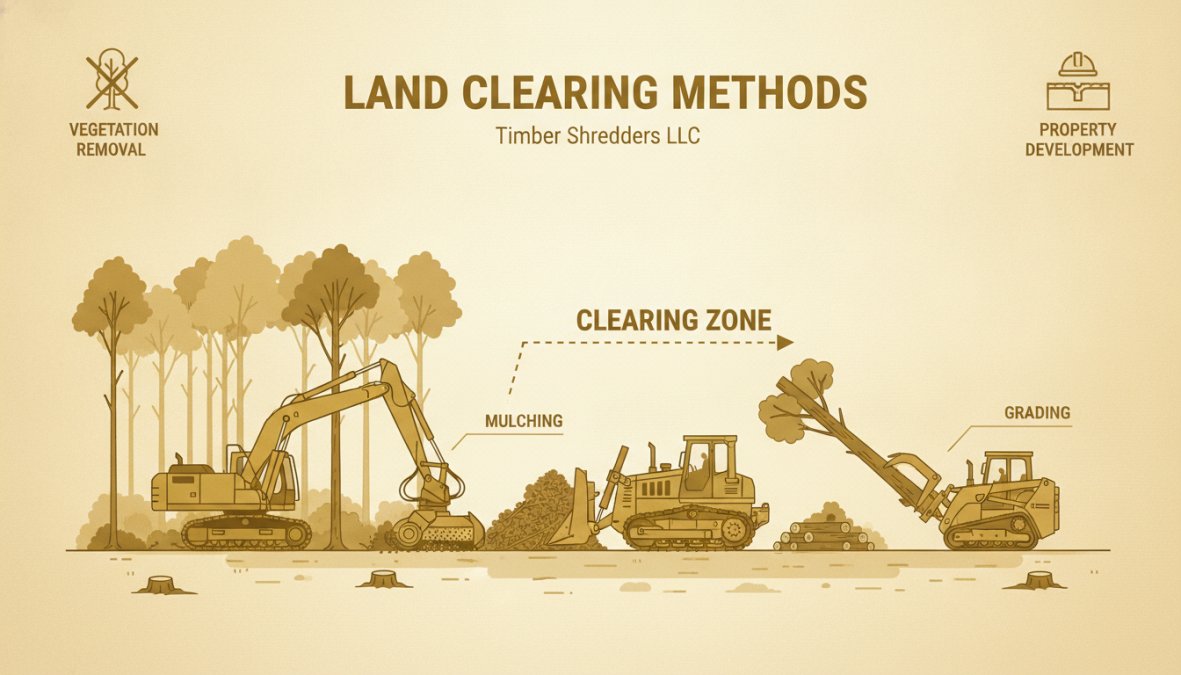
Dozing and Grading
Dozing uses heavy bulldozers to push vegetation, soil, and debris across the property, working effectively for properties requiring significant grading and foundation preparation. Grading follows to establish proper drainage patterns and building pad elevations, preventing water accumulation around future structures. However, dozing creates significant soil disturbance and can compact soil excessively, reducing future drainage capacity. In environmentally sensitive areas, dozing may violate erosion control regulations.
Forestry Mulching and Brush Clearing
Forestry mulching grinds vegetation into fine mulch while clearing the land, working particularly well for dense brush and smaller trees. The resulting mulch can remain on-site to improve soil health or be removed if preferred. This method improves soil composition by adding organic material back into the earth and reduces erosion risk. Brush clearing specifically targets undergrowth and small trees without disturbing larger trees you want to preserve. The main limitation is equipment cost and availability in some regions.
Tree Removal and Stump Removal
Tree removal brings down standing trees safely and removes them from the property, requiring specialized equipment and trained operators to prevent damage to surrounding structures. Stump removal presents a separate challenge, stump grinding removes the stump below ground level while complete extraction removes the entire root system. For land clearing for property development, complete stump removal often proves necessary for construction equipment access and prevents hazards and drainage problems.
Cost of Land Clearing Per Acre
Pricing Models: Hourly Rates vs. Flat Rates
Contractors typically offer either hourly rates or flat project fees. Hourly rates work best for projects with uncertain scope, while flat rates require detailed site assessment but provide budget certainty and incentivize efficient work completion. Many contractors recommend hybrid approaches where initial assessment costs are hourly, but main clearing work operates on flat rates.
How Vegetation Density and Topography Impact Pricing
Dense vegetation dramatically increases clearing costs and timeline. Topography affects equipment access and work efficiency, steep terrain slows progress and may require additional safety measures. Rocky terrain adds hidden costs that emerge during work, while wet or marshy conditions extend project timelines significantly.
| Factor | Impact on Cost | Impact on Timeline |
|---|---|---|
| Dense vegetation | High increase | Extends 2-4 weeks |
| Steep topography | Moderate increase | Extends 1-2 weeks |
| Rocky terrain | High increase | Extends 1-3 weeks |
| Wet soil conditions | Moderate increase | Extends 2-6 weeks |
| Large mature trees | High increase | Extends 1-2 weeks |
Land Clearing Permits and Regulations
Zoning Requirements and Environmental Compliance
Local zoning regulations dictate what clearing activities are permitted on your property. Some jurisdictions restrict tree removal in environmentally sensitive areas, and wetland regulations may prohibit clearing within certain distances of water features. Environmental impact assessments are increasingly required before major clearing projects to identify protected species, wetlands, and sensitive habitats. Permit requirements vary dramatically by jurisdiction, some require detailed clearing plans submitted weeks before work begins, while others require environmental bonds to ensure proper erosion control.
Erosion Control and Environmental Impact Considerations
Erosion control measures protect surrounding properties and water quality during clearing through silt fences, sediment basins, and stabilized exit points. Vegetation removal affects stormwater drainage patterns, and post-clearing site stabilization through seeding or mulching prevents erosion and runoff problems. Soil health considerations influence post-clearing site conditions, removing all topsoil leaves poor-quality soil for landscaping, while preserving topsoil improves long-term site usability. Environmental compliance costs money upfront but prevents far more expensive problems and regulatory violations that can halt projects for months.
Site Preparation for Construction
Soil Composition Assessment and Post-Clearing Maintenance
Soil testing after clearing reveals composition, compaction levels, and bearing capacity. Professional soil testing prevents foundation problems that emerge months or years after construction. Compaction testing ensures soil can support building loads safely, while post-clearing maintenance includes managing runoff, preventing erosion, and stabilizing exposed soil through temporary seeding or erosion control blankets. Drainage system installation becomes critical after clearing to prevent water accumulation under structures.
Land Clearing Equipment Rental vs. Professional Contractors
Comparing Equipment Options: Skid Steer, Excavator, and Heavy Machinery
Skid steers offer versatility for smaller clearing projects and navigate tight spaces effectively, though they lack power for dense vegetation. Excavators provide digging and material handling capabilities for more substantial work. Bulldozers and heavy grading equipment become necessary for large-scale land clearing but escalate costs significantly. Forestry mulchers represent specialized equipment for vegetation-heavy clearing and require trained operators.
When to Hire a Professional vs. Rent Equipment
Hiring professional contractors makes sense when your project exceeds your equipment operation skills or timeline constraints. Professionals bring experience, proper insurance, and regulatory knowledge. Equipment rental works well for property owners with construction experience and flexible timelines, though you assume liability for damage and regulatory compliance. For most property development projects, professional contractors provide better value by navigating regulatory requirements, completing work efficiently, and providing warranty protection.
How to Prepare for Your Land Clearing Project
Land Survey and Site Assessment
Professional land surveys establish exact property boundaries and identify easements or restrictions affecting clearing work. Site assessment identifies vegetation density, topography challenges, and potential obstacles. Environmental assessment may be required before clearing in sensitive areas to identify protected species and environmental restrictions.
Creating a Project Timeline and Budget
Clear project timelines set realistic expectations and help coordinate with other construction phases. Detailed budgets account for clearing work, equipment rental or contractor fees, permit costs, and contingency funds, most projects benefit from 10-15% contingency reserves. Coordinate clearing work with other site preparation activities to prevent conflicts and ensure efficient site preparation.
Common Mistakes to Avoid
Underestimating vegetation density leads to extended timelines and budget overruns. Skipping environmental assessment creates regulatory problems and project delays. Failing to preserve topsoil wastes valuable soil resources and increases landscaping costs. Inadequate erosion control during clearing contaminates adjacent properties and violates regulations. Ignoring drainage during clearing creates persistent water problems in finished buildings.
Land clearing for property development represents a foundational investment in your project’s success. Properties that receive proper clearing work progress smoothly through construction phases while those with inadequate preparation face delays and cost overruns. Timber Shredders LLC specializes in comprehensive land clearing that handles site assessment, environmental compliance, equipment operation, and post-clearing site preparation. Their experienced operators use professional equipment to transform raw property into construction-ready land efficiently.
Frequently Asked Questions
What is the process of land clearing for property development?
Land clearing for property development involves assessing site conditions, removing trees and vegetation, grading the land, and preparing the soil for construction. The process typically starts with a land survey to evaluate topography, vegetation density, and soil composition. Professional contractors use equipment like excavators, skid steers, and dozers to clear brush, remove stumps, and grade the site. The final step includes debris disposal and erosion control measures to meet environmental regulations.
How much does land clearing cost per acre?
Land clearing costs vary significantly based on vegetation density, terrain, topography, and location. Pricing depends on whether you choose hourly rates or flat-rate per-acre pricing, the clearing method used (dozing, mulching, or manual removal), and additional services like stump removal and debris disposal. For accurate pricing specific to your property, contact Timber Shredders LLC for a comprehensive assessment and free quote tailored to your site conditions.
Do I need a permit to clear land on my property?
Permit requirements for land clearing vary by location and zoning regulations. Many jurisdictions require permits for tree removal, especially in environmentally sensitive areas. You may need approval for erosion control plans, stormwater management, and compliance with local environmental regulations. Before starting your land clearing project, check with your local planning department and consider consulting a professional who understands permit requirements in your area.
What is the difference between land clearing and grubbing?
Land clearing removes trees, brush, and vegetation from a property to expose the ground surface. Grubbing goes deeper, removing tree stumps, roots, and underground debris to prepare soil for construction or replanting. Site preparation for construction often requires both processes. Grubbing can be labor-intensive and costly, but it’s essential for creating a stable foundation for building and improving overall land usability.
Should I rent equipment or hire a professional contractor for land clearing?
Equipment rental works for small, straightforward projects if you have operating experience. However, professional contractors bring expertise in site assessment, equipment selection, regulatory compliance, and safety. They understand how vegetation density, topography, and soil composition affect the project. For most property development projects, hiring an experienced contractor like Timber Shredders LLC ensures proper site preparation, faster completion, and reduced liability.
What happens to debris after land clearing?
Debris disposal is a critical component of land clearing. Options include chipping and mulching vegetation for reuse, hauling debris to designated disposal facilities, or burning (where permitted). Forestry mulching is an eco-friendly method that grinds trees and brush into mulch, improving soil health and reducing disposal costs. Your contractor should include debris removal in the project plan and handle proper disposal according to local environmental regulations.
This article was written using GrandRanker