Table of Contents
- Understanding Land Clearing Methods for Pasture Expansion
- Forestry Mulching for Pasture: Benefits and Process
- Stump Removal and Site Preparation
- Soil Testing and Health Restoration Post-Clearing
- Pasture Establishment After Clearing
- Cost of Land Clearing Per Acre and Budgeting
- Common Mistakes to Avoid When Clearing Land for Pasture
- Conclusion
Clearing Land for Pasture Expansion: A Complete Guide
Last Updated: July 16, 2026
Clearing land for pasture expansion represents a significant investment often approached with incomplete information. At Timber Shredders LLC, we’ve spent years helping property owners in Central Virginia reclaim overgrown land and transform it into productive pasture. The difference between success and costly failure comes down to understanding which methods work best for your situation, how to protect soil health, and what happens after clearing ends.
This guide walks you through every phase of clearing land for pasture expansion, from selecting the right method to establishing thriving forage.
Understanding Land Clearing Methods for Pasture Expansion
The method you choose shapes everything that follows: soil health, timeline, cost, and long-term productivity.
Forestry Mulching vs. Traditional Clearing Approaches
Forestry mulching grinds trees, brush, and woody debris into fine mulch on-site, eliminating debris piles and leaving organic material that improves soil structure. Traditional clearing typically involves felling trees, piling slash, and either burning or hauling debris away, a process that removes valuable organic matter and often leaves soil compacted.
For pasture establishment, this distinction matters enormously. Soil with organic matter infiltrates water better, supports beneficial microbes, and requires less supplemental fertilization. Forestry mulching works best on properties with moderate to dense brush and timber, especially on sloped terrain where erosion control is critical. Traditional clearing remains better for narrow corridors, around structures, or when salvaging high-value timber.
Heavy Equipment Requirements and Options
The machinery you use determines how quickly work gets done and the long-term condition of your soil. A skid steer with a brush cutter handles light to moderate vegetation. An excavator with a root rake tackles heavy clay and root systems. A forestry mulcher processes standing timber and dense brush into mulch in a single pass.
Choosing equipment means matching the machine to your soil type and vegetation density. Wet clay soil compacts severely under heavy tracked equipment, creating hardpan that restricts root penetration for years. Most landowners choose between renting equipment and operating it themselves, hiring a contractor with their own machinery, or using a combination approach.
Forestry Mulching for Pasture: Benefits and Process
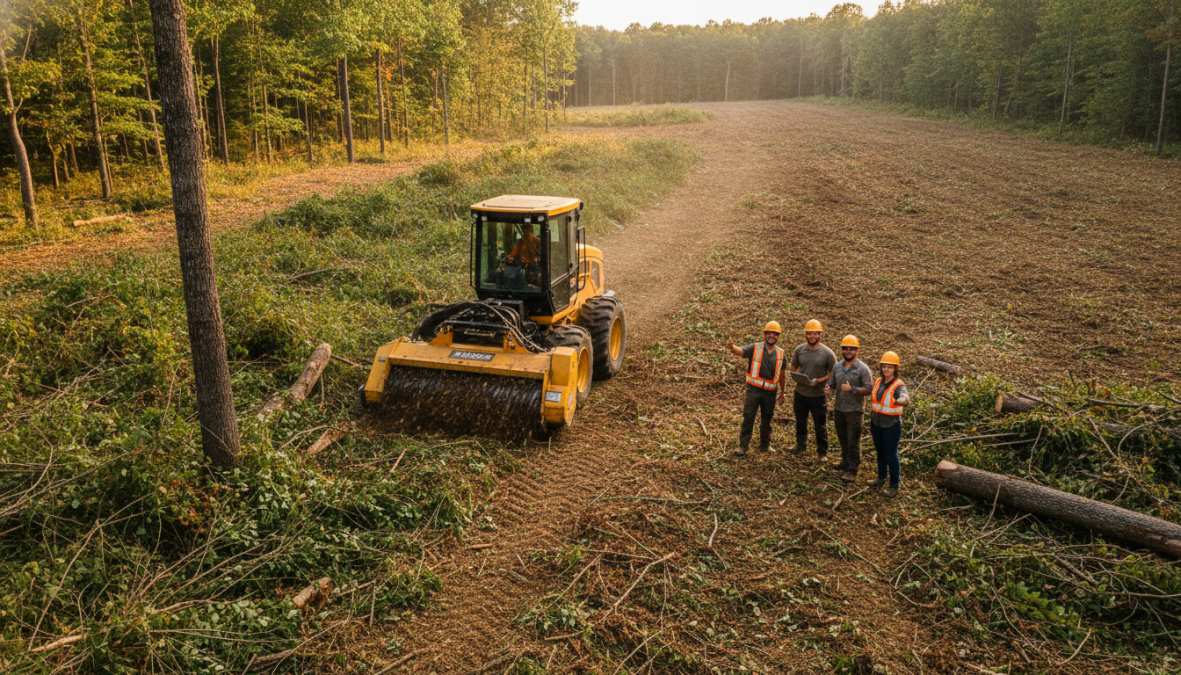
Forestry mulching creates conditions that traditional clearing cannot match. The process grinds standing timber, brush, and woody debris into mulch particles that remain on-site, creating immediate soil amendment while eliminating debris removal problems.
How Forestry Mulchers Improve Soil Health
The mulch produced serves multiple functions. It provides immediate ground cover that prevents erosion during the critical period between clearing and pasture establishment. As the mulch decomposes over 12-24 months, it feeds soil microbes and improves water retention.
Soil structure improves measurably after forestry mulching. Compacted clay becomes more friable as organic matter increases. Water infiltration improves because mulch absorbs and distributes moisture. Fine mulch (under 2 inches) integrates into soil faster and provides better ground cover. Coarse mulch (2-4 inches) takes longer to break down but offers superior erosion control on slopes.
Request a mulch sample from the contractor before full clearing. Quality mulch should feel like coarse sawdust, not wood chips. Poor mulch won’t integrate into soil properly and slows pasture establishment.
Debris Management and Erosion Control
Forestry mulching eliminates the debris pile problem that plagues traditional clearing. The mulch stays on-site and works for you. On sloped terrain, this matters tremendously. Bare soil on slopes loses 10-50 tons per acre annually. Mulch-covered soil loses a fraction of that. During the first heavy rain after clearing, mulch-protected areas show minimal erosion while bare spots develop visible gullies.
Stump Removal and Site Preparation
After trees are cleared, stumps and root systems remain. These obstacles must be addressed before establishing pasture. Stumps in a grazing field create hazards and damage equipment.
Grubbing and Root Removal Techniques
Grubbing removes stumps and root systems using a root rake, essentially a large comb attached to an excavator, that tears stumps from the ground and pulls roots to the surface. You have three options for root piles: bury them in low-lying areas, chip them with a forestry mulcher, or haul them away.
Timing of grubbing affects soil damage. Grubbing wet soil creates deep ruts and compaction. Wait until soil is dry enough that a footprint doesn’t fill with water.
Grubbing in wet soil creates compaction that restricts root growth for 3-5 years. A single careless pass with a heavy excavator in saturated clay can harden soil so severely that pasture roots cannot penetrate. Always test soil moisture before starting.
Addressing Soil Compaction After Clearing
Heavy equipment leaves compacted soil. On clay soils, this can create a hardpan layer lasting years. A better approach is to scarify only heavily trafficked areas, then rely on natural processes and cover crops to break up remaining compaction.
Cover crops accelerate compaction recovery. Legumes send deep taproots that penetrate compacted layers. Grasses develop fibrous root systems that improve soil structure. A cover crop established immediately after clearing works for 6-12 months, breaking up compaction and adding organic matter before permanent pasture establishment.
Soil Testing and Health Restoration Post-Clearing
Clearing removes vegetation that was extracting nutrients and organic matter from soil. Before establishing pasture, you need to know what you’re working with.
Why Soil Testing Matters for Pasture Success
A soil test measures pH, nutrient levels (phosphorus, potassium, calcium, magnesium), organic matter, and trace minerals. These results determine what amendments you need. Pasture quality depends on soil chemistry. Forage quality, disease resistance, and animal performance all trace back to soil fertility.
Get testing done 2-3 weeks after clearing, once soil has settled. Send samples from multiple areas: cleared upland, low spots, and transition zones.
Liming, Fertilization, and Cover Crops
Most pasture forage performs best at pH 6.0-7.0. If your soil test shows pH below 6.0, lime application is essential. Lime raises pH and provides calcium and magnesium. Follow soil test recommendations precisely; over-liming can create nutrient imbalances.
Fertilization follows soil test results. Nitrogen is often needed but should be applied after pasture is established, not before seeding. Cover crops establish while waiting for spring seeding or immediately after clearing. A winter cover crop of rye or oats protects soil through winter and adds organic matter.
Pasture Establishment After Clearing
Once soil is tested, amended, and compaction is addressed, you’re ready to seed.
Seeding Rates and Forage Quality Selection
Seeding rate depends on forage species, soil condition, and climate. Cool-season grasses like tall fescue, orchardgrass, and timothy are standard in Virginia. Legumes like clover and alfalfa add nitrogen fixation and nutritional value. A typical mix for beef cattle pasture might be 20 lbs/acre of grass seed and 5 lbs/acre of legume seed.
Most successful pastures combine species: grasses for persistence and volume, legumes for nutrition and nitrogen fixation. This diversity provides insurance; if one species struggles in a dry year, others fill the gap.
Weed Control and Rotational Grazing Planning
Weeds will emerge during the first year. Aggressive early management prevents establishment. Mowing at the right height and herbicide application target problem weeds without harming desirable forage.
Rotational grazing prevents overuse of new pasture. Divide the pasture into paddocks and rotate animals every 2-4 weeks. This allows forage to recover between grazing periods, improving both animal nutrition and pasture longevity.
| Aspect | Action | Timing | Impact |
|---|---|---|---|
| Soil Testing | Send samples from multiple areas | 2-3 weeks after clearing | Determines amendment needs |
| Liming | Apply lime per soil test | 4-6 weeks before seeding | Raises pH, improves nutrient availability |
| Cover Crop | Establish legume or grass mix | Immediately after clearing | Builds organic matter, breaks compaction |
| Seeding | Apply forage seed at proper rate | Spring or fall, soil temp 50°F+ | Establishes permanent pasture |
| Weed Control | Mow or spray emerging weeds | Throughout first growing season | Prevents weed dominance |
| Rotational Grazing | Move animals every 2-4 weeks | From month 6 onward | Allows forage recovery |
Cost of Land Clearing Per Acre and Budgeting
Clearing costs vary widely based on vegetation density, terrain, equipment type, and debris removal.
Equipment Rental vs. Purchase ROI Calculator
For a one-time clearing project, renting is almost always cheaper than buying. A forestry mulcher costs $150,000-300,000 new; daily rental runs $2,000-4,000. An excavator costs $80,000-150,000; daily rental is $400-800. For a typical property clearing, you’ll need equipment for 5-15 days. Total rental cost typically runs $5,000-20,000.
Professional contractors typically charge $1,500-4,000 per acre for complete clearing including forestry mulching and grubbing. DIY clearing with rented equipment costs $500-1,500 per acre but requires operator skill and takes longer.
Don’t forget soft costs: soil testing ($200-500), lime and fertilizer ($200-400 per acre), seed ($100-300 per acre), and permitting ($500-2,000). Total project cost for a 10-acre clearing typically runs $25,000-60,000 including all phases.
The cheapest clearing is rarely the best clearing. A contractor who rushes through work, leaves stumps, or ignores soil compaction saves money upfront but costs you years of poor pasture performance. Budget for quality work.
Permitting and Environmental Compliance Costs
Some properties require permits before clearing. Wetland areas, stream buffers, and sensitive habitats may have restrictions. Check with your county conservation office and Virginia Department of Environmental Quality before starting. A wetland delineation or environmental assessment adds $500-2,000 but prevents costly violations.
Burn permits are required if burning debris. If burning isn’t allowed, you must chip or haul debris, adding $500-2,000 to the project. Forestry mulching eliminates this question entirely.
Common Mistakes to Avoid When Clearing Land for Pasture
Clearing in wet soil. This is the single most expensive mistake. Wet soil compacts severely, and that compaction lasts years. Always wait until soil is dry enough that a footprint doesn’t fill with water.
Leaving stumps and roots. Stumps create hazards for animals and equipment. Roots left in place prevent forage establishment. Proper grubbing is non-negotiable for functional pasture.
Ignoring soil compaction. If you don’t address compaction through cover crops or time, your new pasture will struggle. Forage roots can’t penetrate hard soil.
Seeding without soil testing. A $300 soil test prevents $5,000 in wasted seed and fertilizer. Soil pH, nutrient levels, and organic matter determine whether your seed will germinate and grow.
Overgrazing in year one. New pasture needs time to establish. Use rotational grazing and allow forage to reach 6 inches before grazing.
Choosing the wrong forage species. Not all pasture mixes work everywhere. Ask your extension office what works best for your specific soil and climate.
Conclusion
Clearing land for pasture expansion is a significant undertaking, but it’s one of the most impactful improvements you can make to your property. The difference between success and failure often comes down to method selection, timing, and attention to soil health.
Timber Shredders LLC specializes in professional land clearing using forestry mulching technology that preserves soil while removing unwanted vegetation. Whether you’re expanding existing pasture or converting overgrown land to productive grazing, the process requires planning, proper equipment, and expertise. Get a FREE quote from Timber Shredders LLC today and let’s discuss how to transform your property efficiently while protecting the soil that will support your pasture for years to come.
RESOURCES & CITATIONS:
According to Virginia Tech’s pasture management guidelines, proper soil preparation and pH management increase forage yield by 20-30% compared to unmanaged clearings.
Research from USDA Natural Resources Conservation Service on soil health demonstrates that organic matter additions through mulching improve water retention and reduce erosion rates by up to 80% on sloped terrain.
The University of Kentucky’s forage quality standards provide species-specific seeding rates and forage quality metrics that should guide your pasture establishment decisions.
Frequently Asked Questions
What is the cheapest way to clear land for pasture expansion?
The most cost-effective approach depends on your land conditions and timeline. Forestry mulching is often competitive because it eliminates separate debris removal and can improve soil health simultaneously. Equipment rental (skid steers, excavators, or root rakes) is typically cheaper than purchasing, especially for one-time projects. Get a professional assessment to compare clearing methods and pricing for your specific property.
How do you prepare cleared land for pasture after removing vegetation and stumps?
After clearing, conduct soil testing to check pH, nutrient levels, and compaction. Address compaction with tillage if needed. Apply lime or fertilization based on test results, most pastures benefit from soil pH between 6.0-7.0. Plant cover crops to prevent erosion and restore organic matter. Finally, seed your pasture mix at the recommended seeding rate for your region and forage type, then implement rotational grazing to maintain forage quality.
What equipment is needed to clear land for pasture expansion?
Common equipment includes bulldozers for pushing vegetation, skid steers with root rakes for stump removal and grubbing, forestry mulchers for chipping woody debris, and excavators for drainage work. For smaller properties, a brush cutter or mower may suffice. Professional land clearing contractors typically own or rent heavy equipment. Assess your property size, vegetation density, and soil conditions to determine which equipment combination is most efficient for your project.
How does forestry mulching benefit soil health compared to traditional land clearing?
Forestry mulching chips vegetation and woody debris on-site, leaving nutrient-rich mulch that improves soil structure and reduces erosion. Traditional clearing (bulldozing and debris removal) often leaves bare, compacted soil prone to runoff. The mulch layer from forestry mulching acts as organic matter, moderates soil temperature, and reduces weed pressure. This leads to better long-term pasture establishment and lower maintenance costs, though initial forestry mulching costs may be higher than basic bulldozing.
This article was written using GrandRanker