Table of Contents
- What Is Forestry Mulching and How Does It Work
- 7 Key Benefits of Forestry Mulching for Land
- 1. Improved Soil Health and Organic Matter
- 2. Erosion Control and Reduced Soil Disturbance
- 3. Cost-Effectiveness Compared to Traditional Methods
- 4. Wildfire Prevention and Reduced Fire Risk
- 5. Environmental Friendliness and Sustainable Land Management
- 6. Native Plant Growth and Invasive Species Control
- 7. Enhanced Property Aesthetics and Increased Value
- Mulching for Soil Health: Long-Term Improvements
- Forestry Mulching vs Traditional Land Clearing: A Direct Comparison
- Wildlife Habitat Improvement Through Forestry Mulching
- Forestry Mulching Cost Per Acre: Pricing and Value Factors
- Potential Limitations and Drawbacks You Should Know
- Maintenance and Long-Term Management After Mulching
Last Updated: July 19, 2026
What Is Forestry Mulching and How Does It Work
Forestry mulching is a land management process that uses specialized equipment to grind vegetation, brush, saplings, and small trees into nutrient-rich mulch in a single pass. Unlike traditional methods that remove debris entirely, forestry mulching leaves the processed material on-site as a protective mulch layer.
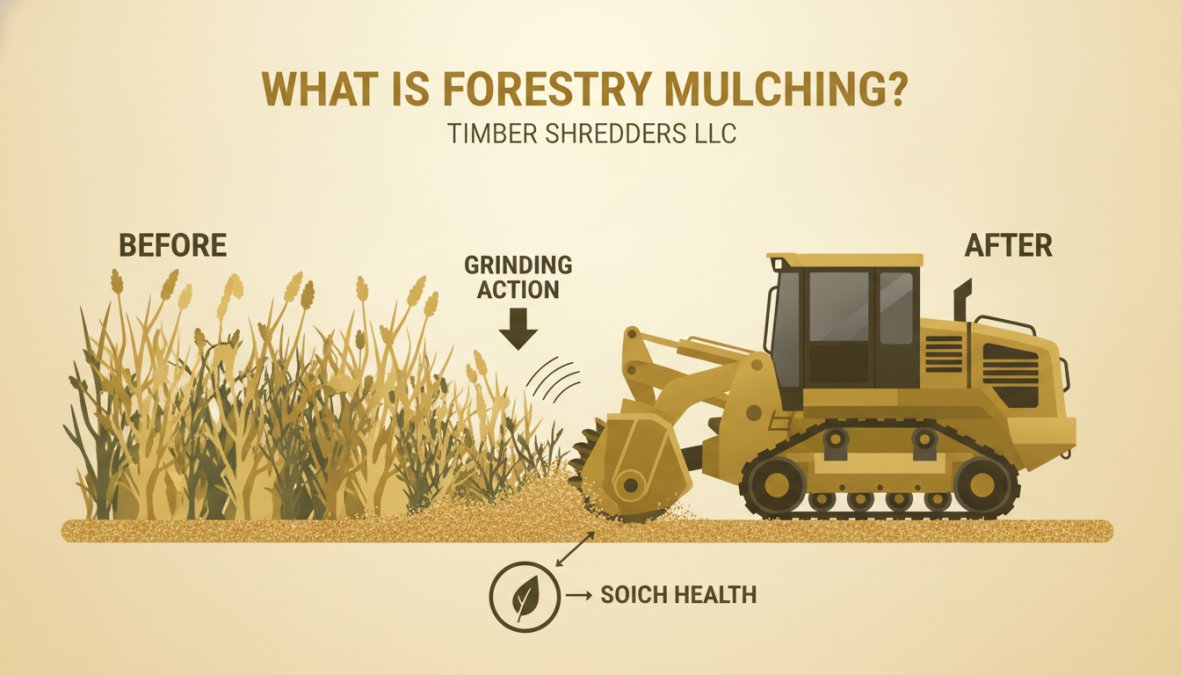
The process works by feeding dense underbrush, fallen branches, and woody debris through a rotating drum or disc with hardened teeth. The equipment breaks everything down into uniformly-sized mulch particles that settle across the cleared area. The entire operation happens in one continuous motion, without requiring separate equipment for grinding, hauling, or debris removal.
The Single-Pass Process Explained
A single-pass forestry mulching operation accomplishes multiple tasks simultaneously that traditionally required separate contractors and equipment. The mulcher attachment grinds vegetation while the operator navigates the property, creating cleared land and distributing mulch in one coordinated movement.
The equipment typically operates on skid steers or excavators equipped with mulcher attachments. These machines can access tight spaces where traditional bulldozers would struggle. This single-pass efficiency saves weeks of project time, traditional land clearing involves cutting vegetation, removing debris with separate hauling equipment, and then grading the site. Forestry mulching collapses these steps into days rather than weeks.
The grinding depth matters more than most realize. Operators should target 2-4 inches of mulch layer for optimal soil coverage, deep enough to suppress weeds and retain moisture, but not so thick that it prevents water penetration or creates matting issues.
Equipment and Technology Behind Forestry Mulching
Modern forestry mulching equipment features variable-speed drums, adjustable discharge heights, and precision controls that allow operators to customize mulch particle size and distribution patterns. The most common equipment includes skid steers with mulcher heads, tracked excavators with specialized attachments, and dedicated mulching machines. Skid steers excel on relatively flat terrain and in tight residential spaces. Excavators handle steeper slopes and larger debris.
Hardened steel teeth withstand impact from rocks and hidden metal without frequent replacement. Variable-speed hydraulics allow operators to adjust grinding force based on vegetation density. Some systems include real-time load monitoring, preventing equipment strain when hitting unexpected obstacles.
Professional-grade equipment with proper maintenance reduces unexpected downtime and ensures consistent mulch quality throughout your project. Equipment age and maintenance history directly correlate with project timeline predictability.
7 Key Benefits of Forestry Mulching for Land
1. Improved Soil Health and Organic Matter
Forestry mulching directly enhances soil health by adding significant organic matter to your land. As the mulch decomposes, it releases nitrogen, phosphorus, and potassium, essential nutrients for vegetation growth. The decomposition process increases microbial activity in soil, improving its biological structure and creating better conditions for root development and water infiltration.
Properties treated with forestry mulching show measurable improvements in soil composition within 12-18 months. This natural nutrient cycling reduces the need for expensive fertilizer applications on pasture land or future landscaping projects.
Avoid assuming all mulch settles evenly on rocky terrain. Uneven distribution can create water pooling in depressions and nutrient concentration imbalances. Proper equipment operation and site assessment prevent these issues.
2. Erosion Control and Reduced Soil Disturbance
One of the most compelling benefits of forestry mulching is its role in erosion prevention. The mulch layer acts as a protective barrier against rainfall impact, reducing soil particle displacement and runoff velocity significantly. Traditional land clearing methods like bulldozing remove topsoil through physical scraping and compaction. Forestry mulching leaves existing soil structure intact while adding protective coverage.
The mulch layer reduces water runoff speed by 40-60% compared to bare soil. This slower water movement allows better infiltration, reducing flood risk on downslope properties and improving groundwater recharge.
3. Cost-Effectiveness Compared to Traditional Methods
Forestry mulching typically costs significantly less than traditional land clearing when accounting for total project expenses. A single-pass operation eliminates separate charges for cutting, debris hauling, grinding, and grading that traditional contractors bill separately. The time savings alone, reducing a two-week project to three days, represents substantial cost reduction when considering equipment rental, labor, and project overhead.
Properties with dense brush and extensive underbrush see the greatest cost advantages. The more vegetation present, the more hauling costs traditional methods incur.
Request detailed cost breakdowns from contractors. Legitimate operators provide line-item estimates showing equipment costs, operator time, and site conditions that affect pricing. Hidden costs typically emerge when contractors discover unexpected rocks, stumps, or difficult terrain mid-project.
4. Wildfire Prevention and Reduced Fire Risk
Forestry mulching dramatically reduces wildfire risk by removing the dense, dry underbrush that carries fire rapidly across properties. Dead saplings, fallen branches, and accumulated debris create ideal fuel conditions for rapid fire spread. The process removes ladder fuels, low vegetation that allows ground fires to climb into tree canopies, interrupting fire spread pathways and reducing intensity significantly.
The mulch layer itself has lower fire risk than standing dead vegetation. Moist mulch particles resist ignition more effectively than dry brush. Post-mulching properties show measurably lower fire spread rates in modeling studies, particularly in the first 12-18 months after treatment.
5. Environmental Friendliness and Sustainable Land Management
Forestry mulching represents one of the most environmentally sound land management approaches available. Unlike burning, which releases carbon and creates air pollution, mulching sequesters carbon in the soil as the mulch decomposes. The process eliminates the need for heavy equipment transportation and fuel consumption associated with debris hauling. No material leaves the property, reducing transportation emissions and landfill burden.
Sustainable land management increasingly emphasizes keeping organic material on-site rather than removing it. Forestry mulching aligns with this philosophy perfectly, reducing carbon footprint while improving long-term land productivity.
6. Native Plant Growth and Invasive Species Control
The mulch layer created by forestry mulching suppresses invasive species while creating favorable conditions for native plant establishment. The weed suppression benefit lasts 18-24 months, providing a critical window for native species to establish before invasive competition returns.
Landowners planning reforestation or native plant restoration see exceptional results when combining forestry mulching with subsequent seeding or planting. Properties show 30-40% higher native plant survival rates when mulching precedes restoration efforts.
7. Enhanced Property Aesthetics and Increased Value
Clearing dense brush and overgrown vegetation immediately improves property aesthetics and perceived value. The uniform mulch layer creates a finished appearance that bare soil never achieves. Cleared land becomes suitable for pasture, building sites, or recreational use. Restored visibility along driveways and property lines enhances security and safety perceptions, translating directly to property valuation increases.
Mulching for Soil Health: Long-Term Improvements
Nutrient Retention and Soil Fertility
As mulch breaks down, it releases nutrients gradually into surrounding soil, mimicking natural forest floor processes. The organic matter increase improves soil’s nutrient-holding capacity, reducing leaching losses. Properties treated with mulching require fewer supplemental fertilizer applications over subsequent years.
Microbial communities in mulch-enriched soil become increasingly diverse and active. These organisms break down organic matter, fix atmospheric nitrogen, and create soil structure improvements that persist for years after mulch application.
Moisture Retention and Root System Development
Mulch layers significantly improve soil moisture retention, particularly important in dry climates or drought conditions. The protective layer reduces evaporation from soil surface, keeping moisture available for root systems longer after rainfall. Improved moisture availability allows root systems to penetrate deeper and develop more extensively.
Even as the original mulch layer decomposes, the improved soil structure and organic matter content maintain enhanced water-holding capacity. Properties show sustained moisture availability improvements 2-3 years after treatment.
Forestry Mulching vs Traditional Land Clearing: A Direct Comparison
| Aspect | Forestry Mulching | Traditional Clearing |
|---|---|---|
| Equipment Used | Single mulcher attachment | Multiple machines (dozers, grinders, trucks) |
| Timeline | 3-7 days typical | 2-4 weeks typical |
| Debris Removal | On-site mulch layer | Hauled away, landfill/burning |
| Soil Disturbance | Minimal, protective layer added | Significant scraping and compaction |
| Cost | Lower total project cost | Higher with multiple contractors |
| Environmental Impact | Carbon sequestration, sustainable | Emissions from hauling and burning |
| Soil Health Impact | Improved fertility and structure | Degraded, compacted topsoil |
| Erosion Risk | Reduced significantly | Increased until vegetation returns |
Environmental Impact and Carbon Footprint
Traditional land clearing typically involves burning debris on-site or hauling it to landfills. Both approaches generate significant carbon emissions. Forestry mulching sequesters carbon in the soil through decomposition. Research indicates that sustainable land management practices like mulching significantly reduce overall carbon emissions compared to traditional clearing.
Time, Labor, and Debris Management
Traditional clearing requires multiple site visits and equipment changes. Forestry mulching consolidates all steps into continuous operation by a single operator, compressing project timelines from weeks to days. Debris management represents a major cost differential, traditional methods generate hauling and disposal fees, while mulching eliminates these costs entirely by processing material on-site.
Wildlife Habitat Improvement Through Forestry Mulching
While clearing dense brush removes cover habitat, properly managed forestry mulching can improve overall ecosystem value through strategic application. The mulch layer creates favorable conditions for ground-nesting birds and small mammals. Decomposing mulch attracts beneficial insects, creating food sources for wildlife.
Strategic mulching, clearing specific areas while retaining habitat corridors, maximizes wildlife benefits. Properties that combine mulching with native plant restoration see increased biodiversity compared to pre-treatment conditions.
Forestry Mulching Cost Per Acre: Pricing and Value Factors
Forestry mulching costs vary significantly based on property conditions, vegetation density, terrain, and regional market factors. Dense brush with extensive underbrush costs more per acre than lighter vegetation. Rocky terrain increases costs due to equipment wear and operational difficulty. Steep slopes require specialized equipment and operator skill, affecting pricing.
Clear initial estimates based on actual site conditions ensure budget predictability throughout the project. Additional factors affecting total project cost include property access, debris distribution requirements, and post-mulching site preparation needs.
Beware of quotes significantly lower than market rates. Inexperienced operators may underestimate project complexity, leading to mid-project cost increases or incomplete work. Reputable contractors provide detailed assessments explaining their pricing rationale.
Potential Limitations and Drawbacks You Should Know
Forestry mulching delivers substantial benefits, but understanding limitations ensures realistic expectations. The mulch layer can create temporary water management challenges on flat terrain with poor drainage. Water may pool in depressions where mulch accumulates heavily. Proper equipment operation and site grading minimize this issue.
Mulch depth consistency varies with operator skill and equipment settings. Inexperienced operators may create uneven coverage, affecting weed suppression effectiveness and soil improvement uniformity. Unexpected buried obstacles, old metal, concrete, or deep rock formations, can damage equipment and increase project costs substantially.
The mulch layer requires time to decompose and integrate into soil. Soil fertility improvements develop gradually over 12-18 months. Properties requiring immediate planting or landscaping may need supplemental amendments while mulch decomposes.
Maintenance and Long-Term Management After Mulching
Site Preparation and Ongoing Land Care
The period immediately following mulching requires attention to water management. Monitor areas where mulch accumulation might create drainage problems. Avoid walking or driving heavy equipment over fresh mulch layers for the first 2-3 weeks to allow material to settle and begin decomposing.
If planning subsequent vegetation establishment, wait 4-6 weeks after mulching before seeding or planting. This delay allows mulch to settle and begin decomposing, creating more stable planting conditions. Ongoing maintenance involves monitoring vegetation regrowth and addressing invasive species that emerge as mulch decomposes.
Document your property conditions with photos immediately after mulching and again at 6-month intervals. This visual record helps track soil improvement, vegetation recovery, and overall project success.
Regulatory Considerations and Permitting
Forestry mulching typically requires fewer permits than traditional land clearing, but local regulations vary significantly. Check with your local planning department before beginning any project. Wetland areas, stream buffers, and protected habitat zones may have specific restrictions on land management activities.
Property line verification becomes important before clearing. Ensure accurate boundary identification to avoid inadvertently clearing neighboring property.
Forestry mulching represents a transformative approach to land management that delivers immediate practical benefits while building long-term soil health and environmental value. The combination of cost efficiency, environmental sustainability, and property improvement makes it an increasingly popular choice for landowners seeking to reclaim and restore their properties. Whether you’re managing erosion concerns, preparing land for future use, or simply restoring property visibility and aesthetics, the benefits of forestry mulching address multiple objectives simultaneously.
Timber Shredders LLC specializes in professional forestry mulching for residential and rural properties throughout Central Virginia. Our experienced operators use professional-grade equipment to deliver consistent results while protecting your soil health. From initial property assessment through project completion, we ensure transparent communication and predictable outcomes. Get a FREE Quote today and discover how forestry mulching can transform your property while improving long-term land productivity.
Frequently Asked Questions
How does forestry mulching improve soil health without causing erosion?
Forestry mulching creates a protective mulch layer that retains organic matter and nutrients while minimizing soil disturbance. Unlike traditional bulldozing, the process grinds vegetation in place rather than scraping topsoil away. This preserves root systems and soil structure, reducing erosion risk while adding organic material that enhances soil fertility and moisture retention for long-term land health.
What is the typical forestry mulching cost per acre, and what factors affect pricing?
Forestry mulching cost per acre depends on several factors including acreage size, vegetation density, presence of stumps and rocks, equipment access, and site conditions. Smaller properties typically cost more per acre due to mobilization, while larger acreage projects benefit from economies of scale. For accurate pricing tailored to your specific property, contact Timber Shredders LLC for a comprehensive quote based on your land’s unique characteristics.
How does forestry mulching compare to traditional land clearing methods like burning or hauling?
Forestry mulching offers significant advantages over traditional methods. Unlike burning, it eliminates air quality concerns and regulatory restrictions while returning organic matter to soil. Compared to hauling debris away, forestry mulching eliminates transportation costs and environmental impact from heavy equipment. The single-pass process is faster, more cost-effective, and leaves behind nutrient-rich mulch that improves soil health rather than leaving bare, compacted ground.
Will forestry mulching really help prevent wildfires on my property?
Yes. Forestry mulching removes dense underbrush, saplings, and dead vegetation that fuel wildfires. By clearing invasive species and creating defensible space around structures, the process significantly reduces wildfire risk. The mulch layer also improves moisture retention in soil, making vegetation less flammable. This is especially valuable in areas prone to seasonal fire danger, providing both immediate risk reduction and long-term ecosystem resilience.
This article was written using GrandRanker