Table of Contents
- Best Driveway Gravel for Virginia: Top Options Compared
- 1. Crusher Run (Crush and Run): The Stability Leader
- 2. #57 Crushed Stone: Versatile & Reliable
- 3. Crushed Granite: Durability for Virginia’s Freeze-Thaw Cycles
- 4. Recycled Asphalt: Budget-Friendly & Sustainable
- 5. River Rock & Pea Gravel: Aesthetic Appeal Over Load-Bearing
- Driveway Gravel Types Virginia: Understanding Your Options
- Cost of Gravel Driveway Virginia: Pricing & Budget Planning
Best Driveway Gravel for Virginia: 2026 Guide
Last Updated: July 31, 2026
Choosing the right gravel for your driveway in Virginia requires understanding the state’s unique climate: freeze-thaw cycles that crack pavement, heavy spring rains that erode soft stone, and summer heat that shifts loose material. This guide from Timber Shredders LLC covers the best driveway gravel for virginia and explains why certain materials outperform others in Central Virginia’s conditions.
The best driveway gravel for virginia depends on your load-bearing capacity, drainage requirements, aesthetic preferences, and budget. We’ll walk you through five proven options, compare their performance, and show you how to avoid costly mistakes that leave your driveway rutted or washed away.
Quick Comparison Table
| Gravel Type | Best For | Load Capacity | Compaction | Drainage | Price Range |
|---|---|---|---|---|---|
| Crusher Run | Durable driveways, heavy traffic | Excellent | Excellent | Good | $107/ton |
| #57 Crushed Stone | Versatile, all-purpose | Excellent | Very Good | Excellent | $121/ton |
| Crushed Granite | Long-term durability, freeze-thaw | Excellent | Very Good | Excellent | $83.52/ton |
| Recycled Asphalt | Budget-conscious, sustainable | Good | Very Good | Fair | $17.55/ton |
| River Rock/Pea Gravel | Aesthetic appeal only | Poor | Poor | Good | $168-184/ton |
1. Crusher Run (Crush and Run): The Stability Leader
Crusher run is a blend of crushed stone and stone dust that compacts tightly to form a stable surface. Professional driveway installers across Virginia favor it because it handles heavy spring runoff and freeze-thaw cycles better than single-stone options.
The magic lies in particle size distribution: stones range from 1/2 inch down to dust. When compacted properly, finer particles fill gaps between larger stones, creating an interlocking matrix that resists rutting. A properly installed crusher run base can support repeated freeze-thaw cycles without developing washboard ripples.
Installation requires a plate compactor or vibratory roller. Each 2-4 inch lift should be compacted until a spike barely penetrates. Most professionals install 2-3 inches of crusher run as a base layer, then top it with #57 stone or pea gravel for drainage and comfort.
Crusher run works best when installed in spring or fall, not summer heat. Hot weather can cause stone dust to dry out before proper compaction, reducing the binding effect.
2. #57 Crushed Stone: Versatile & Reliable
The #57 designation refers to crushed stone approximately 3/4 inch in size, the workhorse of Virginia driveways. Unlike crusher run, #57 stone is pure aggregate with minimal dust, making it an excellent top layer or standalone surface for moderate-traffic driveways.
Angular edges are the key advantage. Sharp corners interlock mechanically, resisting shifting under vehicle weight. A driveway topped with 2-3 inches of #57 stone over a crusher run base remains stable through freeze-thaw cycles. At approximately $121 per ton, #57 stone is competitive with crusher run while offering better drainage.
The limitation: #57 stone requires occasional raking. Annual spring maintenance, adding 1/2 inch of fresh material and raking level, keeps the surface smooth.
3. Crushed Granite: Durability for Virginia’s Freeze-Thaw Cycles
Crushed granite is a premium option ideal for Virginia because granite’s crystalline structure resists freeze-thaw damage that degrades softer stones. When water freezes inside stone pores, it expands and fractures the material. Granite’s density minimizes this risk.
At $83.52 per ton, crushed granite costs less than #57 stone while offering superior durability. The stone comes in attractive gray tones with visible sparkle and angular edges that provide interlocking stability. Crushed granite performs exceptionally well in Virginia’s mountain regions where freeze-thaw cycles are most severe.
Crushed granite dust can stain light-colored concrete or pavers if the driveway borders a patio. During the first few rains after installation, keep water runoff away from adjacent hardscaping.
4. Recycled Asphalt: Budget-Friendly & Sustainable
Recycled asphalt (RC-6 or RC-53) is reclaimed asphalt pavement processed into driveway-suitable aggregate. At $17.55 per ton, it’s dramatically cheaper than virgin stone and diverts material from landfills.
Recycled asphalt compacts well because residual asphalt binder helps particles adhere. The material hardens slightly over time as the asphalt binder re-solidifies, creating a more stable surface in the first 6-12 months. However, recycled asphalt appears as dark, irregular chunks and can leach residual asphalt oils during heavy rains, potentially affecting nearby soil or groundwater. For rural properties with good drainage and distance from wells, this risk is minimal. Recycled asphalt works well for temporary access roads or rural properties where durability and appearance are secondary to cost.
5. River Rock & Pea Gravel: Aesthetic Appeal Over Load-Bearing
River rock and pea gravel are rounded, smooth stones that create an attractive appearance and feel comfortable underfoot. Both drain well but have a critical limitation: rounded stones don’t interlock.
A driveway surfaced with pea gravel or river rock will shift and settle under vehicle weight, developing ruts within months. At $184 per ton and $168 per ton respectively, these materials are expensive for a surface that won’t hold up to regular traffic. Best practice: use river rock or pea gravel only as a thin top layer (1 inch maximum) over a stable base of crusher run or #57 stone.
Driveway Gravel Types Virginia: Understanding Your Options
Virginia experiences 30-40 freeze-thaw cycles annually (more in mountain regions), heavy spring precipitation averaging 3-4 inches per month, and summer temperatures exceeding 90 degrees. These conditions stress gravel driveways significantly.
Angular stone performs better than rounded stone in freeze-thaw environments because interlocking mechanical friction resists movement as moisture expands and contracts. Drainage is equally critical. Virginia’s clay-heavy soils don’t drain naturally, so materials with good permeability, crushed stone, granite, crusher run, allow water to pass through and drain into soil below.
Angular vs. Rounded Stone: Which Performs Better?
Angular stone wins for load-bearing driveways. Sharp edges create friction that prevents particles from rolling under vehicle weight. For driveways, use angular stone for the top 2-3 inches of surface. If you want decorative appearance, add just 1 inch of pea gravel or river rock over the angular base for stability and aesthetics.
Base Layer vs. Top Dressing: Gravel Grading Matters
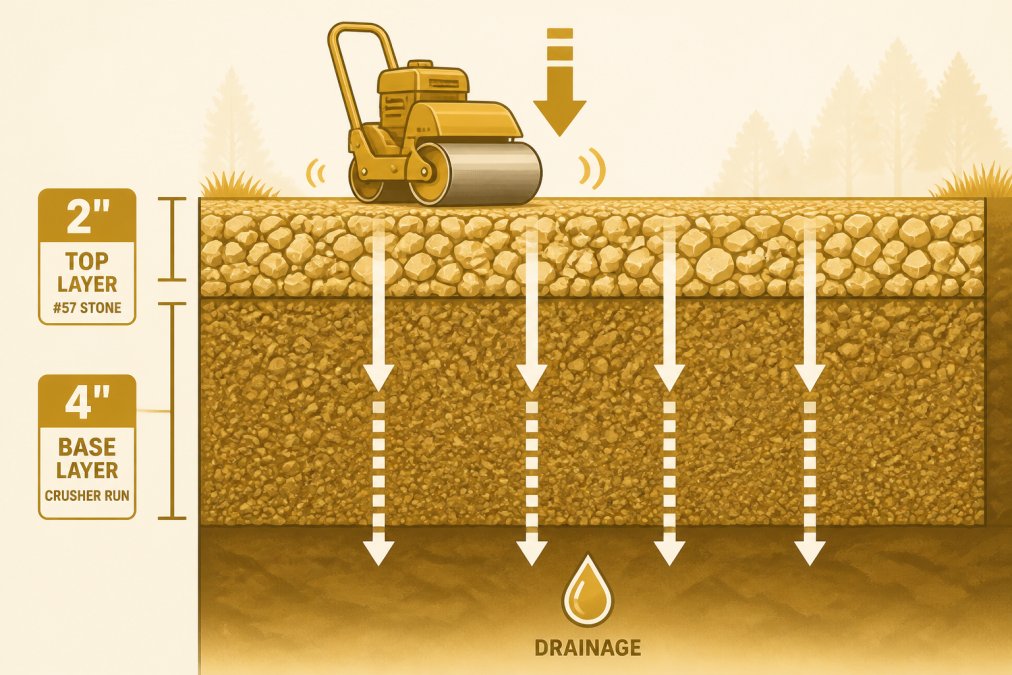
A properly built driveway uses multiple layers. The base layer (4-6 inches) handles compaction and load distribution. The top dressing (2-3 inches) provides comfort, drainage, and aesthetics.
Base layer materials must compact tightly. Crusher run is ideal because dust particles create binding. #57 stone compacts reasonably well with a plate compactor. Top dressing materials prioritize drainage and comfort. #57 stone is standard; crushed granite is excellent. The mistake many homeowners make: installing a single layer of large stone and expecting it to hold up. Large stones don’t compact or interlock and shift immediately under vehicle weight.
Cost of Gravel Driveway Virginia: Pricing & Budget Planning
A 12-foot-wide, 50-foot-long driveway (600 square feet) requires approximately 6-8 tons of material. Using Virginia supplier pricing:
Crusher Run Base (4 inches, ~5 tons): $535 in material
#57 Stone Top (2 inches, ~3 tons): $363 in material
Total Material Cost: ~$900 for 600 square feet
Professional installation with equipment typically doubles this cost to $1,800-2,400 for a properly built driveway.
Factors That Affect Driveway Gravel Pricing
Material Type: Granite and crushed stone run $80-120 per ton. Crusher run averages $107. Pea gravel and river rock command $160-190 per ton. Recycled asphalt is $15-20 per ton.
Delivery Distance: Quarries charge delivery fees based on distance. Rural properties in southwestern Virginia may pay significantly more than homeowners near major quarries in the Piedmont.
Volume: Ordering 10+ tons may reduce per-ton pricing by 10-15% compared to small loads.
Seasonal Demand: Fall ordering (September-October) often yields better rates than spring and summer.
DIY vs. Professional Installation: Hidden Cost Breakdown
DIY installation saves labor but requires equipment rental and skill. A plate compactor rents for $50-75 per day. For a 600-square-foot driveway, you’ll need 2-3 days of rental ($150-225) plus your labor.
The hidden cost: improper compaction. Without experience, it’s easy to under-compact the base layer, causing ruts within the first year. Professional installation typically costs $1,200-1,600 in labor and equipment, plus $900-1,200 in materials. DIY costs $900-1,200 in materials plus $150-300 in equipment rental, but risks poor compaction requiring re-doing the work within 2-3 years.
The true cost of a driveway isn’t the material price, it’s the cost of doing it wrong. A poorly compacted base layer will fail in 2-3 years and require complete removal and reinstallation, doubling your total cost. Proper installation upfront costs 30-40% more but extends driveway life by 4-5 years.
Virginia-Specific Considerations: Soil and Climate Factors
Virginia’s soil composition varies dramatically by region. The Piedmont features clay-heavy soils that drain poorly. The Blue Ridge Mountains have rocky, well-draining soils. Tidewater areas have sandy soils prone to settling.
Clay soils require excellent drainage materials because water sits on top and either erodes the gravel or freezes in winter. Crushed stone and granite are essential. Freeze-thaw cycles are most severe in western Virginia where temperatures fluctuate above and below freezing multiple times per season. According to Virginia Department of Transportation guidelines for unpaved roads, base materials should meet specific gradation standards. VDOT recommends crusher run or #57 stone for base layers.
Permitting and HOA Regulations in Virginia
Most residential driveways don’t require permits in Virginia, but some municipalities and HOAs impose restrictions on material type, color, or depth. Check your HOA covenants before ordering materials. Some communities restrict gravel driveways entirely, requiring asphalt or concrete.
Charlottesville, Richmond, and Arlington have specific stormwater regulations affecting driveway installation. Driveways may require erosion control measures during installation. Contact your local building department before starting work.
Environmental Impact and Runoff Management
Gravel driveways contribute to sediment runoff if not properly managed. Angular stone (crusher run, #57, granite) creates less sediment runoff than rounded stone because particles interlock and don’t shift. Permeable materials allow water to infiltrate and be naturally filtered. Avoid pea gravel in environmentally sensitive areas.
Maintenance and Upkeep: Extending Driveway Life
A gravel driveway requires annual maintenance to extend its life. Spring is ideal for assessment and refresh.
Annual Tasks:
- Rake the surface level, redistributing material from high to low spots
- Add 1/2 inch of fresh material to compensate for compaction and erosion
- Check drainage; clear debris blocking water flow
- Fill ruts and washboard areas
Driveways built with proper base layers and maintained annually last 6-8 years before requiring major resurfacing. Neglected driveways fail in 2-3 years.
Installation Process: Step-by-Step Overview
A professional driveway installation follows these steps:
Step 1: Site Assessment
Evaluate soil type, drainage, existing condition, and slope. Identify obstacles and determine base layer depth needed.
Step 2: Grading and Base Preparation
Remove vegetation and existing material. Grade the surface to slope slightly for drainage (typically 1/8 inch drop per foot of width). Compact native soil.
Step 3: Base Layer Installation
Spread crusher run or stone base in 2-4 inch lifts. Compact each lift with a vibratory roller until base reaches desired depth (typically 4-6 inches).
Step 4: Top Layer Installation
Spread #57 stone or preferred top material. Rake level. Light compaction.
Step 5: Edging and Finishing
Install edging if desired. Final grading and cleanup.
Total Time: 1-2 days for a 600-square-foot driveway, depending on site conditions.
Frequently Asked Questions
What is the best driveway gravel for Virginia’s freeze-thaw cycles?
Crushed granite and crusher run are your best options for Virginia’s climate. Crushed granite’s angular edges interlock tightly, resisting shifting during freeze-thaw cycles. Crusher run, a blend of crushed stone and stone dust, compacts into a solid, stable surface that handles seasonal expansion and contraction. Both materials provide superior load-bearing capacity compared to rounded stones like pea gravel or river rock, which shift more easily under freezing conditions.
How much does a gravel driveway cost in Virginia?
Driveway gravel pricing depends on material type, quantity, and delivery distance. Crusher run typically costs around $107 per ton, while #57 crushed stone runs approximately $121 per ton. Pea gravel is pricier at $184 per ton, and recycled asphalt offers the most budget-friendly option. For accurate pricing tailored to your property size and location in Virginia, contact local suppliers or request a free quote from a professional land management service.
Do I need a permit for a gravel driveway in Virginia?
Permitting requirements vary by county and locality in Virginia. Some areas require permits for driveway installation or modifications, especially if your property is in an HOA community or near sensitive environmental areas. Check with your local county building department or HOA guidelines before starting work. Professional installation companies can often handle permit applications and ensure compliance with local regulations, saving you time and potential fines.
What’s the difference between crush and run and crushed stone for driveways?
Crusher run (crush and run) contains a blend of crushed stone and stone dust fines, allowing it to compact tightly into a firm, stable base. Crushed stone (#57) consists of larger, uniform angular pieces that interlock for stability but allow more water drainage. Crusher run is ideal for base layers where compaction and load-bearing matter most. Crushed stone works well as a top layer or standalone surface where drainage and aesthetic appeal are priorities. Many professionals use both: crusher run as the sub-base, crushed stone as the top dressing.
How often should I maintain my gravel driveway in Virginia?
Gravel driveway maintenance in Virginia typically requires raking and grading 1-2 times per year, especially after heavy rains or winter weather. Check for ruts, bare spots, and erosion after storms. Resurfacing, adding fresh gravel to the top layer, may be needed every 2-3 years depending on traffic volume and weather severity. Proper compaction during installation and using a geotextile fabric underneath can extend your driveway’s lifespan and reduce maintenance frequency significantly.
This article was written using GrandRanker