Table of Contents
- Best Tools for Vegetation Management: Quick Comparison
- Hand Tools for Brush and Tree Removal
- Power Equipment: Chainsaws and Brushcutters
- Remote-Controlled and Mechanical Clearing Equipment
- Herbicide Application Methods and Chemical Control
- Utility Vegetation Management Software and Monitoring
- How to Select the Right Tools Based on Terrain and Scale
- Safety Equipment and Best Practices for Vegetation Management
Best Tools for Vegetation Management: 2026 Guide
Last Updated: July 29, 2026
The best tools for vegetation management depend entirely on your terrain, property size, and operational goals. Timber Shredders LLC has worked with hundreds of landowners across Central Virginia, and we’ve seen firsthand how the wrong tool choice leads to wasted time, damaged equipment, and incomplete results. Whether you’re managing a quarter-acre lot or overseeing utility rights-of-way spanning miles, selecting the right equipment makes the difference between a one-day project and a week-long struggle.
This guide covers the full spectrum of vegetation management solutions, from hand tools that cost under $100 to enterprise software systems costing thousands annually.
Best Tools for Vegetation Management: Quick Comparison
| Tool Category | Best For | Typical Cost | Key Advantage |
|---|---|---|---|
| Hand tools (loppers, pruning saws) | Small brush, precise cuts | $50-$300 | Affordable, no fuel, quiet |
| Brushcutters (STIHL FS series) | Dense vegetation, overgrowth | Contact dealer | High torque for thick material |
| Chainsaws (Husqvarna 592XP) | Felling, limbing, bucking | $720-$1,540 | Power and reliability for demanding work |
| Slope mowers (remote-controlled) | Steep terrain, safety-critical areas | Contact for quote | Operator safety, precision on hazardous terrain |
| Forestry mulchers | Land clearing, stump removal | Professional service | Fast property reclamation, soil improvement |
| Herbicide application | Long-term suppression, chemical control | $240-$960 per unit | Cost-effective per acre over time |
| Trimble Vegetation Manager | Utility-scale monitoring | Custom pricing | AI-powered risk assessment, drone integration |
| AiDash | Satellite-based risk monitoring | Contact for pricing | Proactive threat identification across large areas |
Hand Tools for Brush and Tree Removal
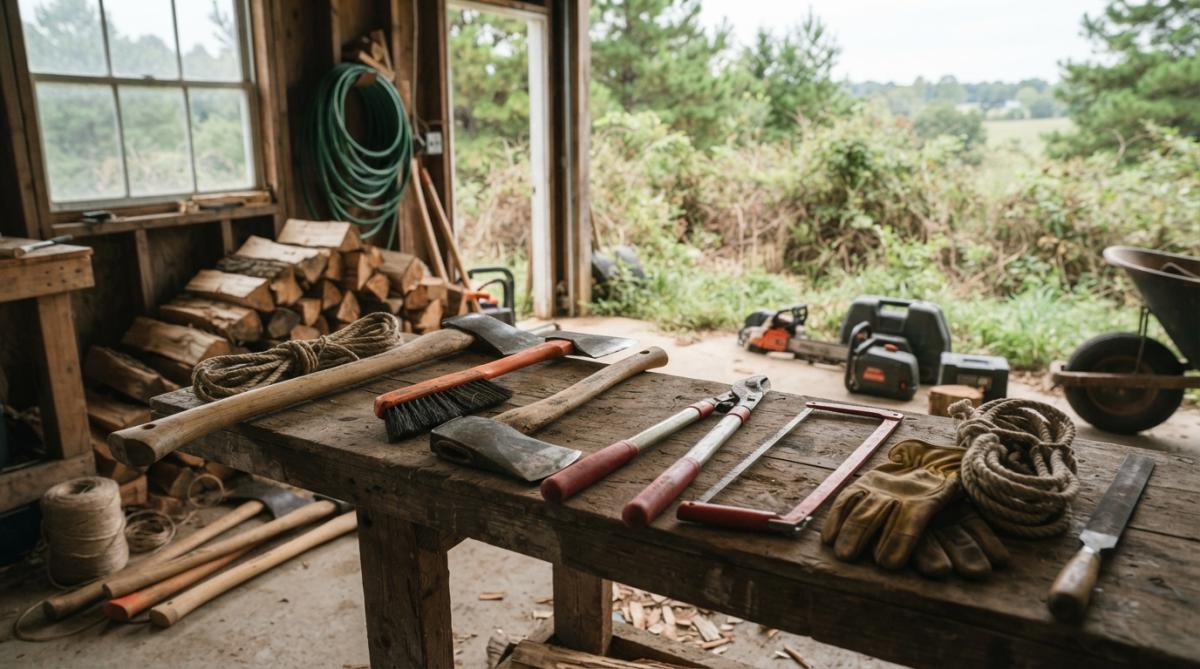
For properties under an acre with scattered brush or small saplings, quality hand tools often outperform powered equipment. You avoid fuel costs, noise complaints, and the learning curve of operating gas-powered machinery.
Loppers and Pruning Saws
Loppers excel at cutting branches up to 2 inches in diameter. A bypass lopper works best on green, living wood; an anvil lopper handles dead branches better. Quality matters, cheap loppers jam and dull quickly.
Pruning saws are essential for branches thicker than lopper capacity. A folding pruning saw is safer to carry and easier to control. Look for a blade with 7-8 teeth per inch for clean cuts through hardwood.
Maintain your hand tools immediately after use. Wipe blades clean, dry them thoroughly, and lightly oil metal parts. A $150 lopper maintained properly lasts 10+ years; a neglected $300 lopper becomes unusable in two seasons.
Brush Hooks and Clearing Tools
A brush hook cuts through dense brush and small saplings faster than loppers when clearing large areas. The curved blade allows sweeping cuts that don’t require precision. Brush hooks demand respect and proper technique, but for clearing overgrown fence lines or establishing trails, nothing beats them.
Grubbing tools remove small stumps and roots. Combine a brush hook with a grubbing tool and you can clear an acre of light brush in a day.
Power Equipment: Chainsaws and Brushcutters
Once brush reaches shoulder height or branches exceed 3 inches, powered equipment cuts your labor time by 60-70%.
Professional Chainsaws for Felling and Limbing
Husqvarna chainsaws dominate professional forestry work. The 592XP delivers 9.3 horsepower with a 20-36 inch guide bar, handling serious felling and bucking work. The T540 XP Mark III costs less and suits smaller operations.
What separates a professional chainsaw from a consumer model: consistent power delivery, advanced vibration dampening, and reliable parts availability. A Husqvarna dealer exists in nearly every region.
A chainsaw in untrained hands becomes a serious injury risk. Kickback happens in milliseconds. If you’re buying a chainsaw for occasional use, consider hiring a professional instead.
Heavy-Duty Brushcutters for Dense Vegetation
STIHL brushcutters handle vegetation that string trimmers cannot touch. The FS 461 C-EM delivers enough torque to cut through woody stems up to 1.5 inches thick. Unlike chainsaws, brushcutters are more forgiving with no kickback risk, but they’re heavier and require sustained physical effort.
Brushcutters excel at clearing ditches, roadsides, and overgrown pasture edges. A skilled operator can clear a mile of roadside in a day.
Remote-Controlled and Mechanical Clearing Equipment
When terrain becomes too steep, too muddy, or too hazardous for foot traffic, remote-controlled and mechanical equipment becomes necessary.
Slope Mowers for Hazardous Terrain
Remote-controlled slope mowers allow an operator to stand safely on level ground while the machine handles a 45-degree embankment. These machines cost tens of thousands of dollars and require skilled operators. For municipalities managing roadsides, utility companies maintaining rights-of-way, and contractors clearing large properties, they’re indispensable for safety.
Forestry Mulchers for Land Clearing
A forestry mulcher grinds trees, stumps, and brush into mulch in a single pass. Timber Shredders LLC uses forestry mulchers to clear overgrown properties across Central Virginia, transforming 3 acres of dense brush into usable land in a day, with nutrient-rich mulch that improves soil health.
The advantage over traditional bulldozing: no erosion, no soil compaction, and organic matter stays on-site.
Forestry mulching is not just land clearing, it’s land restoration. The mulch layer prevents erosion, suppresses future weed growth, and adds organic matter back to the soil.
Herbicide Application Methods and Chemical Control
For right-of-way maintenance and long-term vegetation suppression, herbicides offer cost-effective control per acre compared to mechanical clearing alone.
Corteva Agriscience herbicides like Milestone and Garlon target broadleaf weeds and woody plants. Milestone ($241-$960 per 2.5-gallon unit) works on noxious weeds in pastures and utility corridors. Garlon 4 Ultra provides broader spectrum control.
Professional applicators use backpack sprayers for small areas and truck-mounted systems for large properties. Spot-treating individual plants wastes less chemical than broadcast spraying, but takes more time.
Herbicide application is regulated. You cannot spray near waterways without a buffer zone, and some products are restricted in certain counties. Always check local regulations and, if unfamiliar with chemical application, hire a licensed applicator. TruGreen Commercial Vegetation Control offers professional application services across many regions.
Utility Vegetation Management Software and Monitoring
Electric utilities and large infrastructure operators use specialized software to track vegetation threats, schedule maintenance, and ensure compliance with NERC standards.
Enterprise Solutions with Drone and Satellite Integration
Trimble Vegetation Manager combines GIS mapping, drone imagery, LiDAR data, and AI risk assessment into a single platform. Utilities input their transmission lines, and Trimble’s algorithms identify trees that pose a risk based on proximity, species, and growth trajectory. The software generates work orders, tracks completion, and archives compliance documentation.
The advantage: proactive identification of risks before they cause outages. A tree growing toward a power line is flagged months in advance, allowing scheduled removal rather than emergency response.
AiDash offers a satellite-based alternative. Instead of drone flights, AiDash monitors vegetation using multispectral satellite imagery, identifying high-risk zones and tracking vegetation density changes. It’s less precise than LiDAR but covers vastly larger areas.
LiveEO’s Vegetation Management Insights uses AI to detect tree location, height, species, and vitality from satellite data. The standout feature: post-storm damage assessment using Synthetic Aperture Radar, which works through clouds and darkness.
These enterprise solutions have custom pricing because deployment depends on infrastructure size, data integration needs, and risk tolerance. The ROI calculation is straightforward: prevented outages save millions, making the software investment trivial.
How to Select the Right Tools Based on Terrain and Scale
The biggest mistake landowners make is buying the wrong tool for their situation.
Manual vs. Mechanical Approaches
Manual tools suit these scenarios:
- Property under 0.5 acres
- Scattered brush and saplings (not dense infestation)
- Precise work where you need control
- Budget under $500
- Noise or emissions restrictions
Mechanical equipment becomes necessary when:
- Property exceeds 1 acre
- Vegetation density is high
- Time pressure exists
- Terrain is steep or muddy
- Stumps must be removed
The transition point is roughly 1-2 acres of moderate brush.
Total Cost of Ownership and Operational Efficiency
Comparing tool costs requires looking beyond purchase price. Calculate true cost per acre:
- Hand tools: $200-$400 investment, 20-40 hours per acre = $10-$20 per hour of labor
- Brushcutter: $500-$1,000 investment, 5-10 hours per acre = $100-$200 per hour
- Forestry mulcher (hired): $3,000-$8,000 per acre, completes in hours
- Herbicide follow-up: $50-$200 per acre annually for suppression
For a 3-acre overgrown property, hiring a forestry mulcher ($10K-$20K) clears everything in one day and improves soil. Doing it yourself with hand tools takes 120+ hours over weeks. Timber Shredders LLC combines forestry mulching for initial clearing with follow-up herbicide application for suppression, preventing regrowth that forces repeat clearing every 2-3 years.
Safety Equipment and Best Practices for Vegetation Management
Vegetation management equipment causes serious injuries. Proper PPE and technique reduce risk dramatically.
Essential PPE for Powered Equipment
- Safety glasses or face shield: Flying debris travels at high speed.
- Hearing protection: Chainsaws and brushcutters exceed 100 decibels.
- Cut-resistant chaps or pants: Kevlar-lined chaps prevent amputation.
- Steel-toed boots: Protect feet from dropped equipment and rolling logs.
- Gloves: Protect hands from cuts and blisters.
- Long sleeves and pants: Protect skin from cuts and sun exposure.
For slope work, add a harness and rope system.
Operational Safety Protocols
Never operate powered equipment alone. Maintain clear sight lines before starting equipment. Inspect equipment before use, a dull chainsaw blade forces excessive pressure, increasing kickback risk. Take breaks after 2-3 hours of intense work. Fatigue causes mistakes.
Choosing the best tools for vegetation management comes down to matching the tool to the job and your skill level. For small residential properties, quality hand tools and a brushcutter handle 90% of needs. For larger properties or dense brush, hiring professionals with forestry mulching equipment is faster and produces better results. Timber Shredders LLC combines professional equipment, experienced operators, and a clear assessment process to transform overgrown properties into usable land while improving soil health. Get a free quote and see how forestry mulching can reclaim your property quickly and efficiently.
Frequently Asked Questions
What are the best tools for vegetation management on a property with mixed brush and stumps?
For mixed vegetation and stumps, a combination approach works best. Start with hand tools like loppers and pruning saws for smaller debris, then use power equipment like brushcutters or chainsaws for heavier brush. For large-scale clearing with stumps and rocks, professional forestry mulching equipment, which grinds vegetation into mulch while improving soil health, is ideal. Professional operators can assess your terrain and recommend the most efficient equipment to avoid equipment damage and project delays.
How does forestry mulching compare to traditional debris removal?
Forestry mulching is a mechanical clearing method that grinds vegetation, stumps, and trees into fine mulch on-site, eliminating the need for debris hauling. Unlike traditional clearing that leaves piles of waste, mulching improves soil health by adding organic matter, reduces erosion, and restores property usability faster. The mulch layer also suppresses future vegetation encroachment. While initial equipment investment is higher, the total cost of ownership is often lower because you eliminate tipping fees and debris removal labor.
What safety equipment is essential when using vegetation management tools?
Essential PPE includes a hard hat, safety glasses, hearing protection, cut-resistant gloves, long pants, and steel-toed boots. For chainsaws and brushcutters, add chaps or cut-resistant pants and a long-sleeved shirt. When applying herbicides, wear chemical-resistant gloves, eye protection, and respiratory protection if required by the product label. Always follow manufacturer safety protocols and local regulations. Professional operators are trained in comprehensive safety protocols to minimize injury risk during vegetation management work.
Can vegetation management tools help with right-of-way maintenance and utility compliance?
Yes. Professional vegetation management tools and software are critical for right-of-way clearing to prevent power line interference and meet utility compliance standards like NERC regulations. Remote-controlled slope mowers, brushcutters, and forestry mulchers handle vegetation encroachment efficiently. Enterprise software solutions with GIS mapping and satellite monitoring help utilities track vegetation threats, plan maintenance cycles, and document compliance. Proper tool selection ensures safe, reliable grid operations and reduces outage risk.
What’s the difference between manual hand tools and mechanical equipment for vegetation management?
Manual hand tools like pruning saws, loppers, and brush hooks are best for small-scale work, precision cuts, and areas where equipment can’t access. They’re low-cost and environmentally low-impact but labor-intensive. Mechanical equipment like chainsaws, brushcutters, and forestry mulchers handle large-scale clearing faster and with less physical effort, making them ideal for dense vegetation or commercial projects. The right choice depends on property size, vegetation density, terrain, and budget. Professional assessment ensures you select tools that maximize operational efficiency.
This article was written using GrandRanker