Table of Contents
- Understanding Brush Regrowth: Why It Happens and How to Stop It
- Step 1: Mechanical Removal and Root System Clearing
- Step 2: Herbicides for Brush Control and Cut-Stump Treatment
- Step 3: Stump Treatment for Brush to Eliminate Sprouting
- Step 4: Natural Brush Regrowth Prevention Through Mulching
- Long-Term Brush Management: Maintenance and Seasonal Timing
- DIY vs. Professional Services: Cost-Benefit Analysis
- Common Mistakes to Avoid When Preventing Brush Regrowth After Clearing
Preventing Brush Regrowth After Clearing: A Complete Guide
Last Updated: July 28, 2026
Preventing brush regrowth after clearing is one of the most common challenges landowners face after investing in land clearing. At Timber Shredders LLC, we’ve seen countless properties reclaimed only to watch unwanted vegetation return within months. The difference between a cleared property that stays cleared and one that becomes overgrown again comes down to understanding root systems, choosing the right treatment methods, and committing to a maintenance schedule that works.
This guide covers everything you need to know to stop brush from coming back: mechanical removal, herbicide application, stump treatment, and long-term management strategies. The five strategies covered have helped hundreds of landowners maintain their cleared properties year after year.
Understanding Brush Regrowth: Why It Happens and How to Stop It
Brush doesn’t simply disappear when you cut it down. Most vegetation has two survival mechanisms: visible above-ground stems and an extensive root system beneath the soil. When you remove the stems, the roots remain intact and dormant, ready to send up new growth.
Root systems and sprouting mechanics determine whether a cleared area stays cleared. Woody plants like oak, hickory, and sumac develop deep taproots or spreading lateral roots extending 10-15 feet from the original plant. When you cut the stem, roots respond by pushing up multiple new shoots from the root collar, the area where roots meet the stem. This is why a single cut stem often produces three or four new shoots.
Some species are particularly aggressive resprouters. Sumac spreads through underground runners called rhizomes, creating new plants across entire cleared areas. Sassafras and black cherry do the same. These root systems can remain viable for years, continuously pushing up new growth until the roots are killed or exhausted.
Native vs. invasive species identification affects your treatment strategy. Native species like oak and hickory typically regrow from established root systems but respond well to herbicide treatment. Invasive species like autumn olive, multiflora rose, and Japanese honeysuckle are far more aggressive and often require more intensive chemical treatment or repeated mechanical removal. Identify what you’re dealing with before clearing, as native species generally require less intensive long-term management than invasive species.
Take a close-up photo of bark, leaves, and branching patterns before clearing. This helps you identify what resprouts later and choose the right treatment.
Step 1: Mechanical Removal and Root System Clearing
Mechanical removal is the foundation of preventing brush regrowth. The equipment you choose and technique you use determine whether you’re removing a problem or delaying it.
Equipment selection and safety precautions matter far more than most homeowners realize. A string trimmer cuts stems at ground level but leaves roots completely intact. A brush hog is slightly better but still leaves most root systems untouched. For serious regrowth prevention, you need equipment that actually removes or damages roots.
Manual labor with a shovel or mattock works on small areas. You dig around the base of each plant, expose the root collar, and remove as much of the root system as possible. This is labor-intensive but highly effective on isolated stumps or small clearings. For larger areas, professional equipment like forestry mulchers or excavators with root rakes are far more efficient, grinding vegetation while pulling and breaking root systems.
Wear eye protection and heavy gloves when working with brush, especially species with thorns or irritating sap. Wear long sleeves and pants. Follow all label instructions when using chemical herbicides and wear appropriate protective equipment.
Never attempt to remove large stumps or root systems without proper equipment or training. Rocks hidden in root systems can launch from equipment and cause serious injury.
Manual labor vs. professional land clearing equipment is ultimately a cost-benefit decision. DIY manual removal on a quarter-acre of light brush might take 40-60 hours and cost only your time. The same area cleared with professional forestry mulching equipment takes 2-4 hours and costs several hundred dollars. For small areas or isolated stumps, manual labor makes sense. For anything over a quarter-acre, especially dense brush with large root systems, professional equipment saves time and produces better results.
Step 2: Herbicides for Brush Control and Cut-Stump Treatment
Herbicides are the most effective tool for preventing brush regrowth, but they only work if applied correctly and at the right time. The two most common herbicides are glyphosate and triclopyr, both of which kill roots, not just visible stems.
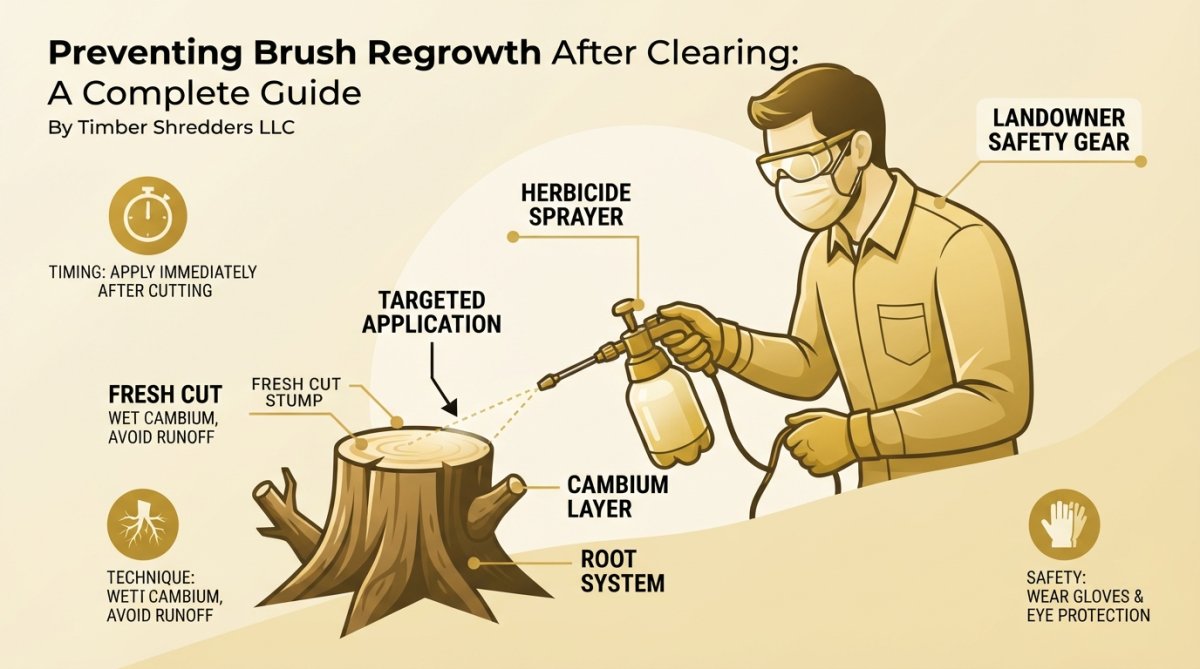
Glyphosate and triclopyr application methods differ in important ways. Glyphosate is a non-selective herbicide that kills any plant it contacts. It works best on actively growing plants in spring or early summer. Triclopyr is more selective and works well on woody plants while leaving grass relatively unharmed.
The cut-stump method is far more effective than foliar spraying. After cutting a stem as close to the ground as possible, immediately apply herbicide to the freshly cut surface. The herbicide enters the vascular system and travels directly to roots, killing them before they can resprout. This method uses less herbicide, works faster, and produces more reliable results.
Foliar application vs. cut-stump method timing matters significantly. Foliar application works best on actively growing vegetation in spring or early summer. However, it requires more herbicide, takes longer to work, and is less reliable on tough woody plants. The cut-stump method works year-round because you’re applying herbicide directly to vascular tissue. Late fall through early spring is ideal for cut-stump treatment because plants have moved nutrients into roots for winter storage.
Cut the stem and apply herbicide within 15 minutes. Use a paint brush or spray bottle to apply herbicide generously to the entire cut surface, including the outer bark ring where vascular tissue is most active.
Step 3: Stump Treatment for Brush to Eliminate Sprouting
Stump treatment prevents new shoots from emerging by targeting the root collar and upper root system, where regrowth originates.
Chemical stump killers and application best practices vary by product. The most reliable approach is using concentrated triclopyr or glyphosate applied to the freshly cut stump surface within 15 minutes of cutting. Brush or spray it generously on the cut surface, making sure to coat the outer ring where vascular tissue is most active. For large stumps (over 6 inches diameter), apply herbicide to the cut surface and any exposed roots around the base.
Fall and winter applications are often more effective because plants have moved carbohydrates into roots for winter storage. The herbicide reaches a concentrated area of root tissue, killing roots more completely.
Root ball removal techniques are necessary for complete prevention on aggressive species. After cutting a stump, dig around the base to expose the root collar and upper roots. Use a mattock or shovel to break and remove as much of the root system as possible. For invasive species or particularly aggressive resprouters, dig out the root ball first, then treat any remaining roots with herbicide.
The cut-stump method is the single most effective technique for preventing regrowth. Cut low, apply herbicide immediately, and treat every stump. This one practice prevents 80% of regrowth problems.
Step 4: Natural Brush Regrowth Prevention Through Mulching
Mulching suppresses weed and brush seeds, moderates soil temperature, retains moisture, and gradually improves soil health. Forestry mulch, the ground-up wood and vegetation produced by forestry mulching equipment, is ideal because it contains no weed seeds and provides long-lasting suppression.
Mulch depth, material selection, and soil health restoration require attention to detail. Effective mulch suppression requires 4-6 inches of depth for woody brush suppression. Anything less than 3 inches allows light penetration and doesn’t suppress aggressive species. Forestry mulch is superior to wood chips because it’s finer, packs more densely, and breaks down more slowly. Avoid hay mulch, which often contains weed seeds.
Mulching also improves soil health over time. As mulch breaks down, it adds organic matter to soil, increasing water retention and microbial activity. Soils with higher organic matter support better plant growth, which means faster establishment of desirable vegetation.
The best mulching strategy combines mechanical clearing, herbicide treatment, and then a 4-6 inch layer of forestry mulch. This three-step approach addresses the problem at every level.
Preventing soil erosion while suppressing weeds is critical on sloped properties. Bare soil erodes rapidly after clearing. Mulch protects soil from rain impact and runoff, reducing erosion dramatically. On steep slopes, forestry mulch also provides mechanical reinforcement that helps hold soil in place during heavy rain.
Long-Term Brush Management: Maintenance and Seasonal Timing
Preventing brush regrowth is not a one-time event. Properties that stay cleared long-term have owners who understand seasonal timing and commit to preventative maintenance.
Preventative maintenance schedules by climate vary based on growing season length and rainfall. In the Mid-Atlantic region, the growing season runs from April through October. Most aggressive regrowth happens in spring and early summer. A maintenance schedule should include:
- Spring (April-May): Scout the cleared area for new growth. Treat any small resprouting stumps with herbicide before they establish.
- Early summer (June-July): Check mulch depth. Add additional mulch if needed to maintain 4-6 inches.
- Late summer (August-September): Monitor for late-season regrowth.
- Fall (October-November): Treat any stumps that missed spring treatment.
In drier climates, regrowth is slower but more persistent. In wetter climates, regrowth is faster and more aggressive. Adjust your maintenance frequency based on what you observe.
Seasonal efficacy and optimal application windows matter significantly for herbicide effectiveness. Spring applications work well for foliar spraying because plants are actively growing. Fall applications work best for cut-stump treatment because plants are moving energy to roots. The optimal window for preventing brush regrowth is immediately after clearing followed by cut-stump herbicide treatment in late fall when plants are storing energy in roots.
DIY vs. Professional Services: Cost-Benefit Analysis
The decision to clear land yourself or hire professional services depends on property size, brush density, available time, and equipment access.
When to hire professional land management services is straightforward: if your property is larger than a quarter-acre, if brush is dense with large root systems, or if you lack equipment and experience, professional services save time and produce better results. Professional operators have equipment that removes root systems more effectively than manual labor. They understand soil health and can apply mulch in ways that minimize erosion.
The hidden benefit of professional clearing is work quality. A professional forestry mulching operation leaves soil in better condition than manual clearing because the equipment grinds vegetation into mulch rather than removing it entirely. This mulch suppresses regrowth and improves soil health.
Hidden costs and soil health outcomes are where DIY clearing often falls short. Manual clearing on a half-acre of dense brush might take 100+ hours over several weekends. Equipment rental adds several hundred dollars. Herbicide purchases add more. By the time you account for your time, the total cost approaches or exceeds professional pricing. Additionally, DIY clearing often leaves soil compacted or damaged, requiring years to recover.
| Approach | Time Required | Equipment Cost | Herbicide Cost | Soil Quality | Best For |
|---|---|---|---|---|---|
| Manual labor only | 40-100+ hours | $0-200 (tools) | $50-150 | Poor to fair | Small areas under 1/4 acre |
| DIY with rented equipment | 8-20 hours | $400-800 (rental) | $50-150 | Fair | Quarter-acre with moderate brush |
| Professional forestry mulching | 2-6 hours | $0 (included) | $0 (included) | Excellent | Any size, dense brush, soil health priority |
Common Mistakes to Avoid When Preventing Brush Regrowth After Clearing
The most common mistake is assuming that cutting brush solves the problem. Cutting alone leaves root systems intact and often stimulates more aggressive regrowth. You must follow cutting with herbicide treatment, stump treatment, or root removal.
A second critical mistake is applying herbicide too late. The cut-stump method only works if you apply herbicide within 15 minutes of cutting. After that window, the cut surface seals and herbicide penetration drops dramatically.
Many landowners also underestimate the importance of mulch depth. Two inches of mulch allows light penetration and doesn’t suppress aggressive brush species. Four to six inches is the minimum for effective suppression.
Timing herbicide application incorrectly is another common error. Applying glyphosate to dormant plants in winter produces poor results. Waiting until midsummer to treat cut stumps means the plant has already moved energy away from roots. Spring and fall are optimal windows.
Finally, many landowners clear a property and then do nothing for maintenance. A cleared property requires monitoring and occasional treatment for at least one full growing season. Scout regularly, treat small resprouting stumps before they establish, and maintain mulch depth.
Maintaining a cleared property long-term requires understanding root systems, choosing the right treatment methods, and committing to seasonal maintenance. Timber Shredders LLC specializes in preventing brush regrowth after clearing through professional forestry mulching, which combines mechanical removal with immediate mulch application and soil health restoration. Our experienced operators understand regional vegetation patterns and apply treatments that keep properties cleared year after year. If you’re dealing with brush regrowth or planning a land clearing project, get a free quote from Timber Shredders LLC and see how professional land management can reclaim your property for good.
Frequently Asked Questions
What’s the most effective way to prevent brush regrowth after clearing?
Preventing brush regrowth requires a multi-step approach: complete root system removal, stump treatment with herbicides (glyphosate or triclopyr), and mulching to suppress new growth. The cut-stump method, applying herbicide immediately after cutting, is highly effective because it targets the plant’s vascular system before it can sprout. For invasive species, combining mechanical removal with chemical stump treatment and maintaining thick mulch cover provides the best long-term results.
How does mulching prevent brush regrowth naturally?
Mulch suppresses brush regrowth by blocking sunlight from reaching seeds and sprouting roots, while also moderating soil temperature and moisture. A 3-4 inch layer of wood chips or forestry mulch creates a physical barrier that prevents germination and weakens new seedlings. Mulching also improves soil health by adding organic matter as it decomposes, creating conditions less favorable for invasive species. This natural method works best when combined with stump treatment for maximum efficacy.
What herbicides work best for brush control, and when should I apply them?
Glyphosate and triclopyr are the most common herbicides for brush control. Glyphosate works on a broad range of species and is best applied via foliar spray during active growth (spring through early fall). Triclopyr is more effective on woody plants and can be applied as cut-stump treatment year-round. Timing matters: late summer and fall applications often show better results because plants are translocating nutrients to roots. Always follow label instructions and apply during dry conditions for best results.
Should I hire a professional or handle brush regrowth prevention myself?
The choice depends on property size, brush density, and your equipment access. Small properties with light brush can be managed with DIY herbicides and mulching. Larger properties (3+ acres) with thick brush and stumps benefit from professional land management services using specialized equipment like brush hogs and forestry mulchers. Professionals ensure complete root removal, proper stump treatment, and soil health restoration, reducing regrowth risk and preventing the erosion damage that improper clearing can cause.
This article was written using GrandRanker