Table of Contents
- Why Clearing Overgrown Brush for Fire Safety Matters
- Understanding Defensible Space and Fire Hazard Zones
- Brush Clearance Regulations and Fire Safety Compliance
- Tools for Clearing Brush: Equipment and Best Practices
- Step-by-Step Process for Clearing Overgrown Brush
- Fire-Resistant Landscaping After Brush Clearing
- Managing Erosion and Soil Health After Clearing
- Debris Disposal: Logistics, Costs, and Options
Last Updated: July 27, 2026
Why Clearing Overgrown Brush for Fire Safety Matters
Clearing overgrown brush is one of the most direct ways property owners can reduce wildfire risk. Dense vegetation, dead trees, and accumulated debris create “fuel load”, the total combustible material that accelerates fire spread. According to National Interagency Fire Center wildfire statistics, residential properties in wildland-urban interface zones face significantly elevated risk when vegetation management is neglected. Properties with proper defensible space dramatically improve their chances of surviving a wildfire event.
A single overgrown property creates a pathway for fire to spread to neighboring homes. Strategic brush clearing protects your investment while contributing to community-wide fire resilience.
Most property owners underestimate how far they need to clear. The standard defensible space extends 100 feet from your home’s foundation. Properties that fall short in the first 30 feet see the highest fire damage rates.
Understanding Defensible Space and Fire Hazard Zones
Defensible space is the area around your home where you’ve removed or reduced vegetation to slow wildfire spread. It’s not about creating a barren landscape, but strategic removal that eliminates fire risk while maintaining property value.
The Three Zones of Defensible Space
Zone 1: Immediate Zone (0-5 feet from structures). Remove all dead vegetation, fallen branches, pine needles, and debris that could ignite from direct flame contact. Clear leaves from gutters and roof valleys. Remove tree branches that hang over the roof or touch the house. This zone should be nearly vegetation-free.
Zone 2: Intermediate Zone (5-30 feet from structures). Space trees so their canopies don’t touch, generally one tree-height distance between crowns. Remove lower branches (ladder fuels) up to 6-10 feet from the ground to prevent fire from climbing into tree canopies. Thin dense shrubs so you can see through them.
Zone 3: Extended Zone (30-100 feet from structures). Focus on thinning overgrown areas and removing dead trees. Space trees further apart and remove small trees and brush under larger trees. This zone can retain more vegetation but should still reduce density and remove anything dead or diseased.
Identifying Fuel Load and Ladder Fuels on Your Property
Fuel load is the total amount of burnable material, dead branches, fallen logs, dense shrubs, pine needles, and dried vegetation. Walk your property after storms and note where debris accumulates; these are your highest-risk areas.
Ladder fuels are vegetation at different heights that allows fire to climb from ground level into tree canopies. The most dangerous ladder fuels are low tree branches (under 10 feet), dense shrub understory, and small trees growing beneath larger trees. Stand at ground level and look up, if you can’t see through vegetation to the sky, you have a ladder fuel problem.
Dead vegetation is the most flammable material on your property. A single dead tree can become a torch that ignites your entire property. Prioritize removing all dead vegetation before thinning living plants.
Brush Clearance Regulations and Fire Safety Compliance
Most counties in fire-prone areas mandate minimum defensible space standards. California’s Public Resources Code Section 4291 requires 100 feet of defensible space for most properties. Check with your local fire marshal or county assessor’s office for your area’s exact requirements. Many jurisdictions now require annual compliance certification.
Insurance companies increasingly deny claims when properties lack proper defensible space. Some insurers require photographic proof of compliance before renewing policies. Failing to clear brush can result in premium increases or policy cancellation.
Fire safety ordinances typically specify minimum clearance distances, maximum vegetation density, dead tree removal requirements, debris disposal methods, and maintenance schedules. Meeting these requirements aligns your property management with professional fire prevention standards.
Tools for Clearing Brush: Equipment and Best Practices
The right equipment makes brush clearance faster, safer, and more thorough.
Professional Equipment vs. Residential Tools
Residential tools work for small properties with light underbrush. A brush mower handles saplings up to 2-3 inches in diameter. Hand tools like pruning saws, loppers, and chainsaws give precise control but are labor-intensive for large properties.
Professional equipment includes forestry mulchers and skid steers with brush clearing attachments. These machines process entire trees, including stumps and roots, into mulch in a single pass. For properties over one acre with mixed brush and trees, professional equipment typically costs less in total time and labor than hand clearing.
Safety Considerations When Operating Equipment
Brush clearing is hazardous work. If using hand tools, wear long sleeves, long pants, steel-toed boots, safety glasses, and hearing protection. Never operate a chainsaw alone or without proper training. For motorized equipment, complete manufacturer training before operation and maintain clear sightlines.
For professional equipment operation, hire certified operators with insurance. The liability risk of operating heavy machinery is substantial.
The most common injuries come from underestimating equipment force and overestimating personal skill. Hiring professional operators for anything beyond light brush removal is almost always safer and more cost-effective.
Step-by-Step Process for Clearing Overgrown Brush
Step 1: Assess Your Property and Plan Removal Zones
Walk your entire property with a printed map or satellite image. Mark areas with dead vegetation, dense brush, ladder fuels, and trees that are too close together. Take photos from multiple angles. Identify your three defensible space zones on the map. Pacing works fine for identifying the 5-foot, 30-foot, and 100-foot zones around structures. Document existing conditions with dated photos from consistent angles.
Step 2: Remove Dead Vegetation and Underbrush
Start by removing everything dead, dead trees, dead branches, dead shrubs. Dead vegetation is your highest fire risk. For small dead trees, use a chainsaw or hand saw. For larger dead trees, hire professional removal.
Remove all underbrush in the immediate zone completely. In the intermediate zone, thin underbrush so you can see through it at waist height. Clear fallen branches and debris completely in the immediate zone.
Step 3: Thin the Canopy and Remove Ladder Fuels
Space trees one tree-height apart so their canopies don’t touch. Remove all lower branches (ladder fuels) from remaining trees up to 6-10 feet from the ground. Remove entire small trees (under 6 inches diameter) that grow directly under larger trees. In the immediate zone, remove all lower branches up to 15 feet if possible.
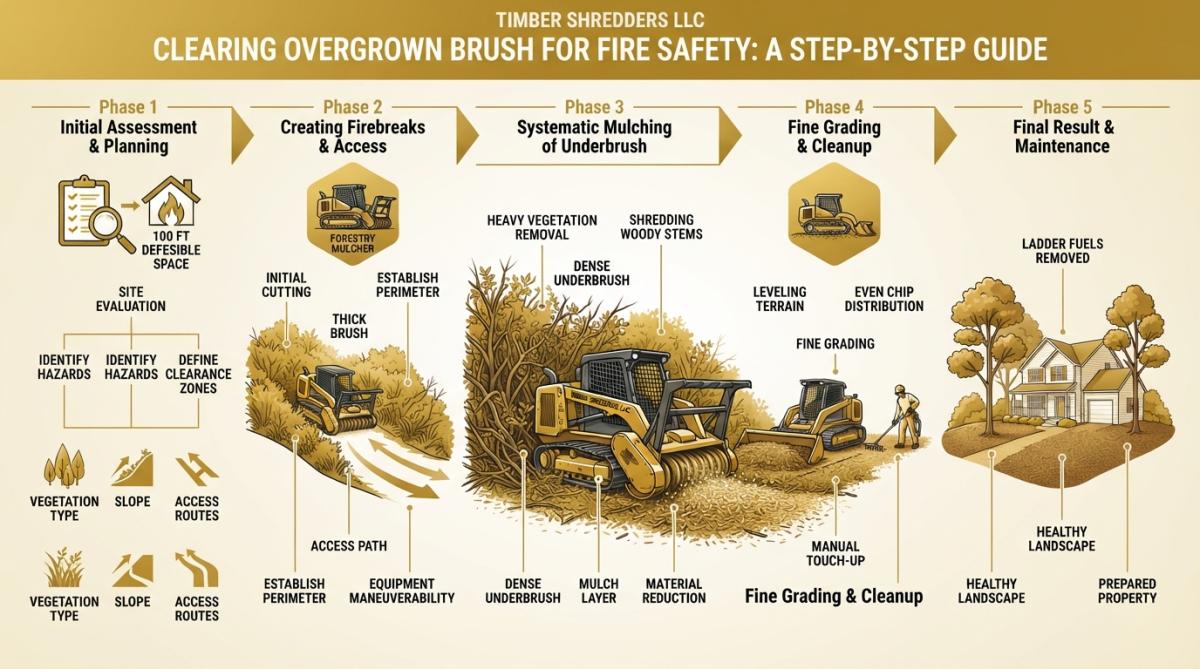
Step 4: Create Firebreaks and Clear Debris
Ensure driveways, gravel paths, and cleared strips between properties are clear of vegetation and debris. Clear debris from your property systematically. In the immediate zone, remove all debris. In other zones, consider chipping, mulching, or removal.
Forestry mulching equipment grinds debris into mulch that can be spread across your property to improve soil health and prevent erosion. If clearing by hand, arrange for debris removal or rent a chipper. Many communities offer free chipping services during fire season.
Fire-Resistant Landscaping After Brush Clearing
Once you’ve cleared overgrown brush, replant thoughtfully to prevent the problem from returning.
Native vs. Invasive Species: What to Plant and Avoid
Native plants are adapted to your local climate and typically require less water, fertilizer, and maintenance. Many are naturally more fire-resistant. Research native plants for your specific region through your local extension office.
Invasive species are often highly flammable and spread aggressively. Don’t replant areas with invasive species. When replanting, space plants further apart than you might prefer, avoid dense shrub plantings in defensible space zones, choose species with high moisture content, and maintain clearance between plantings.
Managing Erosion and Soil Health After Clearing
Removing dense vegetation exposes soil to erosion. Erosion prevention strategies include applying mulch (2-4 inches deep), planting ground cover species, installing erosion control blankets on steep slopes, and maintaining vegetative buffers along streams.
Forestry mulch from cleared vegetation is ideal for erosion control. It protects soil from rain impact, reduces water runoff velocity, and decomposes to improve soil structure and fertility.
Debris Disposal: Logistics, Costs, and Options
Your disposal options depend on debris volume, local regulations, and investment:
On-site chipping: Rent or hire a professional chipper to process debris into mulch. Ideal for properties where you want to use mulch for landscaping.
Professional removal: Straightforward but expensive for large volumes.
Community chipping programs: Many fire departments offer free or low-cost chipping services during fire season.
Controlled burning: Some areas permit on-site burning under specific conditions, but liability concerns make it risky.
Mulching in place: Forestry mulching equipment processes vegetation where it stands, leaving mulch on the property. Most efficient for large properties with dense vegetation.
| Disposal Option | Cost Range | Time to Complete | Best For |
|---|---|---|---|
| On-site chipping | $500-$2,000 | 1-2 days | Small to medium properties |
| Professional removal | $1,000-$5,000+ | 2-4 weeks | Small properties with limited space |
| Community programs | Free-$200 | 2-8 weeks | Properties near collection points |
| Forestry mulching | Varies by property | 1-3 days | Large properties, steep terrain |
| Controlled burning | $0 (permits required) | 1 day | Rural areas with regulations |
For properties over one acre with mixed brush and trees, professional forestry mulching is typically most cost-effective.
Clearing overgrown brush for fire safety requires commitment, but the payoff is substantial. You’re protecting your property investment, reducing insurance risk, and contributing to community fire resilience. Timber Shredders LLC brings professional expertise and specialized equipment to this work. Rather than spending months on hand clearing, professional forestry mulching completes large properties in days while improving soil health. Get a free quote from Timber Shredders LLC and discover how professional land management transforms overgrown properties into defensible, fire-safe spaces.
Frequently Asked Questions
What is defensible space and why is it important for fire safety?
Defensible space is the area around your home where vegetation and debris are managed to slow or stop wildfire spread. It typically extends 100-200 feet from structures and includes three zones: immediate zone (0-5 feet), intermediate zone (5-30 feet), and extended zone (30-100+ feet). Clearing overgrown brush and removing dead vegetation, ladder fuels, and excess fuel load significantly reduces fire risk and gives firefighters a safer area to defend your property during wildfire events.
Are there regulations or laws regarding brush clearance in my area?
Yes. Most U.S. states and counties have brush clearance regulations and fire safety ordinances that require property owners in fire-prone areas to maintain defensible space. Requirements vary by location and fire hazard severity zones. Contact your local fire marshal, county code enforcement, or county extension office to learn specific brush clearance requirements for your property. Non-compliance can result in fines or citations.
Will clearing brush cause erosion and damage my soil?
Professional clearing using modern equipment like forestry mulchers minimizes soil disturbance compared to traditional bulldozers. The key to preventing post-clearing erosion is proper mulching, which returns organic material to the soil, stabilizes slopes, and improves soil health. Native plant replanting, strategic mulch placement, and erosion control measures further protect your topsoil. Professional land management ensures your property remains usable for pasture, landscaping, or other purposes after clearing.
Can clearing overgrown brush actually reduce my homeowners insurance premiums?
Yes, many insurance companies offer premium discounts for homes with maintained defensible space. Clearing dead vegetation, reducing fuel load, and demonstrating fire safety compliance can lower your risk profile and qualify you for discounts. Contact your insurance agent to discuss your property’s defensible space improvements and ask about available premium reductions for fire mitigation work.
This article was written using GrandRanker