Table of Contents
- Understanding the Cost of Clearing Dense Brush
- Land Clearing Cost Per Acre: What You’ll Actually Pay
- Forestry Mulching Cost vs. Traditional Clearing Methods
- Debris Removal Cost in Land Clearing Projects
- Key Factors Affecting Dense Brush Clearing Costs
- DIY vs. Professional Brush Clearing: Cost and Risk Analysis
- Use a Land Clearing Cost Calculator to Estimate Your Project
- Post-Clearing Maintenance and Soil Health Investment
Cost of Clearing Dense Brush: 2026 Pricing Guide
Last Updated: July 26, 2026
Understanding the cost of clearing dense brush requires looking beyond simple per-acre quotes. Property owners face a complex range of variables that dramatically shift final invoices, from vegetation density and equipment selection to regional labor rates and disposal fees. At Timber Shredders LLC, we’ve tracked these cost drivers across hundreds of residential and rural land clearing projects in Central Virginia.
This guide breaks down what you’ll actually pay for dense brush clearing, the factors that move costs up or down, and how to avoid contractor surprises.
Understanding the Cost of Clearing Dense Brush
Dense brush clearing costs vary dramatically based on what you’re removing and how you remove it. A property with light undergrowth costs a fraction of what a site demands when heavy, tangled vegetation covers multiple acres with mixed tree stumps and rocky terrain.
Most property owners underestimate hidden costs: site assessment, permits, debris hauling, stump removal, and post-clearing grading.
Before comparing quotes, ask contractors to itemize every cost separately: equipment rental, labor per hour, debris hauling per ton, stump removal, permit fees, and site restoration. Bundled quotes hide the true cost drivers and make fair comparison impossible.
Why Dense Brush Clearing Costs Vary
Vegetation density is the primary cost multiplier. Light undergrowth costs far less than dense, tangled brush where trees intertwine with vines and saplings. A forestry mulcher moves slower through thick vegetation, burning more fuel and labor hours.
Tree diameter and stump presence matter significantly. Small saplings clear quickly. Mature trees with large root systems demand additional equipment and time.
Site topography affects equipment access and movement speed. Steep slopes require specialized equipment and slower work. Rocky terrain forces operators to work around obstacles, reducing efficiency.
Regional labor costs vary substantially across the United States. Central Virginia rates differ from California or Texas rates.
Debris removal is where many homeowners get blindsided. Hauling brush, wood chips, and stumps off-site costs money. Local landfill or mulch facility fees vary by region.
Land Clearing Cost Per Acre: What You’ll Actually Pay
Per-acre pricing gives you a starting point, but it’s only meaningful when you understand what’s included. Light brush removal on accessible land costs significantly less than dense undergrowth with mature trees, a difference of 3-5 times the cost.
Break your property into density zones. Walk your land and identify areas of light brush, moderate undergrowth, and dense vegetation with trees. Get separate pricing for each zone rather than a single per-acre number.
Acreage and Vegetation Density Impact
Larger acreage doesn’t always mean proportionally higher costs. A 10-acre property with consistent, moderate brush density clears more efficiently than a 2-acre property with mixed dense and light zones. Equipment setup and mobilization costs spread across more land.
Vegetation density is the real cost driver. A heavily wooded 1-acre lot with mature trees and thick undergrowth costs more than a 3-acre property with light brush and few trees. A forestry mulcher that processes 2 acres per day on light brush might handle only 0.5 acres per day on dense vegetation, a 4x difference in per-acre cost.
Regional Price Variations Across the U.S.
Labor costs drive significant regional differences. Central Virginia clearing rates differ substantially from West Coast, Northeast, or Texas pricing. Equipment availability, fuel costs, and local labor supply all factor in.
Urban and suburban areas typically cost more than rural regions. Disposal costs vary by region, some areas have low-cost landfills; others charge premium tipping fees, adding $500-$2,000+ to project costs. Permit requirements also vary by county and municipality.
| Region | Typical Labor Rate (per hour) | Debris Disposal (per ton) | Permit Complexity |
|---|---|---|---|
| Rural Southeast | Lower range | Low-cost facilities | Minimal |
| Suburban Mid-Atlantic | Mid range | Moderate facilities | Moderate |
| Urban Northeast | Higher range | Premium tipping fees | Complex |
| West Coast | Highest range | High tipping fees | Very complex |
Forestry Mulching Cost vs. Traditional Clearing Methods
Forestry mulching grinds vegetation in place, converting brush, trees, and stumps into mulch that stays on-site. No debris hauling. No separate stump removal. One piece of equipment handles the entire job.
Traditional clearing removes vegetation, hauls it off-site, and often requires separate stump removal and grading. More equipment, more labor, more trips to the landfill.
Forestry mulching costs less for projects where debris removal is expensive. It costs more when the site requires precise grading or when you want material completely removed.
How Equipment Choice Affects Total Price
Equipment selection determines project timeline, labor requirements, and final cost. A skid steer with a brush cutter works for light undergrowth but struggles with dense brush and trees. A forestry mulcher handles thick vegetation but requires a skilled operator.
Larger equipment moves faster but costs more to rent and operate. A wheeled excavator might process an acre per day; a compact skid steer might take 3-4 days.
Skid Steer vs. Forestry Mulcher: Cost Comparison
A skid steer with a brush cutter attachment rents for significantly less than a dedicated forestry mulcher. For small projects under 0.5 acres, skid steer costs are lower upfront.
However, skid steers work slower on dense vegetation. A forestry mulcher processes dense brush 2-3 times faster. On larger projects, the speed advantage often offsets its higher rental cost through reduced labor hours. Skid steers require separate debris removal equipment; a forestry mulcher eliminates this step entirely, saving thousands on disposal.
Debris Removal Cost in Land Clearing Projects
Debris removal is often the second-largest cost component after labor. A typical acre of dense brush generates 10-20+ tons of debris depending on vegetation type and tree size. At regional tipping fees, this adds $1,000-$4,000+ to your project cost.
Some contractors offer alternatives: chipping debris on-site for mulch, burning (where permitted), or leaving material for the property owner to process. These options reduce costs but require additional work or regulatory compliance.
Hauling Fees and Disposal Expenses
Hauling costs depend on distance to disposal facilities and debris volume. A 5-mile haul costs less than a 30-mile haul. Tipping fees vary by facility and material type. Wood chips might cost $15-$30 per ton; mixed brush and debris costs more.
Calculate total disposal cost by estimating debris volume, checking local tipping fees, and calculating round-trip hauling distance. Alternatively, on-site chipping reduces hauling costs but requires space to stockpile mulch.
Key Factors Affecting Dense Brush Clearing Costs
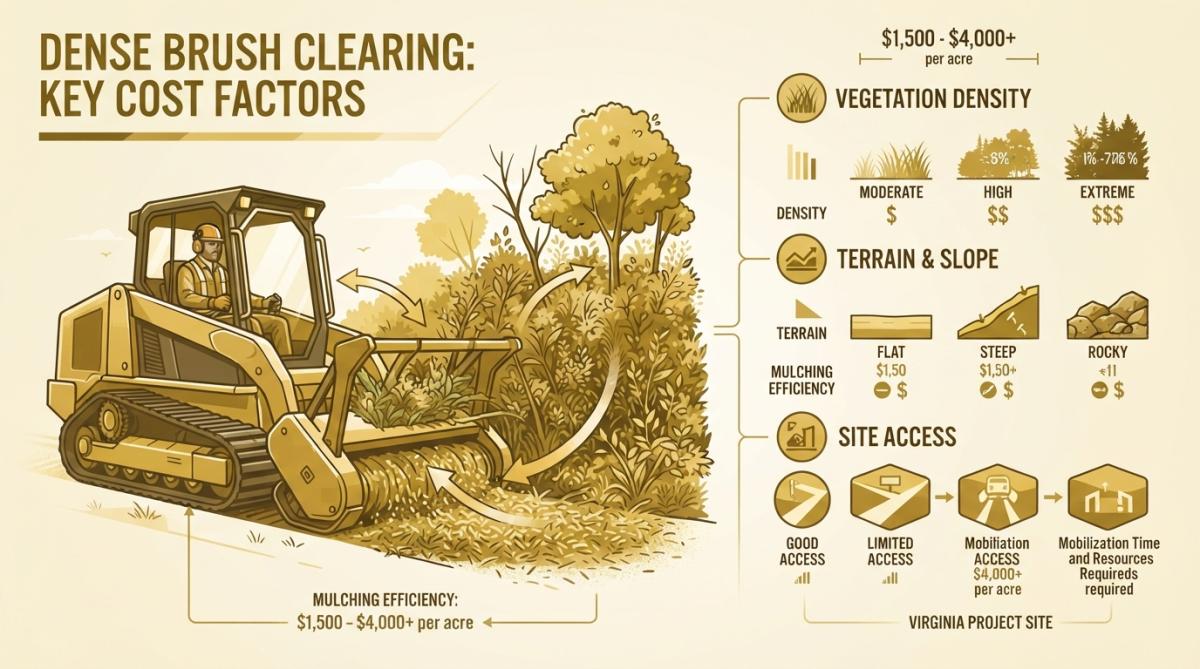
Site accessibility determines equipment movement speed. A property with a wide, flat driveway and open areas clears faster than one where equipment must navigate narrow paths or work around structures.
Existing structures, buildings, utility lines, and septic systems require careful work and slow equipment movement. Overhead power lines demand extra caution. Soil conditions matter for equipment operation; wet, muddy soil slows equipment and increases rutting damage.
Tree Diameter, Undergrowth Density, and Site Topography
Tree diameter directly affects removal cost and time. Small saplings clear quickly. Trees 8-12 inches in diameter take significantly longer. Large mature trees (18+ inches) require specialized equipment and add substantial cost.
Undergrowth density determines equipment speed. Light undergrowth with spaced trees clears fast. Dense, tangled vegetation forces slower, more careful work.
Topography affects equipment access and stability. Steep slopes require slower, careful work. Flat terrain allows faster movement and larger equipment. Rocky terrain forces operators to avoid large rocks, reducing efficiency.
Stump Removal and Grubbing Expenses
Stumps can stay in place or be removed entirely. Forestry mulching grinds stumps into mulch, eliminating separate stump removal cost. Traditional clearing leaves stumps that must be addressed separately through grubbing, which pulls roots from the ground.
Large stumps with extensive root systems cost more to remove than small ones. Rocky soil complicates grubbing.
Permits and Site Assessment Costs
A professional site assessment costs $200-$500 but prevents surprises. Contractors identify access issues, vegetation density zones, buried debris, and other factors that affect pricing.
Permits vary by location. Some counties require land clearing permits; others don’t. Environmental permits might be needed for properties near wetlands or waterways. Permit costs range from zero to several hundred dollars, plus processing time.
DIY vs. Professional Brush Clearing: Cost and Risk Analysis
DIY clearing works for very small projects, under 0.25 acres of light brush with no trees. Renting a skid steer for a weekend might save labor costs.
For anything larger or denser, professional clearing makes financial sense. Equipment rental, fuel, and labor hours add up quickly. A professional completes in days what takes an amateur weeks.
Liability is the larger concern. Improper equipment operation damages property. Professional contractors carry insurance; you don’t.
DIY clearing on steep terrain or around structures risks serious injury and property damage. Equipment rollovers, falling trees, and struck utilities are common accident causes. Professional operators have training and insurance for these risks.
Equipment Rental vs. Purchase for Small Projects
Renting equipment for a small project costs less than purchasing. A skid steer rents for $200-$400 per day; purchasing costs $20,000+.
Purchase makes sense only if you have multiple projects over several years. For most property owners, professional contractors with owned equipment deliver better value than DIY rental.
Hidden Costs and Liability Considerations
DIY clearing creates liability exposure. If equipment damages a neighbor’s property, your homeowner’s insurance might not cover it. Professional contractors carry liability insurance that protects you if something goes wrong.
Equipment damage is another hidden cost. Renting equipment means you pay for damage. Hitting a buried rock, striking a utility line, or rolling equipment on a slope results in rental company charges.
Use a Land Clearing Cost Calculator to Estimate Your Project
A land clearing cost calculator helps you estimate costs before getting formal quotes. Walk your property, measure acreage, assess vegetation density by zone, identify trees and stumps, note site access, and check local permit and disposal costs. Then input these specifics into a calculator or share them with contractors for detailed quotes.
Variables to Input for Accurate Estimates
Start with acreage. Measure or estimate your property size and break it into zones by vegetation density: light, moderate, and dense.
Identify tree count and diameter ranges. Note site access, can equipment drive directly to work areas, or must it navigate obstacles? Check local disposal costs by calling nearby landfills or mulch facilities for tipping fees. Research permit requirements by contacting your county or municipal office.
Input clearing method preference. Do you want forestry mulching (in-place grinding) or traditional removal with separate stump extraction?
| Project Variable | Impact on Cost | Example |
|---|---|---|
| Acreage | Linear (more acres = higher cost) | 1 acre vs. 3 acres |
| Vegetation density | Major multiplier (dense = 3-5x more) | Light brush vs. dense with trees |
| Tree count/diameter | Significant (large trees add cost) | No trees vs. 20 trees over 8 inches |
| Site topography | Moderate (slopes reduce efficiency) | Flat vs. steep terrain |
| Debris disposal | Major (hauling and tipping fees) | On-site mulch vs. off-site removal |
| Permits required | Minor to moderate (location-dependent) | No permits vs. environmental review |
Post-Clearing Maintenance and Soil Health Investment
Clearing dense brush is the beginning, not the end, of land restoration. After vegetation removal, your property needs attention. Exposed soil erodes without cover. Regrowth happens quickly without maintenance.
Post-clearing costs include grading to improve drainage, seeding or replanting for erosion control, and ongoing weed management.
Why Forestry Mulching Protects Topsoil and Prevents Erosion
Forestry mulching leaves mulch on-site, which protects topsoil and prevents erosion. The mulch layer acts as ground cover, reducing rainfall impact and water runoff. It also improves soil over time as it decomposes, enriching soil with organic matter and improving water retention.
Properties cleared with forestry mulching require less post-clearing erosion control work. The mulch layer provides immediate protection.
Long-Term Land Management Costs After Clearing
Budget for ongoing land management after clearing. Regrowth happens quickly, especially on properties with good soil and moisture.
Herbicide application slows regrowth but requires annual treatments. Mowing or brush hogging controls regrowth on larger properties. If you’re converting cleared land to pasture, seeding and fencing costs add up. Properties left unmaintained revert to brush within 2-3 years.
The cost of clearing dense brush isn’t determined by acreage alone. Vegetation density, equipment choice, site conditions, and disposal logistics drive the final invoice. A professional site assessment before getting quotes prevents surprises and ensures you’re comparing apples to apples.
Timber Shredders LLC handles dense brush clearing across Central Virginia with forestry mulching equipment that grinds vegetation in place, preserves topsoil, and eliminates expensive debris hauling. The team provides detailed site assessments, transparent pricing that itemizes every cost component, and professional operators who complete projects efficiently while protecting your property. Get a free quote and see exactly what your clearing project costs, no hidden fees, no surprises.
Frequently Asked Questions
What factors affect the cost of clearing dense brush?
Multiple variables impact pricing for clearing dense brush: vegetation density and undergrowth thickness, tree diameter and species, property topography and accessibility, presence of stumps requiring grubbing, regional labor rates, and equipment availability. A professional site assessment evaluates these conditions to provide an accurate estimate. Properties with mixed brush, rocks, and old stumps typically cost more than uniform vegetation due to increased clearing complexity and potential equipment challenges.
How much does forestry mulching cost compared to traditional clearing?
Forestry mulching cost varies based on acreage, vegetation density, and regional pricing, but the method offers significant advantages over traditional clearing. Unlike conventional grubbing and hauling, forestry mulching grinds vegetation on-site, eliminating debris removal and disposal fees. This approach reduces labor costs, prevents soil erosion, and improves land management outcomes by leaving beneficial mulch that protects topsoil. Get a free quote to compare pricing for your specific property.
What’s included in debris removal cost for land clearing projects?
Debris removal cost in land clearing encompasses hauling fees for removed material, tipping or disposal fees at landfills, and labor for site cleanup. Forestry mulching eliminates most of these expenses by processing material on-site, while traditional clearing methods require separate hauling and disposal. When requesting estimates, clarify whether debris removal and site restoration are included, as these can represent 20-40% of total project cost if handled separately.
Will forestry mulching tear up my topsoil like a bulldozer would?
No, forestry mulching actually protects topsoil better than traditional equipment. A forestry mulcher grinds vegetation while maintaining soil structure, leaving behind mulch that prevents soil erosion and improves land health. Unlike bulldozers that compact and displace topsoil, this method preserves your land’s usability for pasture, gardens, or future development. The mulch layer also suppresses regrowth, reducing long-term maintenance costs and supporting sustainable land management.
Can I save money by clearing dense brush myself?
DIY clearing saves on labor but introduces significant costs and risks. Equipment rental for skid steers or mulchers runs hundreds per day, and mistakes can damage property or injure you. Professional contractors have insurance, experience with unexpected obstacles (rocks, stumps), and efficiency that reduces total project time. Hidden costs, permits, liability, improper disposal, often exceed contractor quotes. For dense brush projects over 1 acre, professional clearing typically offers better value and guaranteed results.
This article was written using GrandRanker