
Table of Contents
- What Is Forestry Mulching and How It Works
- Key Benefits of Forestry Mulching for Soil Health
- Erosion Control Methods Through Forestry Mulching
- Moisture Retention and Soil Temperature Regulation
- Forestry Mulching vs Traditional Land Clearing: Environmental Impact
- Soil Health Improvement Techniques and Long-Term Maintenance
- Forestry Mulching Environmental Benefits and Carbon Sequestration
- Common Questions About Forestry Mulching for Your Property
Last Updated: July 21, 2026
Forestry mulching is one of the most effective land management practices available to property owners today. This process fundamentally rebuilds soil structure, restores microbial ecosystems, and creates conditions for long-term land productivity. At Timber Shredders LLC, we’ve worked with hundreds of Central Virginia property owners and seen firsthand how forestry mulching revitalizes degraded land within months rather than years.
This comprehensive guide covers the key benefits of forestry mulching for soil, explains how the process works, and addresses the specific concerns landowners raise before committing to the work.
What Is Forestry Mulching and How It Works
Forestry mulching is a land management technique that uses specialized equipment to grind trees, brush, stumps, and woody debris into fine mulch while leaving it on-site. Unlike traditional clearing methods that remove material, mulching equipment reduces everything to a uniform, nutrient-rich ground cover that immediately begins improving soil conditions.
The Mulching Process and Equipment
A professional operator begins with a property assessment, evaluating vegetation density, terrain, rock presence, and soil composition. Most properties require a single pass with a forestry mulcher, a tracked machine equipped with a rotating drum or disc that grinds material into pieces roughly one to three inches in size.
The mulcher operates at ground level, and the operator controls grinding speed and depth to avoid excessive soil disturbance. This is a critical difference from bulldozers or excavators, which compact soil and remove topsoil entirely. A well-operated mulcher leaves a protective layer of organic material on the ground surface while minimizing damage to underlying soil structure.
The entire process typically takes one to three days for a three-acre property. Once grinding is complete, the mulch layer remains in place with no cleanup or secondary equipment needed.
The key to successful forestry mulching is equipment operator experience. A skilled operator maintains consistent grinding depth, preserves topsoil, and works with terrain rather than against it.
Key Benefits of Forestry Mulching for Soil Health
The benefits of forestry mulching emerge from a single fundamental change: adding organic matter back to degraded land. Most cleared properties have been stripped of vegetation and topsoil, leaving compacted, nutrient-poor earth. Forestry mulching reverses this damage by introducing billions of organic particles that feed soil microorganisms and rebuild structure.
Nutrient Cycling and Organic Matter Addition
Freshly ground wood, bark, and leaf material contain carbon, nitrogen, phosphorus, and potassium in forms that soil organisms can access. As decomposition begins, these nutrients become available to plant roots. The mulch layer acts as a slow-release fertilizer, delivering nutrients steadily over months and years rather than washing away in heavy rain.
Decomposition accelerates in warm months and slows in winter, creating a natural rhythm that matches plant growth cycles. Many landowners report that pastures established on mulched ground require less supplemental fertilizer in the first two years because soil organisms have already begun breaking down organic matter into plant-available forms.
Organic matter is the foundation of soil health. A single forestry mulching application adds more organic material to degraded soil than most landowners could apply through conventional composting in a decade.
Soil Structure and Aeration Improvement
Soil structure refers to how individual soil particles aggregate into larger units. Poor structure means soil particles remain tightly packed, water cannot move through easily, and roots cannot penetrate. Organic matter acts as a binding agent. As microorganisms decompose the mulch, they produce sticky compounds that hold soil particles together in stable aggregates, creating pore space where water and air can move.
Within six months of mulching, soil structure measurably improves. Within a year, the transformation becomes visible: soil crumbles in your hand instead of forming hard clods, water infiltrates quickly instead of running off, and plant roots push deeper into the earth. Improved aeration also benefits soil organisms directly, allowing earthworms and beneficial microorganisms to thrive.
Erosion Control Methods Through Forestry Mulching
Erosion is one of the most destructive soil processes. Unprotected soil on slopes loses inches of topsoil annually to wind and water, carrying away the finest, most nutrient-rich soil particles.
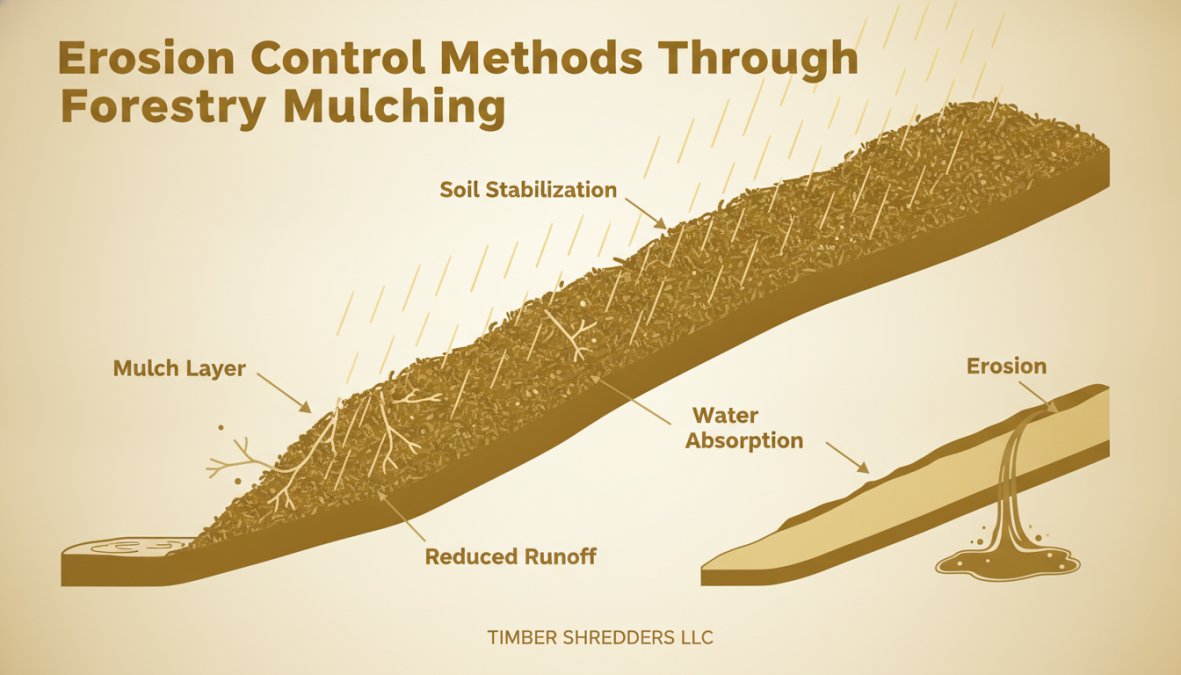
Forestry mulch acts as a physical barrier. The mulch layer absorbs the impact of raindrops, which otherwise dislodge soil particles, and increases water infiltration so water soaks into mulch instead of running across bare ground. On slopes, mulch anchors light soil particles and reduces wind erosion while trapping additional organic matter blown by wind.
Traditional erosion control methods like erosion cloth and silt fences are temporary fixes requiring maintenance and removal. Forestry mulch is self-renewing. As the original mulch decomposes, new organic matter accumulates from falling leaves and plant debris, improving erosion protection over time rather than degrading it.
Moisture Retention and Soil Temperature Regulation
The mulch layer reduces evaporation significantly. Soil beneath mulch stays cooler and moister than exposed soil, even during hot, dry periods, allowing plant roots to access water between rainfall events and maintaining conditions for soil microorganisms.
Temperature regulation is equally important. Bare soil in full sun can reach 140+ degrees Fahrenheit in summer, killing beneficial soil organisms and stressing plant roots. Mulch insulates soil, keeping temperatures more moderate. In winter, mulch prevents extreme freezing.
This temperature stability extends the growing season. Spring growth starts earlier because soil warms more gradually, and fall growth continues later because mulch prevents rapid cooling. Landowners preparing pasture or hay ground notice mulched areas green up faster in spring and maintain better color through dry summers.
Without mulch protection, newly seeded pastures often fail during the first dry spell. Mulched ground solves this problem by keeping surface soil moist while roots establish.
Forestry Mulching vs Traditional Land Clearing: Environmental Impact
Traditional land clearing methods remove topsoil, compact remaining soil, and leave bare ground vulnerable to erosion. These methods are fast and cheap upfront, but the long-term costs are substantial: erosion damage, loss of productivity, and years of recovery before the land becomes usable again.
Forestry mulching takes longer and costs more initially, but it preserves topsoil, improves soil structure, and leaves the land immediately more productive.
Comparison Table: Mulching vs. Conventional Methods
| Factor | Forestry Mulching | Traditional Clearing | Winner |
|---|---|---|---|
| Topsoil Preservation | Retains 95%+ | Removes or buries | Mulching |
| Erosion Risk | Low (mulch protects) | High (bare ground) | Mulching |
| Soil Compaction | Minimal | Severe | Mulching |
| Organic Matter Added | High (ground debris) | None (removed) | Mulching |
| Vegetation Establishment | 3-6 months | 12+ months | Mulching |
| Cost (3 acres) | Higher initial | Lower initial | Clearing |
| Long-term Land Value | Improved | Degraded | Mulching |
| Carbon Sequestration | Active | Minimal | Mulching |
Traditional clearing creates compacted, sterile soil that requires years of amendment before it becomes productive again. Forestry mulching is the sustainable alternative that works with soil biology rather than against it.
Soil Health Improvement Techniques and Long-Term Maintenance
Forestry mulching is the foundation of a long-term soil improvement strategy. Understanding how to maintain and build on initial mulching results ensures that soil health continues improving for years.
Microbiome Development and Soil Chemistry
Soil is alive. A single handful of healthy soil contains more microorganisms than humans on Earth. Degraded, cleared land has minimal microbial life because there’s no food source or favorable conditions.
Forestry mulch changes this immediately. The mulch layer provides food for decomposer organisms, which multiply rapidly and produce compounds that bind soil particles, create pore space, and release nutrients. Soil pH also shifts gradually, with fresh wood mulch being slightly acidic, which helps dissolve mineral nutrients and make them available to plants.
Soil chemistry improves through biological processes rather than chemical amendments. Microorganisms break down organic matter and release nutrients in plant-available forms. Fungi form symbiotic relationships with plant roots, extending their reach and improving nutrient uptake.
Regional Suitability and Maintenance Cycles
Forestry mulching works well in Central Virginia’s climate. A single application provides active soil improvement for 18-24 months. After that, the original mulch layer has largely decomposed, but the soil structure and microbial communities it created persist.
For pasture or hay ground, allowing native vegetation to establish on mulched soil provides ongoing organic matter. Fallen leaves and plant debris continue the decomposition process, creating a self-sustaining cycle where soil health improves indefinitely.
Plan mulching timing for late summer or early fall. This gives the mulch layer time to settle and begin decomposing before winter, and allows spring vegetation to establish in improved soil.
Forestry Mulching Environmental Benefits and Carbon Sequestration
Beyond soil health, forestry mulching provides significant environmental benefits. When wood is ground into mulch and left on-site, the carbon it contains remains in the soil system rather than being released into the atmosphere. Soil carbon levels increase as organic matter decomposes slowly over years.
Runoff reduction improves water quality downstream. Mulched ground infiltrates water instead of shedding it, reducing erosion and improving water quality. Mulched ground with establishing vegetation provides cover and food for insects, birds, and small mammals, creating more resilient ecosystems. Wildfire risk reduction is significant in some regions by removing dense brush and converting it to ground-level mulch.
Common Concerns About Forestry Mulching
Will mulching damage my topsoil like a bulldozer would?
No. A properly operated forestry mulcher keeps ground-level disturbance minimal. Topsoil is preserved and improved, not removed.
Can your equipment handle my property with rocks and old stumps?
Yes, but rocks and stumps affect timeline and cost. A free property assessment identifies these issues upfront.
How long does a typical project take?
Most three-acre properties take one to three days, depending on vegetation density and site conditions.
Will the mulch improve soil for pasture use?
Yes. Mulched ground establishes pasture faster and more reliably than cleared ground. Most landowners see productive pasture within one growing season.
What happens to the mulch layer over time?
It decomposes gradually over 12-18 months, improving soil structure and adding organic matter. New organic matter from fallen leaves and plant debris takes its place.
Reclaiming degraded land shouldn’t mean choosing between speed and soil health. Forestry mulching delivers both, fast property access combined with genuine, long-term soil improvement. Timber Shredders LLC specializes in professional mulching that preserves topsoil, establishes vegetation faster, and leaves your land more productive than traditional clearing methods. The difference shows within months: better drainage, faster vegetation growth, and soil that works with you instead of against you. Get a free quote today and see how forestry mulching can transform your property.
Frequently Asked Questions
How does forestry mulching improve soil health compared to traditional bulldozing?
Forestry mulching preserves topsoil and adds organic matter through decomposition, whereas traditional land clearing removes or compacts soil. The mulch layer protects against erosion, regulates soil temperature, and supports microbial activity. Unlike heavy equipment that damages soil structure and compaction, mulching equipment gently fragments vegetation in place, maintaining soil porosity and aeration while enriching soil fertility naturally over time.
Does forestry mulching really prevent erosion and runoff on sloped properties?
Yes. The mulch layer acts as ground cover that reduces water runoff velocity and protects topsoil from washing away. By maintaining soil structure and improving porosity, forestry mulching allows better water infiltration rather than surface flow. This is especially effective on slopes where traditional clearing leaves bare, compacted soil vulnerable to erosion. The organic matter also binds soil particles together, further resisting erosion.
What long-term soil health improvements can I expect from forestry mulching?
Over time, decomposition of the mulch layer enriches soil with nutrients and organic matter, improving soil structure and water-holding capacity. Microbial populations increase, supporting nutrient cycling and plant growth. Soil pH stabilizes as organic matter buffers chemical changes. Weed suppression reduces competition for resources. These benefits compound over multiple growing seasons, creating increasingly productive land suitable for pasture, planting, or other uses without requiring additional soil amendments.
How does forestry mulching affect soil moisture and prevent excessive evaporation?
The mulch layer acts as a natural insulator, reducing soil temperature fluctuations and limiting evaporation. By maintaining consistent moisture levels, mulching helps soil retain water during dry periods while preventing waterlogging during heavy rain. This moisture regulation supports root development and microbial activity. Plants also experience less stress, and you may need less supplemental watering. The improved soil structure from decomposing organic matter further enhances water retention capacity.
This article was written using GrandRanker