Table of Contents
- Forestry Mulching vs Traditional Land Clearing: Key Differences
- Comparison Table: Forestry Mulching vs Traditional Land Clearing
- Process Differences: How Each Method Works
- Environmental Impact and Soil Health in Land Clearing
- Land Clearing Cost Per Acre: Budget Breakdown
- Time Efficiency and Project Speed
- Stump Removal vs Mulching: Equipment and Limitations
- Land Clearing Equipment: Machinery Comparison
Forestry Mulching vs Traditional Land Clearing: A Complete Comparison
Last Updated: July 20, 2026
When facing dense brush, overgrown stumps, and tangled vegetation, the choice between forestry mulching and traditional land clearing determines your timeline, cost, soil health, and land usability. This guide breaks down what separates these approaches, where each excels, and which suits your situation.
Forestry Mulching vs Traditional Land Clearing: Key Differences
Forestry mulching grinds trees, brush, and stumps into fine mulch on-site in a single pass, leaving organic material to protect soil and control erosion. Traditional land clearing uses bulldozers and excavators to push vegetation, remove stumps, and haul debris away, leaving bare dirt requiring additional grading and site preparation.
The fundamental difference is philosophy: one works with the soil, the other against it. This affects your timeline, budget, environmental footprint, and immediate land usability.
Most landowners don’t realize that bare-dirt grading after traditional clearing requires months of settling before use. Forestry mulching eliminates this waiting period because the mulch layer stabilizes soil immediately.
What is Forestry Mulching?
Forestry mulching uses a specialized attachment on a compact track loader to grind standing trees, brush, stumps, and undergrowth into fine mulch in a single pass. The rotating drum with carbide teeth pulverizes material and ejects it downward as ground cover.
Trees up to 8 inches diameter are typically handled in one pass. Nothing leaves the property, all organic material stays on-site as ground cover, eliminating debris piles, burning permits, and hauling costs. The mulch layer prevents soil erosion, suppresses weeds, improves soil structure, and creates a stable surface for equipment or future construction.
What is Traditional Land Clearing?
Traditional clearing uses bulldozers and excavators to push over trees, rip out stumps, and create debris piles that are burned, chipped separately, or hauled away. The process requires multiple pieces of equipment and multiple passes.
A bulldozer pushes vegetation into windrows. An excavator with a grapple pulls stumps and sorts material into piles. A grader then smooths the bare soil and creates drainage slopes. Debris is burned, chipped, or removed. The result is clean, graded bare soil vulnerable to erosion and requiring months of settling before heavy use.
Comparison Table: Forestry Mulching vs Traditional Land Clearing
| Factor | Forestry Mulching | Traditional Clearing | Winner |
|---|---|---|---|
| Single-Pass Efficiency | Yes, one machine does all work | No, requires multiple equipment | Forestry Mulching |
| Debris Handling | Mulch stays on-site | Debris hauled or burned | Forestry Mulching |
| Soil Erosion Control | Mulch layer prevents runoff | Bare dirt exposed to erosion | Forestry Mulching |
| Project Timeline | 3-7 days typical | 5-14 days typical | Forestry Mulching |
| Equipment Cost | Lower per-acre cost | Higher equipment rental/labor | Forestry Mulching |
| Site Preparation | Immediate usability | Requires 2-4 months settling | Forestry Mulching |
| Stump Removal | Mulched on-site | Physically removed | Traditional (if full removal needed) |
| Grading Capability | Limited | Excellent | Traditional |
| Best For | Erosion control, quick turnaround | Building pads, graded surfaces | Depends on project |
Process Differences: How Each Method Works
Forestry Mulching Process
A site assessment evaluates vegetation density, tree size, obstacles, and terrain to determine equipment access and timeline. A compact track loader equipped with a drum mulcher is positioned at the property edge and moves systematically across the property, engaging the mulcher head with standing vegetation. The rotating drum grinds material into fine mulch ejected downward and spread across the cleared area at 2-4 inches depth.
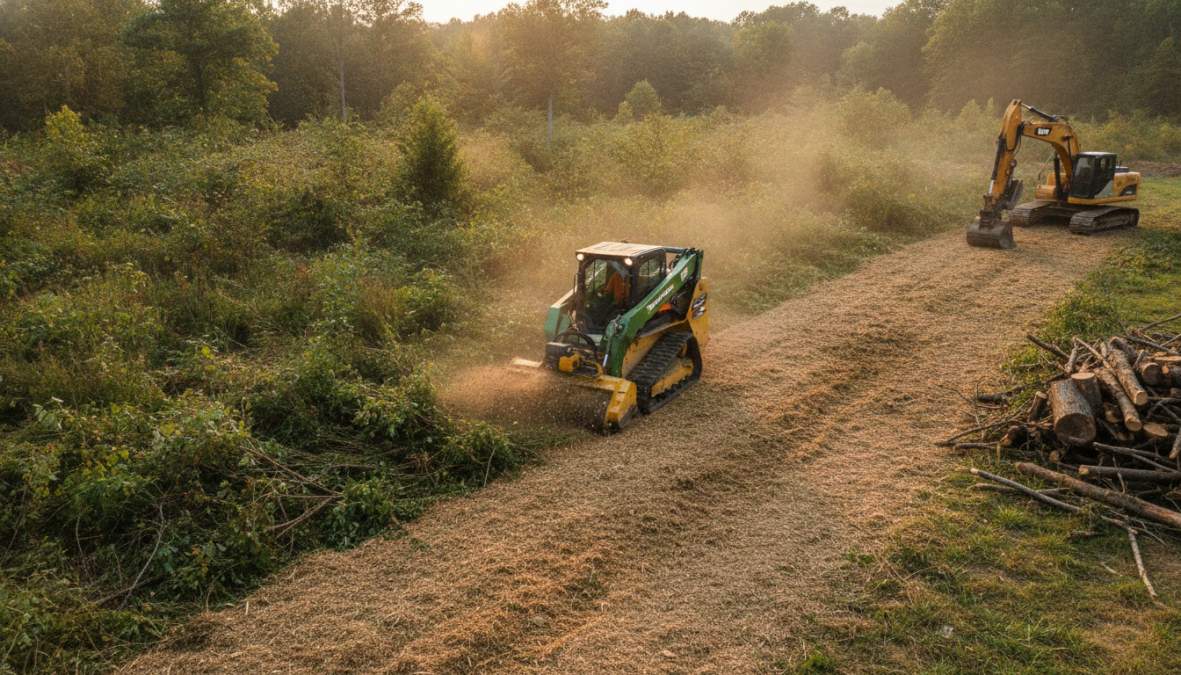
Dense brush and small trees (up to 6 inches diameter) clear in single passes. Larger trees may require multiple passes or preliminary chainsaw cutting. Stumps are mulched in place, eliminating separate stump removal equipment.
As work progresses, the mulch layer accumulates, immediately stabilizing soil. Once the property is cleared, equipment is removed and the project is complete. The property is immediately usable for pasture, construction, or other purposes.
Traditional Land Clearing Process
A bulldozer pushes over standing trees and vegetation, creating windrows. An excavator with a grapple bucket pulls stumps, separating them from soil and rocks. Material is sorted into piles: logs, brush, and rocks separately. This sorting requires multiple passes.
Debris is processed according to project plans and local regulations, burned (with permits), chipped by a separate contractor, or hauled away. A grader then levels bare soil, creates drainage slopes, and compacts the surface. This entire process requires coordination between multiple contractors and typically takes longer than forestry mulching.
Environmental Impact and Soil Health in Land Clearing
Erosion Control and Soil Preservation
Forestry mulching leaves a protective organic layer that immediately reduces soil erosion. The mulch acts as a physical barrier, preventing rainfall from impacting bare soil and slowing runoff velocity. Research from the U.S. Department of Agriculture confirms that organic ground cover reduces sediment loss by 80-95% compared to bare soil.
The mulch layer suppresses weed growth naturally and incorporates organic matter into soil over 12-18 months, improving soil structure and water retention. Your land becomes more productive over time.
Traditional clearing removes all organic material and leaves bare soil exposed. Without ground cover, rainfall causes soil compaction and accelerates erosion. Sediment washes into adjacent areas, potentially violating environmental regulations. Bare soil becomes a seedbed for invasive weeds requiring management.
If your property slopes toward a stream, wetland, or neighbor’s property, bare-dirt grading can trigger sedimentation violations. Forestry mulching eliminates this risk because the mulch layer controls runoff immediately.
Long-Term Soil Nutrient Analysis
Forestry mulching improves soil nutrient cycling. As mulch decomposes, it releases nitrogen, phosphorus, and potassium back into soil. Organic matter increases microbial activity, improving nutrient availability to plants. Studies from Virginia Tech show that mulch-cleared properties have 15-25% higher soil organic matter content after 18 months compared to bare-dirt properties.
Traditional clearing removes nutrients from the site. Stumps, logs, and brush that would naturally decompose and return nutrients are hauled away or burned. Bare soil is left depleted, and topsoil is often mixed with subsoil during grading, reducing fertility.
For pasture, crops, or vegetation-dependent uses, forestry mulching provides a significant head start with immediate ground cover and organic matter supporting plant establishment.
Land Clearing Cost Per Acre: Budget Breakdown
What Affects Pricing for Each Method
Forestry mulching pricing depends on vegetation density, tree size, terrain accessibility, and acreage. Light brush and small trees clear faster and cost less per acre than dense hardwood with large stumps. Steep terrain may require additional equipment or multiple passes.
Because forestry mulching is single-pass with one machine, the cost structure is straightforward: equipment rental, operator time, and fuel.
Traditional clearing costs are more variable, involving multiple equipment types, multiple contractors, and variable debris disposal costs. A bulldozer rental, excavator rental, grader rental, hauling trucks, and potentially a separate chipping contractor add up. Burning debris requires permits and favorable weather. Hauling debris to landfills or recycling facilities adds additional cost.
A property appearing cheaper to clear traditionally often becomes more expensive once all phases complete. Hidden costs, debris hauling, grading, site preparation, and the waiting period before usability, accumulate quickly.
Get a detailed written quote from any contractor before committing. Compare not just clearing cost, but total project cost including any required grading, site preparation, and timeline impacts.
Time Efficiency and Project Speed
How Long Each Method Takes
Forestry mulching typically completes in 3-7 days for properties up to 5 acres, depending on vegetation density and terrain. A 3-acre property with moderate brush clears in 4-5 days. A densely overgrown 5-acre property with large trees takes 7-10 days. Once equipment leaves, the project is done and your property is immediately usable.
Traditional clearing takes 5-14 days for the same acreage, not including debris processing. Hauling, burning, or chipping adds 3-7 days. Grading adds 2-3 days. Total timeline stretches to 10-24 days, and bare soil requires 2-4 months of settling before heavy use.
If you need your driveway cleared before winter or your property ready for building before the rainy season, forestry mulching gets you there faster with less risk.
Seasonal Considerations
Forestry mulching works year-round in most conditions. Wet soil doesn’t stop work because compact track loaders have excellent traction and spread weight across a wider footprint than traditional dozers. Light rain doesn’t halt the project.
Traditional clearing is more weather-dependent. Wet soil can become impassable for heavy equipment, halting the project. Burning debris requires dry conditions and favorable wind patterns.
Fall and early winter are ideal for both methods in Central Virginia because vegetation is dormant and soil conditions are stable. Spring can be problematic for traditional clearing because wet soil limits equipment access and extends timelines.
Stump Removal vs Mulching: Equipment and Limitations
Stump Handling in Forestry Mulching
Forestry mulching eliminates stumps by grinding them into mulch along with other vegetation. The rotating drum pulverizes stump wood, and mulch spreads across the property. Stumps up to 12 inches diameter are typically handled in one or two passes.
The advantage is complete removal with no separate equipment or additional cost. The disadvantage is that stump grinding creates fine mulch, not wood chips suitable for other uses. If you want to save large logs for firewood or lumber, forestry mulching isn’t ideal.
For most landowners who simply want stumps gone, forestry mulching solves the problem completely.
Stump Removal in Traditional Clearing
Traditional clearing physically removes stumps using an excavator with a grapple bucket. The excavator digs around the stump base, loosens the root system, and pulls the entire stump from the ground. The stump is then loaded onto a truck for removal or placed in a debris pile.
Physical removal allows you to save large logs if they have value and provides a completely clean site with no remaining wood in soil. However, it requires additional equipment, time, and cost. The excavator must make multiple passes to extract each stump, and holes left behind must be filled and compacted.
For properties where you want to save timber or need a completely stump-free site for building, traditional stump removal is necessary. For most projects, the extra cost and time aren’t justified.
Land Clearing Equipment: Machinery Comparison
Mulching Equipment Specifications
The Fecon Bull Hog Mulcher and Bobcat Drum Mulcher are industry-standard attachments for forestry mulching. The Fecon Bull Hog features a rotating FGT rotor system with double carbide teeth designed for efficient wood shredding, available in 50-inch to 72-inch cutting widths.
The Bobcat Drum Mulcher works with Bobcat 700-Series and 800-Series compact track loaders, featuring heavy-duty carbide teeth, depth control rings for consistent mulch, and a two-speed hydraulic motor. Available in 50-inch, 61-inch, and 72-inch cutting widths, it’s designed for utility line maintenance, site preparation, and property maintenance.
Both systems require high-flow hydraulic compact track loaders. The compact track loader’s design allows operation in wet conditions, steep terrain, and tight spaces where traditional dozers can’t operate. Distributed weight of 15,000-25,000 pounds means less soil compaction than a bulldozer’s 30,000-50,000 pounds.
Traditional Clearing Equipment
The Caterpillar D3 Small Dozer, with a 104-horsepower engine and operating weight of approximately 20,640 pounds, excels at pushing trees, grubbing stumps, and creating graded surfaces. However, it doesn’t mulch vegetation, it just moves it, requiring follow-up debris processing and grading.
Excavators with grapple buckets handle stump removal and debris sorting. A typical excavator weighs 25,000-40,000 pounds and requires multiple passes to extract stumps and sort material. Bandit Industries whole-tree chippers, such as the Model 3590XL with a 48-inch diameter chipping drum, can process large volumes of wood but require additional equipment to fell and transport trees. Used models start at $325,000, making them practical only for large-scale commercial operations.
Forestry mulching equipment is best for properties under 10 acres with moderate to dense vegetation and no requirement for graded building pads. Traditional equipment is best for properties requiring finished grades, building pads, or complete stump removal.
Conclusion
The choice between forestry mulching and traditional land clearing depends on your specific needs, timeline, and long-term property plans. Forestry mulching offers speed, environmental protection, and immediate land usability at lower total cost. Traditional clearing provides graded surfaces and complete stump removal when necessary.
For most Central Virginia landowners clearing overgrown properties for pasture, access restoration, or general land management, forestry mulching delivers the best combination of speed, cost-effectiveness, and soil health. The mulch layer protects your land from erosion, improves soil structure, and eliminates the months-long settling period required after traditional clearing.
Frequently Asked Questions
Is forestry mulching better than traditional land clearing for erosion control?
Forestry mulching typically offers superior erosion control because it leaves a protective mulch layer on-site that stabilizes soil and reduces runoff. Traditional land clearing removes all vegetation and organic matter, leaving bare dirt exposed to erosion and sedimentation. However, the best choice depends on your site’s slope, soil type, and intended post-clearing use. Professional assessment of your specific property helps determine which method best protects your soil health.
What’s the difference in land clearing cost per acre between the two methods?
Costs vary significantly based on property size, vegetation density, terrain, and local market rates. Forestry mulching often costs less per acre when you factor in eliminated debris hauling and disposal fees, but traditional clearing with bulldozers may be cheaper for very large properties or extreme clearing needs. Get quotes from multiple providers for accurate pricing on your specific acreage and site conditions. Timber Shredders LLC offers free estimates to help you compare actual costs.
How does stump removal vs mulching affect my land’s usability after clearing?
Forestry mulching grinds stumps into the mulch layer, leaving the ground workable for pasture, building, or replanting without additional stump removal. Traditional clearing requires separate stump removal or extraction, adding time and cost but leaving bare-dirt grading ready for immediate construction. If you plan pasture or landscaping use, mulching’s retained organic matter improves soil health faster. For building sites needing clean grading, traditional methods with stump removal may be preferable despite higher costs.
Will forestry mulching damage my topsoil like a bulldozer would?
Forestry mulching causes significantly less soil disturbance than traditional dozers. Mulchers grind vegetation in place, preserving the soil structure and topsoil layer. Bulldozers push and compact soil, creating ruts and removing topsoil, which increases erosion risk. The mulch layer left behind actually protects and rebuilds topsoil over time by adding organic matter. Professional operators using appropriate equipment for your terrain minimize any soil impact, making mulching the better choice for properties where soil health matters.
How long does a typical land clearing project take with each method?
Forestry mulching typically completes faster, a 2-3 acre property often finishes in 1-3 days. Traditional clearing with debris hauling takes longer due to the additional time needed for equipment mobilization, debris removal, and site cleanup. Project duration depends on vegetation density, terrain accessibility, and equipment availability. Seasonal factors like wet weather can delay either method. Timber Shredders LLC provides transparent timelines during the initial property assessment so you can plan accordingly.
If you’re facing overgrown brush, tangled vegetation, or unclear property lines, Timber Shredders LLC can assess your specific situation and recommend the right approach. With professional equipment, experienced operators, and a comprehensive property assessment, we’ll clear your land efficiently while protecting the soil health that makes your property usable for years to come. Get a free quote today and see how forestry mulching can reclaim your property fast.