Table of Contents
- Understanding Why Clearing Overgrown Fence Lines Matters
- Assessing Your Overgrowth: What You’re Dealing With
- Essential Fence Line Clearing Tools and Equipment
- Safety Precautions Before You Start
- Step-by-Step Guide to Clearing Your Fence Line
- Cost to Clear Fence Line: DIY vs. Professional Services
- Forestry Mulching for Fence Lines: Environmental Benefits
- Long-Term Fence Line Maintenance and Prevention
How to Clear Overgrown Fence Lines: Step-by-Step Guide
Last Updated: July 17, 2026
Overgrown fence lines create serious problems beyond aesthetics. Property boundaries become invisible, fire hazards increase, and pest habitats flourish in dense vegetation. This guide walks you through assessing overgrowth, selecting tools, clearing safely, and preventing regrowth so you can restore access and visibility to your property.
An overgrown fence line isn’t just an eyesore; it’s a liability. Brush and saplings damage fencing, create fire corridors during dry seasons, and harbor rodents and insects. Dense vegetation also creates security blind spots where livestock can escape and hazards go unnoticed. According to research from the National Fire Protection Association on wildfire prevention, properties with vegetation clearance within 30 feet of structures see significantly reduced fire risk during peak seasons.
Clearing overgrown fence lines protects fencing infrastructure, improves property safety, and prevents fire hazards. Early intervention prevents compounding problems that become exponentially more expensive to fix later.
Understanding Why Clearing Overgrown Fence Lines Matters
Neglected fence lines deteriorate faster than expected. Vines and brush press against fencing, accelerating rot and rust. Saplings grow into fence posts, eventually toppling the entire structure. Overgrown fence lines also indicate broader property issues and attract invasive species, creating pest habitats that make the entire property harder to maintain.
Assessing Your Overgrowth: What You’re Dealing With
Before touching a tool, evaluate what you’re facing. Walk your entire fence line and categorize the vegetation. Dense brush can be cleared with hand tools but requires persistence. Saplings under 4 inches diameter come out more easily than mature trees but still demand strategy. Vines like kudzu or poison ivy are deceptive; they look thin but anchor deeply and regrow aggressively if roots aren’t removed.
Mature trees growing directly into fence posts present the hardest problem. Check for invasive species specific to your region using The USDA’s invasive species database. Note the density too, light overgrowth with visible fence posts is DIY-friendly weekend work, while heavy overgrowth with completely obscured fencing typically demands professional equipment.
Essential Fence Line Clearing Tools and Equipment
Your tool selection determines efficiency, safety, and whether the job gets done right.
Hand Tools vs. Powered Equipment
Hand tools work for light clearing: pruners, loppers, hedge trimmers, and a sharp shovel. Pruners handle branches up to 1 inch diameter; loppers extend reach for branches up to 2 inches. A good hedge trimmer handles dense brush quickly.
Powered equipment scales the work dramatically. A brush cutter tackles thick brush that hand tools can’t handle. A chainsaw cuts larger branches and small trees efficiently but demands respect and training. A hand-held mulcher shreds brush into chips, reducing debris volume by 80 percent.
For heavy overgrowth, a forestry mulcher mounted on a tractor is the gold standard. It grinds vegetation into mulch in a single pass, eliminating the brush-pile problem entirely and reducing clearing time from days to hours.
Rent equipment rather than buy for one-time projects. A day rental on a brush cutter or small mulcher costs $50-150 and saves hours of manual labor. For properties over one acre with heavy overgrowth, professional clearing often costs less than equipment rental plus your time.
Safety Precautions Before You Start
Clearing overgrown fence lines carries real hazards. Wear full PPE: safety glasses, heavy gloves, long sleeves and pants, and steel-toed boots. Chainsaws demand chaps or protective pants. Hearing protection is non-negotiable with powered equipment.
Before cutting, inspect for hazards hidden in vegetation: buried wire, metal posts, or rocks that damage tools and cause injury. Look for nests or active animal burrows. Notify utility companies before digging near fence lines; buried gas, electric, or water lines may be present.
Never work alone on heavy clearing projects. A second person spots hazards and can call for help if needed. Never operate chainsaws when tired or distracted. Clear in moderate temperatures on dry ground whenever possible.
Step-by-Step Guide to Clearing Your Fence Line
The clearing process follows a logical sequence. Skipping steps often creates rework and safety issues.
Phase 1: Preparation and Marking
Mark your property line clearly with bright flagging tape or paint marks every 10-15 feet. This prevents accidental clearing beyond your boundary and helps track progress. Identify problem areas: mature trees, dense brush sections, stubborn stumps.
Clear access paths before starting the main work. You need room to move equipment, stack debris, and retreat if necessary. Gather all tools before starting. Charge batteries if using cordless tools and fill fuel tanks if using gas equipment.
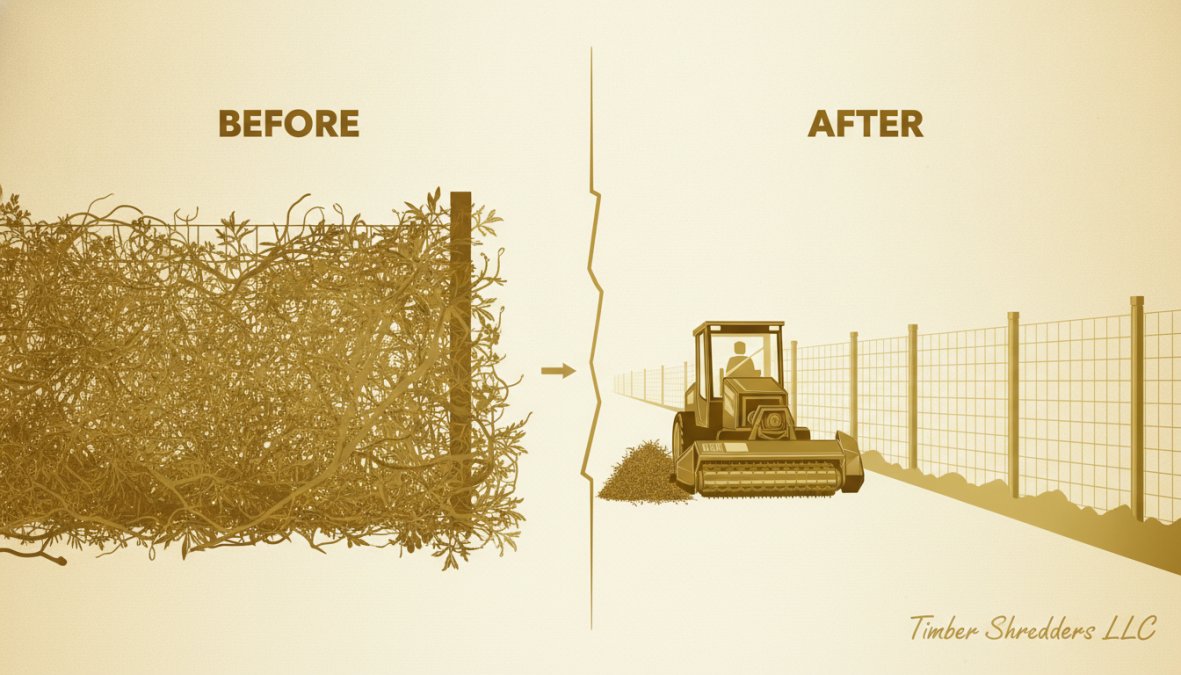
Phase 2: Removing Brush, Vines, and Saplings
Start at one end and work systematically. Begin with the perimeter, clearing brush and vines away from the fence line first.
For vines, cut them at ground level and pull them away from the fence. Dig out root systems using a shovel or grub hoe; they’ll regrow if left intact. Poison ivy and oak require extra caution, wear gloves, don’t burn debris (smoke carries toxins), and dispose of it in yard waste bags.
Saplings come next. Cut them as close to ground level as possible using a chainsaw or pruning saw. For saplings under 2 inches diameter, a sharp lopper handles them efficiently. Remove the stump by digging around the base and pulling. If the root system is too deep, cut as low as possible and treat the stump with herbicide to prevent regrowth.
Dense brush responds well to a brush cutter. Make passes parallel to the fence line, working from the fence outward. This prevents tangling and keeps debris manageable.
Phase 3: Dealing with Trees and Stubborn Roots
Mature trees require different tactics. A tree growing directly into a fence post creates a dilemma. If the tree is small enough (under 6 inches diameter), a chainsaw and careful felling works. Always cut away from the fence.
Larger trees demand professional assessment. Felling a 20-foot oak into a fence line is genuinely dangerous. Professional services become cost-effective when the risk of property damage or injury exceeds the cost of hiring experienced operators.
Stumps are the stubborn problem. A fresh stump can be pulled using a truck and chain if the root system isn’t too deep. For deeper roots, dig around the stump, expose major roots, and cut them with a chainsaw or axe. Apply a brush killer to the fresh cut within minutes to prevent sprouting.
Phase 4: Debris Management and Cleanup
For light clearing, yard waste bags work fine. Chip brush and small branches using a hand-held mulcher, reducing volume significantly. For heavy clearing, a wood chipper rental handles branches up to 4 inches diameter, reducing a truckload of brush to a few cubic yards of mulch.
Larger logs can be stacked for firewood if they’re suitable species like oak, hickory, or maple. If you have significant debris volume and limited disposal options, professional land clearing services use forestry mulching equipment that grinds everything on-site, eliminating the disposal problem and leaving nutrient-rich mulch.
Cost to Clear Fence Line: DIY vs. Professional Services
The decision between DIY and professional clearing hinges on property size, overgrowth density, and available time.
Light overgrowth on a small property (under half acre) with accessible terrain is DIY-friendly if you have hand tools and basic chainsaw skills. DIY also works for specific, isolated problems like a single mature tree or routine maintenance on already-cleared property.
Heavy overgrowth covering multiple acres demands professional equipment. A forestry mulcher clears in hours what would take weeks of manual labor. Terrain matters too, steep slopes, wet ground, or difficult access makes DIY hazardous. Professional operators have equipment designed for challenging conditions and carry insurance.
Never attempt to fell a large tree into a fence line yourself unless you have professional arborist training. The risk of the tree hanging up, bouncing back, or damaging the fence exceeds any cost savings.
Forestry Mulching for Fence Lines: Environmental Benefits
Forestry mulching grinds everything on-site into organic material that improves soil. Mulch reduces erosion dramatically by slowing water flow and trapping sediment. Soil health improves measurably as mulch breaks down, adding organic matter and nutrients while supporting vegetation growth.
Ground wood mulch sequesters carbon as it decomposes. For landowners interested in environmental stewardship, mulching demonstrates measurable environmental benefit compared to hauling debris to landfills. The practical advantage is simplicity, no debris piles to manage, no trips to the dump, and mulch stays on-site where it suppresses invasive species while supporting desirable plants.
Long-Term Fence Line Maintenance and Prevention
Clearing is the beginning, not the end. Long-term success depends on preventing regrowth and managing vegetation seasonally.
Seasonal Considerations for Clearing
Fall and early spring are ideal for clearing, cooler temperatures reduce heat stress and vegetation is less vigorous. Avoid clearing during growing season if possible; spring and summer regrowth is aggressive. Late-season clearing (September through November) gives you the advantage of slower regrowth heading into winter.
For herbicide application, timing is critical. Apply to fresh cuts within minutes; effectiveness drops significantly if you wait hours.
Preventing Regrowth and Invasive Species
Annual maintenance prevents major regrowth problems. A single pass with a brush cutter each spring keeps saplings and brush from establishing. Herbicide application to cut stumps prevents sprouting and stops 80 percent of regrowth from cut trees and brush.
Mulch application suppresses regrowth significantly. A 4-6 inch layer of wood chips prevents most seeds from germinating. For invasive species, identify the specific threat and use targeted control. Regional extension services provide species-specific guidance for your area.
| Task | Frequency | Season | Time Required |
|---|---|---|---|
| Brush cutting | Annual | Spring | 2-4 hours per acre |
| Stump treatment | As needed | Within days of cutting | 30 minutes per stump |
| Mulch application | Every 2-3 years | Fall | 4-8 hours per acre |
| Sapling removal | Annual | Spring or fall | 1-2 hours per property |
| Invasive species control | As needed | Varies by species | 2-6 hours per season |
Clearing overgrown fence lines is manageable when you approach it systematically and understand your options. Light overgrowth responds to hand tools and persistence. Heavy overgrowth demands equipment and expertise. The real key is starting, neglect compounds the problem exponentially. Professional land management solutions can restore access and visibility while improving soil health through forestry mulching, eliminating the physical strain and guesswork of DIY clearing.
Frequently Asked Questions
What’s the best way to clear an overgrown fence line without damaging the fence?
Start by carefully identifying the fence location and marking it. Use hand tools like loppers and pruners for vegetation close to the fence to avoid accidental damage. For thicker brush and saplings further from the fence, use a brush cutter or chainsaw. Work methodically from one end to the other, removing debris as you go. When clearing overgrown fence lines, always prioritize the fence structure, cut vegetation away from it rather than pulling or pushing material against the posts or rails.
How much does it cost to clear an overgrown fence line?
Costs vary significantly based on the extent of overgrowth, fence length, vegetation type, and whether you choose DIY or professional services. DIY clearing requires purchasing or renting equipment and investing your time. Professional services handle everything with specialized equipment like forestry mulchers or tractors, ensuring faster completion and proper debris disposal. For current pricing on professional fence line clearing services, contact Timber Shredders LLC for a free quote tailored to your property’s specific needs.
How often should you clear a fence line to prevent overgrowth?
Most properties benefit from annual fence line maintenance, typically in late winter or early spring before new growth begins. High-growth areas may need twice-yearly clearing. Regular maintenance prevents vegetation from becoming dense and difficult to remove. Seasonal considerations matter, clearing in dormant seasons reduces regrowth and minimizes impact on wildlife. Consistent mowing or brush cutting every 6-8 weeks during growing season prevents saplings and vines from establishing, keeping your fence line clear year-round.
What are the main benefits of keeping fence lines clear?
Clear fence lines improve property access, restore visibility of your property boundaries, and enhance overall land usability. Removing dense vegetation reduces fire hazards, eliminates pest habitats, and extends fence longevity by improving air circulation and reducing moisture damage. Clearing also prevents erosion issues caused by tangled root systems and allows you to identify fence damage early for repairs. Additionally, maintained fence lines improve property aesthetics and can increase land value while reducing long-term maintenance costs.
This article was written using GrandRanker