Table of Contents
- How to Reclaim Overgrown Residential Land: What You’ll Need First
- Best Tools for Clearing Brush on Residential Property
- Clearing Overgrown Land Safety Tips and Best Practices
- Step-by-Step Process to Reclaim Your Overgrown Residential Land
- How Long Does It Take to Clear an Acre of Land
- Cost to Clear Overgrown Residential Lot: DIY vs. Professional Services
- Legal Permits and Zoning Requirements for Land Clearing
- Post-Clearing Erosion Control and Soil Health
How to Reclaim Overgrown Residential Land: Step-by-Step Guide
Last Updated: July 15, 2026
Reclaiming overgrown residential land requires systematic planning across site assessment, vegetation clearing, debris management, and soil restoration. This guide covers the complete process, including legal requirements, erosion control, and soil testing that most guides skip.
How to Reclaim Overgrown Residential Land: What You’ll Need First
Assess your property size, vegetation density, terrain slope, and obstacles like structures or utility lines. A quarter-acre of light brush requires different tools than a full acre of dense saplings. Document what you’re dealing with: grass and small shrubs, mature trees and thick brush, invasive species, or wet terrain.
Essential tools fall into three categories: hand tools for light work, power equipment for moderate clearing, and heavy machinery for serious brush control. Hand tools (pruning saws, loppers, axes) work for small areas. Power equipment like chainsaws and wood chippers speed up medium properties. Heavy equipment including skid steers with mulching attachments and forestry mulchers handle dense overgrowth efficiently.
Safety gear is non-negotiable: hard hats, safety glasses, work gloves, steel-toed boots, long sleeves and pants, and hearing protection. When operating chainsaws, add face shields and chaps.
| Tool Category | Best Use | Cost Range | Skill Level |
|---|---|---|---|
| Hand tools (pruning saw, loppers, axe) | Light brush, small areas | $50-$300 | Beginner |
| Brush cutter / string trimmer | Grass, light undergrowth | $150-$800 | Beginner |
| Chainsaw | Felling trees, cutting logs | $200-$1,500 | Intermediate |
| Wood chipper | Processing branches into mulch | $500-$3,000 | Intermediate |
| Skid steer with mulcher | Dense brush, 0.25-1 acre | Rental $150-$300/day | Advanced |
| Forestry mulching equipment | Large areas, heavy vegetation | Rental $300-$600/day | Advanced |
Best Tools for Clearing Brush on Residential Property
Hand tools work for scattered light vegetation and small saplings but progress is slow. A pruning saw and loppers can clear a quarter-acre of light brush in 2-3 weekends, though stump removal remains difficult.
Power tools accelerate progress significantly. A brush cutter handles tall grass and light undergrowth in hours. Chainsaws fell trees efficiently but require practice and safety discipline. Wood chippers process branches into mulch, reducing debris volume by 80%. For a half-acre with mixed brush and small trees, a combination of chainsaw work plus chipping takes 3-5 days for one person.
Heavy equipment transforms dense overgrowth projects. A forestry mulcher can clear an acre of dense brush in one day. Equipment rental costs $150-$300 per day, but you finish faster and handle tougher conditions.
Forestry Mulching vs. Traditional Clearing Methods
Forestry mulching uses specialized equipment to grind trees, brush, and undergrowth into chips while clearing. Everything stays on-site as mulch, suppressing weeds, reducing erosion, and improving soil over time.
Traditional clearing involves cutting vegetation with chainsaws, removing stumps, and hauling debris off-site or burning it. This method gives you a clean slate but is more labor-intensive and requires debris disposal.
Forestry mulching typically costs less because equipment does more work faster and you skip disposal fees. For most residential projects, forestry mulching delivers better value and soil health outcomes.
If you’re reclaiming land for erosion control or want to improve soil health post-clearing, forestry mulching leaves behind beneficial organic material. Traditional clearing requires you to add mulch afterward to prevent erosion and restore soil.
Hand Tools vs. Heavy Equipment
Hand tools require no fuel, minimal setup, and low cost, but you work slowly and handle only light vegetation. A single person clearing a half-acre of dense brush with hand tools faces 4-6 weeks of weekend work.
Heavy equipment accelerates progress dramatically. A skid steer with a forestry mulcher clears that same half-acre in 2-3 days. For properties over a quarter-acre or with dense brush, heavy equipment usually pays for itself in time saved and reduced physical strain.
Clearing Overgrown Land Safety Tips and Best Practices
Overgrown properties hide hazards: hidden holes, dead branches overhead, buried debris, unstable terrain, and utility lines. A hazard assessment before you start prevents injuries and property damage.
Walk your entire property and document hazards. Look for dead trees that might drop branches, steep slopes prone to erosion, standing water, utility lines (call 811 before digging), old structures, and signs of animals. Mark hazards with flagging tape.
Clear on dry days; wet conditions make slopes slippery and hide hazards.
Hazard Assessment Before You Start
Walk the property slowly, looking down and up. Document steep slopes, water drainage patterns, and any structures. Check for utility lines by calling 811 and waiting for marking before any digging or heavy equipment use. Identify any large dead trees or dead branches that might fall during clearing.
Look for invasive species like multiflora rose, kudzu, and autumn olive. Assess soil conditions, is the ground wet or dry? Muddy terrain requires different equipment and timing.
Never clear near utility lines without calling 811 first. Hitting buried electric, gas, or water lines causes serious injury, property damage, and service outages. The marking service is free and takes 2-3 business days.
Common Mistakes to Avoid
Underestimating debris volume is the biggest mistake. A quarter-acre of dense brush produces 20-40 cubic yards of material. Plan debris management before you start clearing.
Clearing without assessing soil conditions causes severe erosion on slopes. Removing all vegetation without erosion control causes gully erosion within weeks.
Ignoring permits and regulations costs money and creates legal headaches. Check with your local planning department before starting.
Attempting to clear without proper equipment leads to slow, frustrating progress and safety risks. Burning debris without permits is illegal in most areas and dangerous. Chip, haul, or compost it instead.
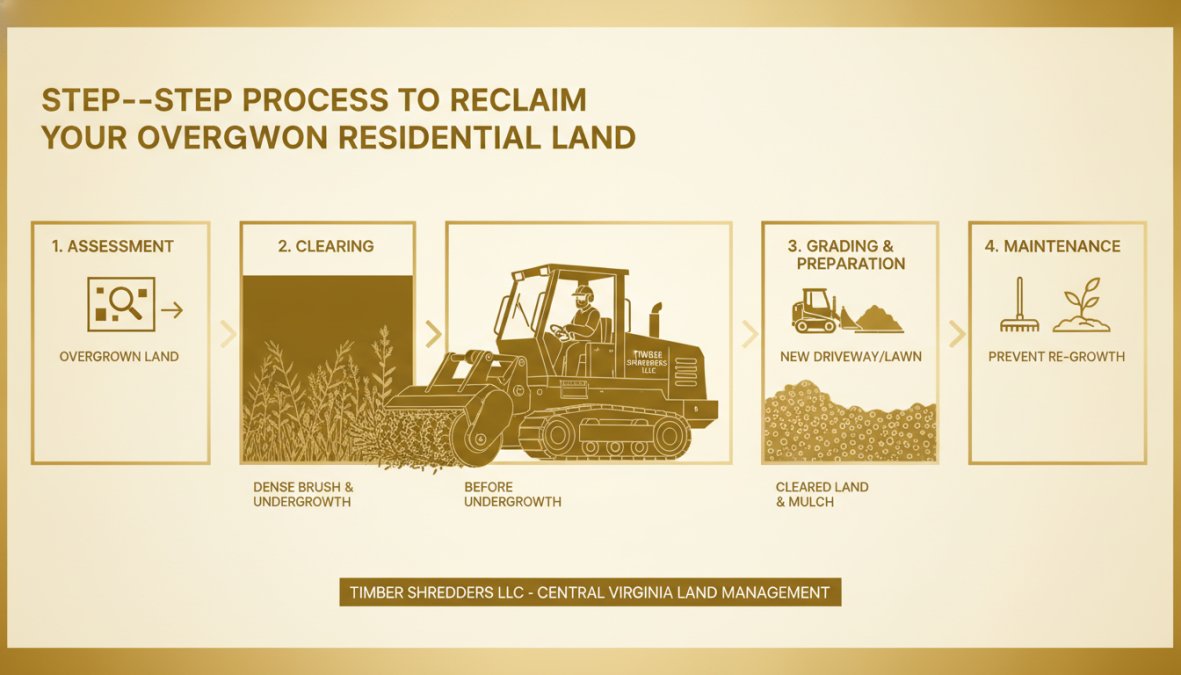
Step-by-Step Process to Reclaim Your Overgrown Residential Land
Step 1: Assess Your Property and Plan the Clearing
Walk your entire property and measure the total area. Document vegetation types and note terrain slope and drainage patterns. Create a clearing plan identifying the safest starting point, usually an area with lighter vegetation. Mark utility lines (call 811 first) and flag any hazards.
Estimate timeline: light brush on flat terrain takes 1-2 days for a quarter-acre with hand tools or 4-6 hours with a mulcher. Dense brush with trees takes 3-5 days with hand tools or 1-2 days with heavy equipment.
Step 2: Clear Vegetation and Undergrowth
Start with light clearing: remove loose branches, dead wood, and small saplings by hand or with a brush cutter. This opens up the area and makes heavy equipment access easier.
For brush and small trees, a chainsaw or brush cutter works well. Cut vegetation into manageable pieces. For dense brush and undergrowth, a forestry mulcher or skid steer with mulching attachment is most efficient. Operate equipment in overlapping passes, grinding vegetation into mulch.
Step 3: Remove Stumps and Root Systems
Stumps left behind create tripping hazards and sprout regrowth. For small stumps (under 6 inches diameter), dig around the stump with a mattock, expose roots, and cut them with an axe or pruning saw.
For larger stumps, rent a stump grinder. The machine grinds the stump 6-12 inches below ground, leaving chips that can be composted or used as mulch. Budget $150-$300 per day.
Step 4: Manage Debris and Mulch Processing
You have three main options: haul away, chip on-site, or compost.
Hauling: Rent a dumpster or arrange dump truck pickup. Costs $300-$800 per load but offers no post-clearing benefit.
Chipping: Rent a wood chipper or hire a chipping service. Chipping reduces debris volume by 80%, producing mulch you can use on-site or compost. Saves disposal costs and improves soil long-term.
Composting: Pile chipped material and let it decompose over 6-12 months to produce rich compost for landscaping.
For most residential properties, chipping is the best balance.
How Long Does It Take to Clear an Acre of Land
Timeline depends on vegetation density, terrain, equipment choice, and crew size.
Light brush, flat terrain, one person:
- Hand tools only: 6-8 weeks (weekends)
- Brush cutter: 2-3 weeks
- Chainsaw + chipping: 1-2 weeks
- Forestry mulcher: 2-3 days
Dense brush with small trees, one person:
- Hand tools: 12-16 weeks (weekends)
- Chainsaw + chipping: 3-4 weeks
- Skid steer with mulcher: 3-5 days
Adding crew members cuts timeline proportionally. Professional crews with heavy equipment clear an acre in 1-2 days. Weather delays add 20-30% to timelines.
Cost to Clear Overgrown Residential Lot: DIY vs. Professional Services
DIY Clearing Costs and Considerations
Hand tools cost $50-$300 total. Chainsaws run $200-$1,500. Brush cutters cost $150-$800. A wood chipper rental is $500-$3,000 per week. Stump grinder rental is $150-$300 per day. Dumpster rental is $300-$800 per load.
For a quarter-acre with light brush, DIY with hand tools costs under $500 but takes 4-6 weekends. DIY with a rented chipper and brush cutter costs $800-$1,500 and takes 1-2 weeks. DIY with a skid steer mulcher costs $600-$1,200 and takes 2-3 days.
The hidden cost is your time. If you value your time at $25/hour, a 4-week project costs an additional $4,000 in labor. Safety risk is also real; chainsaw injuries and slip-and-fall accidents can exceed $10,000-$50,000 in medical bills.
Professional Land Clearing Services
Professional clearing services handle everything: assessment, equipment, labor, permits, and debris removal. Costs range from $1,500-$5,000 for a quarter-acre to $5,000-$15,000 for a full acre, depending on vegetation density and terrain.
Professional services offer faster completion (days instead of weeks), lower injury risk, proper equipment handling, and permit navigation. For properties over a quarter-acre or with dense vegetation, professional services usually deliver better value.
Legal Permits and Zoning Requirements for Land Clearing
Before you clear a single branch, check local regulations. Many municipalities require permits for land clearing, especially if you’re removing trees, working near wetlands, or on slopes over 25%.
Contact your local planning or zoning department and ask: Do I need a land clearing permit? Are there tree removal restrictions? Are there wetland or stream buffer requirements?
Wetland regulations are common near streams, ponds, or marshy areas. Clearing within 50-100 feet of a stream often requires permits and environmental review. Violating wetland rules carries fines of $1,000-$10,000 per day.
Tree removal regulations vary by area. Burning restrictions are nearly universal; open burning is illegal in most residential areas without a permit. Chip, haul, or compost debris instead.
Post-Clearing Erosion Control and Soil Health
Clearing vegetation removes the root systems and mulch layer that hold soil in place. Without erosion control, heavy rain triggers gully erosion, topsoil loss, and nutrient depletion. On slopes, erosion happens fast, a cleared slope loses 1-2 inches of topsoil in a single heavy rain.
Prevent this with immediate erosion control: apply mulch (2-4 inches), install erosion cloth, or plant fast-growing cover crops. On flat terrain, erosion is slower but still significant. Bare soil compacts, loses structure, and becomes hydrophobic. Mulch application restores soil structure and water infiltration.
Soil Testing and Amendment After Clearing
Before replanting or landscaping, test your soil. A basic soil test costs $15-$30 through your county extension office. It measures pH, nutrient levels, organic matter, and texture.
Most cleared residential land benefits from organic matter addition. Compost or aged mulch improves soil structure, water retention, and nutrient availability. Apply 2-4 inches and work it into the top 6 inches of soil. Cost is $200-$600 for a quarter-acre.
Preventing Soil Erosion and Invasive Species Return
Erosion control begins immediately after clearing. On slopes, install silt fences or erosion cloth to slow runoff. Mulch application (2-4 inches) is the most effective erosion control; it protects soil, retains moisture, and suppresses weeds.
Invasive species often return aggressively after clearing. Prevent this by applying thick mulch to suppress regrowth, planting desirable vegetation to outcompete invasives, and monitoring for sprouts.
The biggest mistake after clearing is leaving soil bare. Apply mulch immediately, test soil within 2-4 weeks, and amend based on results. This 30-day window determines whether your cleared land becomes healthy or degraded.
For long-term success, maintain your cleared land. Remove regrowth saplings promptly. Refresh mulch every 2-3 years. Monitor for invasive species and remove sprouts before they establish.
Reclaiming overgrown residential land is achievable with the right planning, equipment, and follow-through. Most property owners succeed with a combination of hand tools for initial work and one or two days of heavy equipment rental for serious brush clearing. The real challenge is the aftermath: erosion control, soil restoration, and long-term maintenance.
If you’re facing dense overgrowth or a large property, professional land clearing saves time and delivers better results. Timber Shredders LLC specializes in forestry mulching and land reclamation for Central Virginia properties. Their experienced operators assess your property, clear vegetation efficiently using professional equipment, manage debris on-site, and prepare soil for regrowth. The result: reclaimed land in days, not months, with improved soil health and no disposal hassles. Get a free quote from Timber Shredders LLC and see how professional clearing transforms your property.
Frequently Asked Questions
What is the fastest way to clear overgrown residential land?
Forestry mulching is typically the fastest method to reclaim overgrown residential land, processing vegetation in a single pass while grinding debris into mulch. For large properties, professional equipment like skid steers with mulching attachments can clear an acre significantly faster than manual labor or traditional methods. The speed depends on property size, vegetation density, and terrain. Contact professionals for a timeline estimate specific to your property.
Do I need a permit to clear overgrown land on my residential property?
Permit requirements vary by location and depend on property size, vegetation type, and local zoning regulations. Many municipalities require permits for land clearing, especially if you’re removing trees or near protected areas. Check with your local building department or county office before starting work. Some areas have restrictions on invasive species removal or wetland clearing. Always verify requirements to avoid fines or work stoppages.
How long does it take to clear an acre of overgrown land?
Timeline varies based on vegetation density, terrain, and equipment used. Light brush on flat terrain may take 1-2 days with professional equipment, while dense woodlots with large trees could take 5-7 days or longer. DIY hand clearing typically takes weeks. Factors include stump grinding, debris removal, and site preparation. Professional operators can provide accurate timelines after assessing your specific property conditions and clearing goals.
How do I prevent weeds and invasive species from returning after clearing land?
Post-clearing erosion control and vegetation management are essential. Apply mulch from forestry mulching to suppress weed growth and stabilize soil. Consider soil testing to identify nutrient deficiencies that favor invasive species. Install erosion control measures like silt fencing on slopes. Regular maintenance and monitoring during the first year help catch regrowth early. Planting native vegetation or ground cover can prevent invasive species from reestablishing on your reclaimed property.
This article was written using GrandRanker